


What this calculator does
This calculator estimates a fixed-rate mortgage payment and shows where the money goes. It includes principal and interest, property tax, home insurance, HOA dues, and optional PMI. The advanced section lets you test extra monthly or one-time payments and see the effect on interest and payoff time. It is built for first-time buyers comparing offers, current owners considering a refinance, and anyone testing a larger down payment or a shorter term. Every result is an estimate: lenders use different escrow rules, PMI pricing, fees, and rounding.
Is this the right calculator?
Use it when
- You are comparing fixed-rate home loans for the same property and want a monthly principal-and-interest estimate.
- You want a planning figure that bundles principal, interest, property tax, insurance, HOA dues, and PMI.
- You want to test extra monthly or one-time payments, PMI removal, or a yearly amortization schedule.
Use something else when
- You need a lender-specific APR, discount points, prepaid interest, or closing-cost quote.
- You are comparing adjustable-rate, interest-only, or balloon mortgages.
What changes the result most
| Interest rate | A higher rate raises the monthly payment and the total interest paid. |
|---|---|
| Loan term | A longer term lowers the monthly payment but usually increases total interest. |
| Down payment and PMI | A larger down payment reduces the loan and can remove PMI; PMI usually ends at 80% LTV. |
| Extra payments | Extra principal reduces future interest and can shorten the payoff period. |
| Taxes, insurance, HOA | These costs change the monthly outlay but do not reduce the loan principal. |
How to use it
- Enter the home price and down payment.
- Add the interest rate and loan term.
- Fill in annual property tax, annual home insurance, and monthly HOA dues. Use zero if a cost does not apply.
- Open Advanced options to add a PMI rate, extra monthly payment, one-time extra payment, or loan start date.
- Review the monthly payment, breakdown, payoff date, and yearly amortization schedule.
- Change one input at a time to compare scenarios, such as 15 vs 30 years or a larger down payment.
How it works
Example calculations
Example 1: 20% down, 30-year fixed
$400,000 home with $80,000 down leaves a $320,000 loan. At a hypothetical 6.5% rate over 30 years, principal and interest is about $2,023/month. Add $400 tax and $150 insurance for an estimated $2,573/month before HOA. There is no PMI at 20% down.
Example 2: 10% down with PMI
The same $400,000 home with $40,000 down leaves a $360,000 loan. At 6.5%, principal and interest is about $2,276/month. A 0.5% annual PMI rate adds about $150/month until the balance falls to 80% of the original price.
Example 3: extra monthly payment
Adding $300/month to the 10%-down example pays the loan off about 8 years earlier and avoids a large amount of interest. The exact savings depend on the rate, term, PMI, and when the extra payments start.
What the result means
Treat the monthly figure as a planning estimate, not a lender quote. It shows how price, down payment, rate, term, taxes, insurance, HOA, and PMI interact. Lenders may also charge origination fees, appraisal costs, discount points, and prepaid escrow. A larger down payment lowers the loan and can remove PMI; a shorter term raises the monthly payment but usually lowers total interest. Extra payments save the most when they are made early and consistently. The amortization table shows the yearly split between principal, interest, PMI, and the remaining balance.
Common mistakes
- Using the home price as the loan amount instead of subtracting the down payment.
- Leaving property tax, insurance, or HOA at zero when those costs apply.
- Assuming PMI is permanent; it usually ends when the loan balance reaches 80% of the original value, or earlier with extra payments.
- Comparing only the interest rate and ignoring the APR, fees, and PMI.
- Choosing a 30-year term for the lower payment without checking the extra interest.
- Forgetting that taxes, insurance, and HOA can rise after closing.
- Making extra payments without confirming the lender applies them to principal.
Assumptions and limits
- The loan has a fixed interest rate that does not change over the term.
- Payments are made monthly, on time, for the full term unless extra payments are entered.
- Property tax, insurance, HOA, and PMI are estimates and may change.
- PMI is estimated from the loan amount and annual PMI rate; actual lender pricing varies.
- Extra payments are applied to principal with the first payment and stay constant.
- The estimate leaves out mortgage insurance application costs, closing costs, discount points, and lender fees.
- The payoff schedule assumes the first payment is one month after the loan start date.
Frequently asked questions
Does this include property tax and insurance?
Yes. Enter annual property tax and annual home insurance; the calculator divides each by 12. It also adds monthly HOA dues.
What is PMI and when does it end?
Private mortgage insurance is usually required when the down payment is below 20%. The calculator estimates it as an annual percentage of the loan and stops charging it once the balance falls to 80% of the original home price. Actual lender and investor rules vary.
How do extra payments reduce interest?
Extra money goes to principal, so future interest is charged on a smaller balance. The calculator compares the loan with and without extra payments and shows the interest saved and months saved.
What is loan-to-value (LTV)?
LTV is the loan amount divided by the home price. A $320,000 loan on a $400,000 home is 80% LTV. PMI is commonly required above 80% LTV.
Can I use this for a refinance?
Yes. Enter the new loan amount, rate, term, and costs. The result estimates the new payment and schedule; it does not calculate closing costs or break-even time.
What is the difference between the interest rate and the APR?
The interest rate sets the principal-and-interest payment. APR includes certain fees and points, so it is usually higher. This calculator uses the interest rate, not APR.
Why is more of my early payment interest than principal?
Interest is charged on the remaining balance. Early in the loan the balance is highest, so interest takes a larger share; principal grows over time.
Why is my actual payment different from the estimate?
Escrow rules, PMI pricing, taxes, insurance, HOA, fees, and rounding vary by lender and location. Use this as a planning estimate and compare a Loan Estimate from each lender.
Sources
2026 update
How to use the professional output
This page is not just a formula box. The result is designed to be checked, compared, and taken away.
- Professional worksheet. The result includes the inputs used, the method and scope, and a one-variable sensitivity check for finance calculators.
- A/B scenarios. Save two input sets in the browser and compare the primary, secondary, and breakdown figures side by side.
- Print / PDF and CSV. Print a branded worksheet, or export the year-by-year table when the calculator produces one.
- Quote differences. The section below explains why a bank, lender, broker, or provider can quote a different number.
The formulas and assumptions above still govern the number. The worksheet makes the estimate auditable; it does not make it a lender quote, tax return, or personalized advice.
Before you use a quote
Why your bank, lender, or provider’s number may differ
A mortgage quote can differ from this estimate even when the loan amount and rate look the same. The lender’s Loan Estimate is the document that controls the actual offer.
What changes the quote
- Rate versus APR. Points, lender credits, and closing costs can make the APR different from the note rate.
- Escrow and insurance. Property tax, homeowners insurance, PMI, and HOA are local and lender-specific.
- Loan-level pricing. Credit score, down payment, occupancy, property type, and loan size can change the rate.
- Timing. Rates can change daily; a quote is not a lock until it is locked in writing.
How to compare offers
- Compare the APR and total cost, not only the monthly payment.
- Ask for a written quote or Loan Estimate with all fees itemized.
- Use the same loan amount, term, date, and assumptions for every offer.
- Check what is excluded: taxes, insurance, closing costs, maintenance, or provider fees.
- Keep an emergency reserve; the lowest payment is not always the safest choice.
Reference: CFPB Loan Estimate explainer.
Part of a decision center
Mortgage & Home Buying Center
See the companion tools, decision guides, and patterns that go with this calculator.
Go deeper
Guides that explain the math

The PMI Cliff: When Mortgage Insurance Actually Drops Off
How the 80% and 78% LTV thresholds work, why an appraisal can change the date, and how extra payments move the PMI cliff forward.
Escrow Shock: Why Your Mortgage Payment Can Jump
Property taxes and insurance change, escrow is re-analyzed, and the monthly payment can move even when the mortgage rate does not. Here is the mechanism and how to prepare.
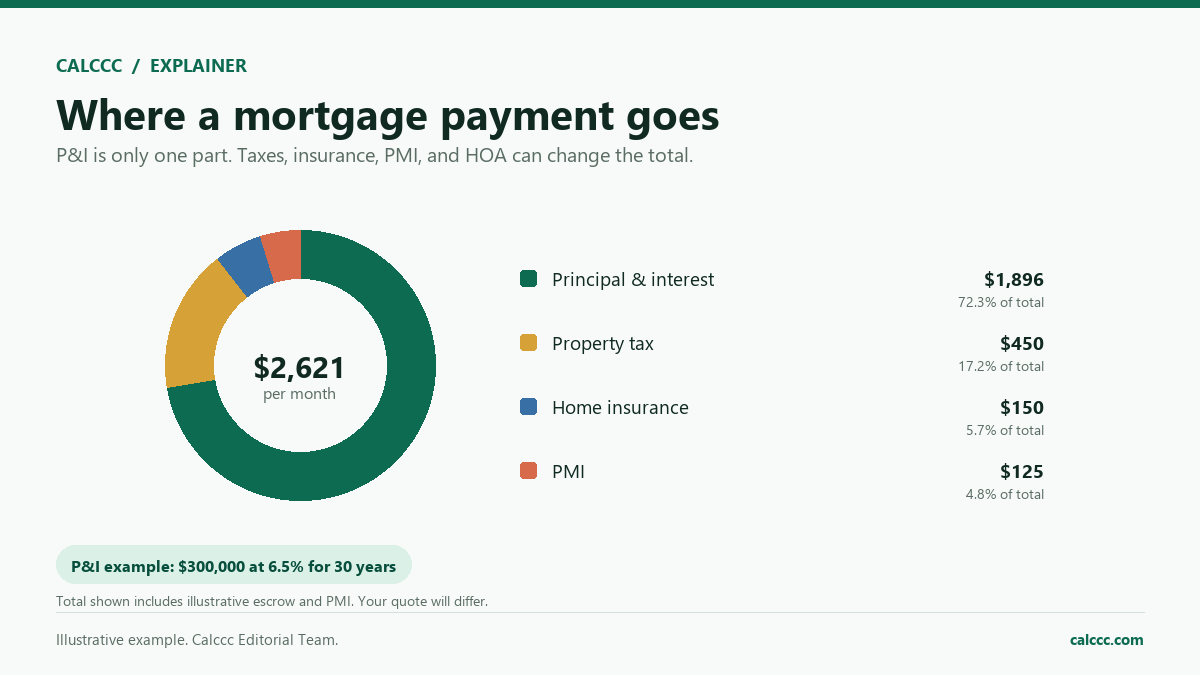
How to Read a Mortgage Payment (and What PMI Changes)
A mortgage payment is not just principal and interest. We break down PITI, escrow, PMI, and HOA, with a worked example and the questions that change the quote.