


Key takeaways
- P&I is the loan payment. It is set by the amount borrowed, the rate, and the term — not by the home price alone.
- PITI adds escrow. Property tax and homeowners insurance are often collected monthly and paid by the servicer.
- PMI is not the same as FHA MIP. PMI is private insurance; FHA loans use a different mortgage insurance structure.
- PMI can usually be removed. Under the Homeowners Protection Act, borrowers can generally request cancellation at 80% loan-to-value and get automatic termination at 78% of the original value, subject to conditions.
- Compare the Loan Estimate, not the headline payment. Two quotes with the same rate can differ on taxes, insurance, PMI, points, and closing costs.
Principal and interest: the part that pays the loan
Principal is the amount you borrowed. Interest is the lender’s charge for that money. A fixed-rate mortgage has a level principal-and-interest payment, but the mix changes every month: early payments are mostly interest because the balance is high; later payments are mostly principal.
For a $300,000 loan at 6.5% for 30 years, the principal-and-interest payment is about $1,896. That number does not include taxes, insurance, PMI, or HOA. It also does not include closing costs, which are paid at closing rather than spread across the monthly payment.
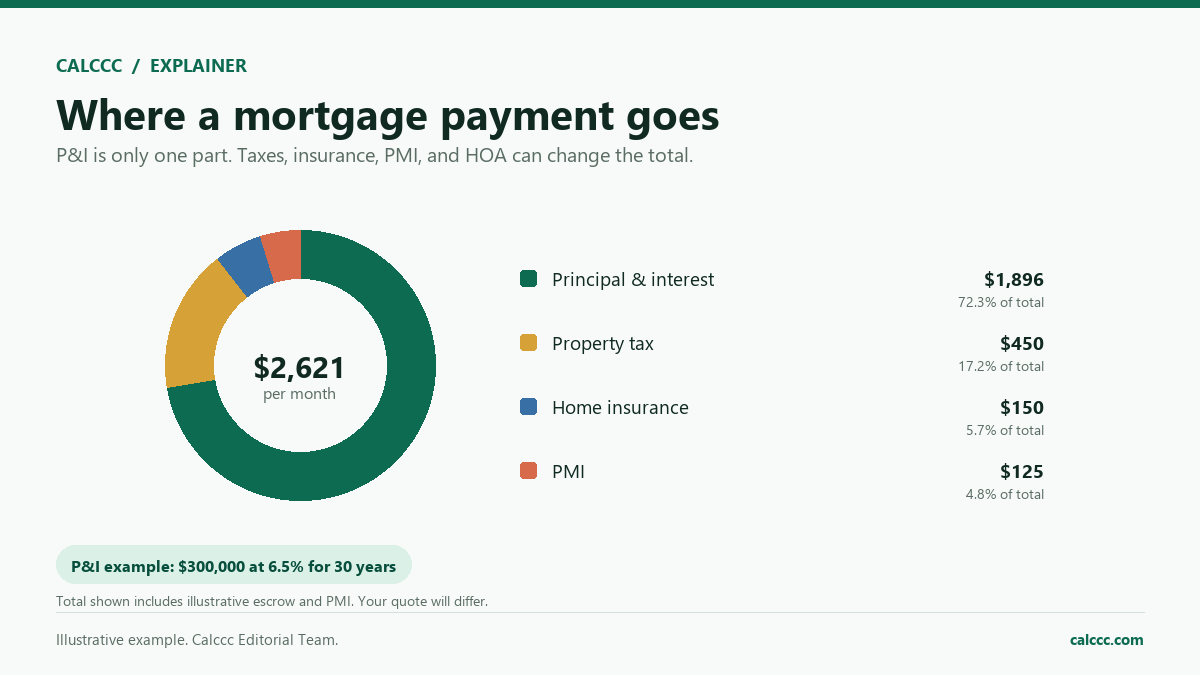
PITI: what the four letters mean
PITI stands for principal, interest, taxes, and insurance. The CFPB uses the term to describe the total monthly housing payment. In practice, the servicer may collect the tax and insurance portions into an escrow account, then pay the tax authority and insurer when bills come due.
Escrow is convenient, but it is not a fixed cost. Property tax assessments can rise after a reassessment, and insurance premiums can change at renewal. If the escrow account runs short, the servicer may increase the monthly payment or ask for a lump sum. That is why a payment that looked affordable at closing can change in year two or three.
PMI: what it is and when it can go away
Private mortgage insurance protects the lender if the borrower defaults. It is commonly required when the down payment is below 20%, but the exact rule depends on the lender and loan program. PMI is not a permanent feature of every mortgage, and it is not the same as FHA mortgage insurance premium (MIP).
Under the federal Homeowners Protection Act, a borrower can generally ask the servicer to cancel PMI when the principal balance reaches 80% of the home’s original value, if the loan is current and other conditions are met. The servicer must generally terminate PMI automatically when the balance reaches 78% of the original value based on the scheduled amortization schedule. The CFPB has a plain-language explanation of these rules.
Two practical points are often missed. First, the 80% and 78% thresholds use the original value, not a new appraisal, unless the borrower requests an appraisal-based cancellation. Second, a lender may have its own appraisal or seasoning requirements. A higher home value does not automatically remove PMI.
What changes the total — and what does not
| Payment part | What drives it | Can it change after closing? |
|---|---|---|
| Principal & interest | Loan amount, rate, term | Fixed-rate: no. Adjustable-rate: yes, when the rate resets. |
| Property tax | Local assessment and exemptions | Yes. Reassessments and levy changes can raise or lower it. |
| Home insurance | Coverage, deductible, property risk, insurer | Yes, at renewal. |
| PMI | Down payment, loan program, lender | Yes, until it is removed or the loan is refinanced. |
| HOA dues | Association budget and reserves | Yes. Special assessments are separate. |
Why two buyers with the same rate pay different amounts
Take two buyers with a 6.5% rate. One puts 20% down and has a $300,000 loan. The other puts 5% down on the same price, so the loan is larger and PMI may apply. The second buyer also pays more interest over the life of the loan because the balance is higher. The rate is the same; the payment is not.
Taxes and insurance can widen the gap further. A home in a higher-tax jurisdiction or a coastal insurance market can carry a monthly escrow payment that is hundreds of dollars above a neighboring home with a similar loan. When you compare quotes, compare the whole payment and the Loan Estimate — not just the interest rate.
How to compare a mortgage quote properly
- Ask for the Loan Estimate. It shows the rate, points, closing costs, projected payment, and escrow estimates in a standard format.
- Separate one-time costs from recurring costs. Closing costs are paid once; taxes, insurance, PMI, and HOA recur.
- Check the PMI terms. Ask how PMI is calculated, when it can be removed, and whether an appraisal is required.
- Stress-test the escrow. Add 10–20% to the tax and insurance portions to see whether the payment still fits.
- Model a longer and shorter term. A 30-year loan lowers the payment; a 15-year loan usually raises it but reduces total interest.
2026 calculator update: what changed
The linked calculator has been upgraded. It now includes a professional worksheet with the inputs used, the method and scope, and a one-variable sensitivity check for finance tools. You can save two input sets as Scenarios A/B and compare the results side by side. The Print / PDF action produces a branded worksheet, and table-producing calculators can export a CSV.
The page also explains why a bank, lender, broker, or provider can quote a different number: rate versus APR, fees, credit pricing, taxes, insurance, and timing. Use the written quote or Loan Estimate as the binding document, not the calculator estimate.
Frequently asked questions
Is PMI always required below 20% down?
No. It is common, but lender and program rules vary. Some loans use lender-paid PMI, some use a different insurance structure, and some portfolio lenders have their own guidelines. Ask for the specific requirement in writing.
Does PMI disappear automatically at 80%?
Generally, the borrower must request cancellation at 80% of original value, and the servicer must terminate automatically at 78% based on the scheduled amortization schedule. The loan must usually be current, and lender conditions apply. Do not assume a new market value triggers removal by itself.
Are property taxes and insurance always escrowed?
No. Some lenders allow the borrower to pay them directly, often with a higher rate or a fee. Escrow is common because it protects the lender’s collateral, but it is not universal.
Should I include HOA dues in the mortgage payment?
For budgeting, yes. HOA dues are a recurring housing cost even though they are paid to the association, not the lender. The calculator lets you add them separately.
How we checked this guide
We compared the CFPB’s explanations of PITI, the principal-and-interest payment, and PMI cancellation with the calculator’s assumptions. The worked example is illustrative, not a lender quote. Tax and insurance figures are deliberately round numbers so the arithmetic is easy to follow; your actual escrow will depend on your property and location.
Further reading
Keep exploring
Decision path