


Key takeaways
- Use percentage points when the values are themselves percentages, such as rates or shares.
- Use percentage change when comparing an old and a new value relative to the old value.
- Always identify the base. The same absolute change can be large or small depending on the starting number.
- A 50% fall is not undone by a 50% rise: 100 → 50 → 75.
- Markup and margin are different percentages; do not use them interchangeably.
The three questions people mix up
- What is X% of Y? Part = whole × percentage.
- What percent of Y is X? Percentage = part ÷ whole × 100.
- What is the percentage change? Change = (new − old) ÷ old × 100.
Most errors come from using the wrong base or from subtracting two percentages and calling the result a “percent change.”
Percentage points: the simple difference
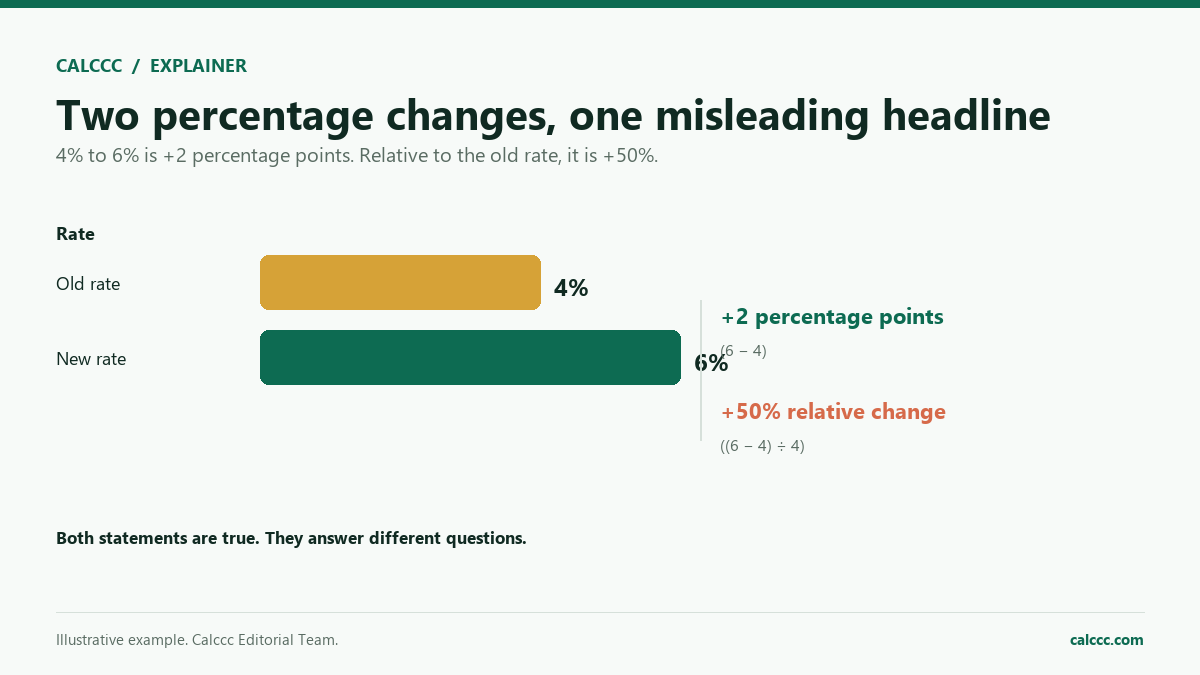
If a savings rate rises from 3% to 5%, it rose by 2 percentage points. The two numbers are already percentages, so subtracting them gives points, not a relative change.
News reports often say “the rate rose 2%” when they mean 2 percentage points. That is ambiguous at best. “Rose 2 percentage points” is precise; “rose 50% relative to its old value” is a different statement.
Percentage change: relative to the base
The formula is (new − old) ÷ old × 100. It answers “how much did this change compared with where it started?” It is useful for prices, revenue, weight, and any quantity with a meaningful starting value.
| Old | New | Change | Percentage change |
|---|---|---|---|
| 100 | 110 | +10 | +10% |
| 50 | 60 | +10 | +20% |
| 1,000 | 1,010 | +10 | +1% |
| 4% | 6% | +2 points | +50% |
Notice that the same absolute +10 produces 10%, 20%, or 1% depending on the base. That is why “up 10” without context is not a percentage story.
The asymmetry of percent change
A 50% decline from 100 gives 50. A 50% increase from 50 gives 75, not 100. To recover a 50% decline, you need a 100% increase. This is not a trick; it is the arithmetic of multiplying by 1 − 0.5 and then 1 + 0.5.
This asymmetry matters for investments, prices, and performance metrics. A fund that falls 20% needs a 25% gain to break even: 0.8 × 1.25 = 1.0.
Markup vs margin
Markup is the percentage added to cost. Margin is the percentage of the selling price that is profit. A 50% markup is a 33.3% margin, not 50%.
| Cost | Selling price | Markup | Margin |
|---|---|---|---|
| $100 | $150 | 50% | 33.3% |
| $100 | $200 | 100% | 50% |
If you calculate margin using the cost as the denominator, you are calculating markup. Use the selling price for margin.
Reverse a percentage change
If a price after a 20% increase is $120, the original is 120 ÷ 1.20 = $100. If the price after a 20% discount is $80, the original is 80 ÷ 0.80 = $100. Do not multiply by 1.20 or 0.80 in the wrong direction.
For a percentage-of calculation, the whole is part ÷ percentage. If 15 is 30% of a number, the number is 15 ÷ 0.30 = 50.
2026 calculator update: what changed
The linked calculator has been upgraded. It now includes a professional worksheet with the inputs used, the method and scope, and a one-variable sensitivity check for finance tools. You can save two input sets as Scenarios A/B and compare the results side by side. The Print / PDF action produces a branded worksheet, and table-producing calculators can export a CSV.
The difference
A change from 10% to 12% is 2 percentage points, but a 20% relative increase. The percentage-point difference is 12 − 10 = 2. The relative change is (12 − 10) ÷ 10 = 20%. Both are correct; they answer different questions.
An example
An interest rate rises from 4% to 5%. That is 1 percentage point, or a 25% increase. A poll moves from 40% to 44%: 4 points, or a 10% relative increase. Report the unit so the reader knows which one you mean.
What to compare
Compare the absolute change, the relative change, and the base. A percentage-point change is not a percent change.
State the base and the unit before comparing.
Now check it.
Frequently asked questions
Is “percent” the same as “percentage point”?
No. A percentage point is the unit difference between two percentages. A percent change is relative to a base. “2%” is ambiguous in a rate comparison; “2 percentage points” is not.
How do I calculate a percentage increase?
(New − old) ÷ old × 100. If the result is positive, it is an increase; negative, a decrease.
Why does a 50% drop need a 100% gain to recover?
Because the base changed. After a 50% drop, the new value is half the old value; doubling it returns to the old value, which is a 100% increase from the new base.
What is the difference between markup and margin?
Markup uses cost as the base; margin uses selling price. A 50% markup equals a 33.3% margin.
How we checked this guide
We verified the formulas with hand calculations and cross-checked the rate example against the percentage calculator’s three modes. The examples use simple numbers so the base is visible. No external statistic is required for the arithmetic.
Further reading
Keep exploring
Decision path