


Key takeaways
- PMI protects the lender. It is not the same as FHA mortgage insurance.
- Request cancellation at 80% of the original value; automatic termination generally happens at 78% on the original amortization schedule.
- A higher market value does not remove PMI by itself. An appraisal-based request is a separate process.
- Being current on payments matters. A late payment can delay removal.
- Call the servicer, follow its written process, and check the removal date in writing.
What PMI actually is
Private mortgage insurance is a policy that pays the lender if you stop paying the mortgage. It does not protect you, and it does not build equity. It is common when the down payment is below 20%, because the lender sees less cushion if home values fall or you default.
Think of PMI as a fee for a thinner down payment. It is usually added to the monthly payment, though some loans use lender-paid PMI with a higher rate instead. PMI is different from FHA mortgage insurance premium (MIP), which has its own rules and often lasts for the life of the loan unless you refinance.
The two numbers: 80% and 78%
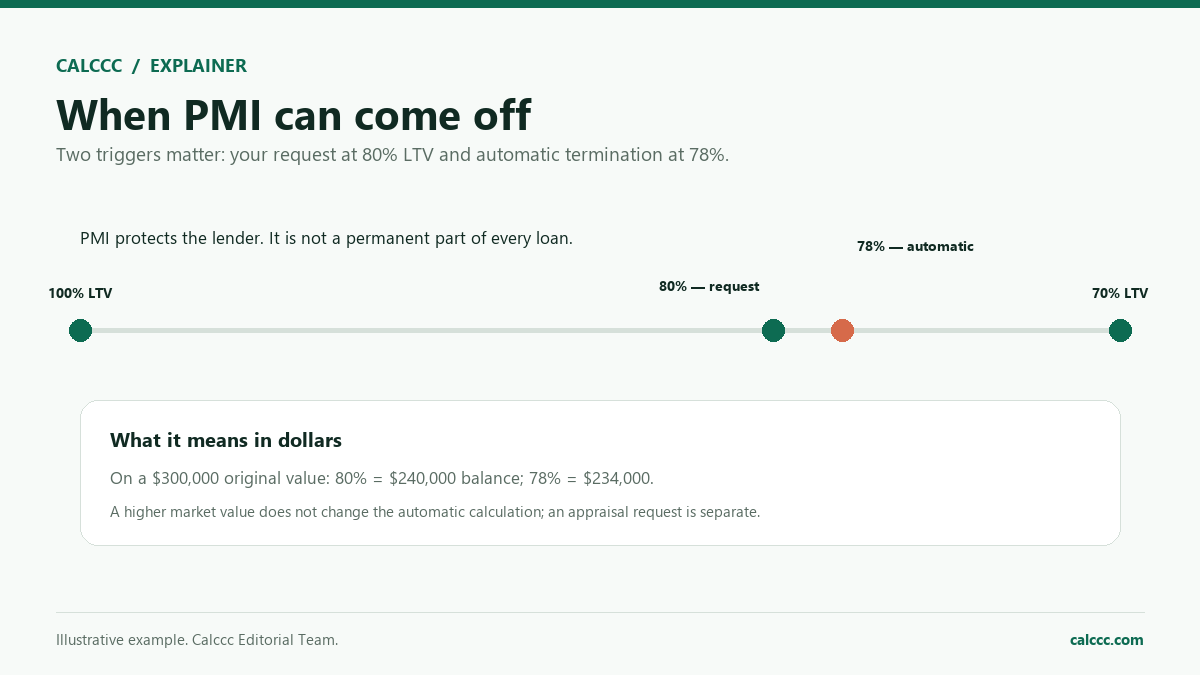
The federal Homeowners Protection Act sets two important milestones. The first is 80% of the home’s original value: you can ask the servicer to cancel PMI. The second is 78% of the original value: the servicer must generally terminate PMI automatically based on the scheduled amortization schedule.
“Original value” usually means the value at closing, not today’s market value. If you bought for $300,000, the 80% point is a $240,000 balance and the 78% point is $234,000. Extra payments can get you to those balances sooner. A rising market does not automatically change the calculation.
What the servicer may require
- Current payments. Most lenders require no late payments in the recent past.
- A written request. Some servicers have a specific form or online portal.
- An appraisal. If you are using a higher current value rather than the original schedule, the lender may require an appraisal you pay for.
- No second mortgage or lien. A home equity line or other lien can complicate removal.
- Loan type rules. FHA, VA, and USDA loans do not use the same PMI rules.
How to request removal, step by step
- Find your original home value and current principal balance on your statement or closing documents.
- Calculate the loan-to-value ratio: current balance ÷ original value.
- Call the servicer and ask for the PMI removal process in writing.
- Submit the request and any required documents.
- Ask for a written confirmation of the removal date and the new payment.
- Check the next statement to confirm PMI is gone.
| Loan-to-value | What usually happens |
|---|---|
| Above 80% | PMI generally remains unless the lender agrees otherwise. |
| At or below 80% | You can request cancellation; conditions apply. |
| At or below 78% | Automatic termination on the scheduled amortization date, subject to conditions. |
Why a higher home value does not automatically help
If home prices rise, you may have more equity, but the servicer’s automatic termination calculation uses the original value and the original schedule. To use a new value, you generally need an appraisal-based cancellation request. The lender may use the new appraised value, but it may also require a minimum seasoning period and a satisfactory appraisal.
This is why two neighbors with the same original purchase price can have different PMI outcomes. One may have paid extra principal or requested an appraisal; the other may still be on the original schedule.
Should you refinance instead?
Refinancing can remove PMI by replacing the loan, but it also resets the term and adds closing costs. It can make sense if rates are lower or you need to change the loan structure. It rarely makes sense only to remove PMI if a simple cancellation request would work. Compare the total cost, not just the new payment.
2026 calculator update: what changed
The linked calculator has been upgraded. It now includes a professional worksheet with the inputs used, the method and scope, and a one-variable sensitivity check for finance tools. You can save two input sets as Scenarios A/B and compare the results side by side. The Print / PDF action produces a branded worksheet, and table-producing calculators can export a CSV.
The page also explains why a bank, lender, broker, or provider can quote a different number: rate versus APR, fees, credit pricing, taxes, insurance, and timing. Use the written quote or Loan Estimate as the binding document, not the calculator estimate.
Frequently asked questions
Can I remove PMI at 20% equity?
“20% equity” usually corresponds to 80% LTV, which is the request milestone. The lender must agree and the loan must meet its conditions. Automatic termination is generally at 78% of original value on the scheduled plan.
Does a new appraisal remove PMI automatically?
No. You generally have to request appraisal-based cancellation and pay for the appraisal. The lender decides whether to accept it.
What if I have an FHA loan?
FHA mortgage insurance is not PMI. FHA MIP rules are different and may require refinancing to remove. Ask your servicer or a HUD-approved counselor.
Can I stop paying PMI myself?
No. Stopping the payment can create a delinquency. Follow the servicer’s removal process and get the change confirmed in writing.
How we checked this guide
We compared the CFPB’s PMI cancellation guidance with the calculator’s mortgage assumptions. The 80% request and 78% automatic termination milestones are described as general rules; loan type, servicer requirements, and state law can change the process. The example is illustrative.
Further reading
Keep exploring
Decision path