


Key takeaways
- Hours run from 00 to 23; minutes still run from 00 to 59.
- No AM/PM is needed.
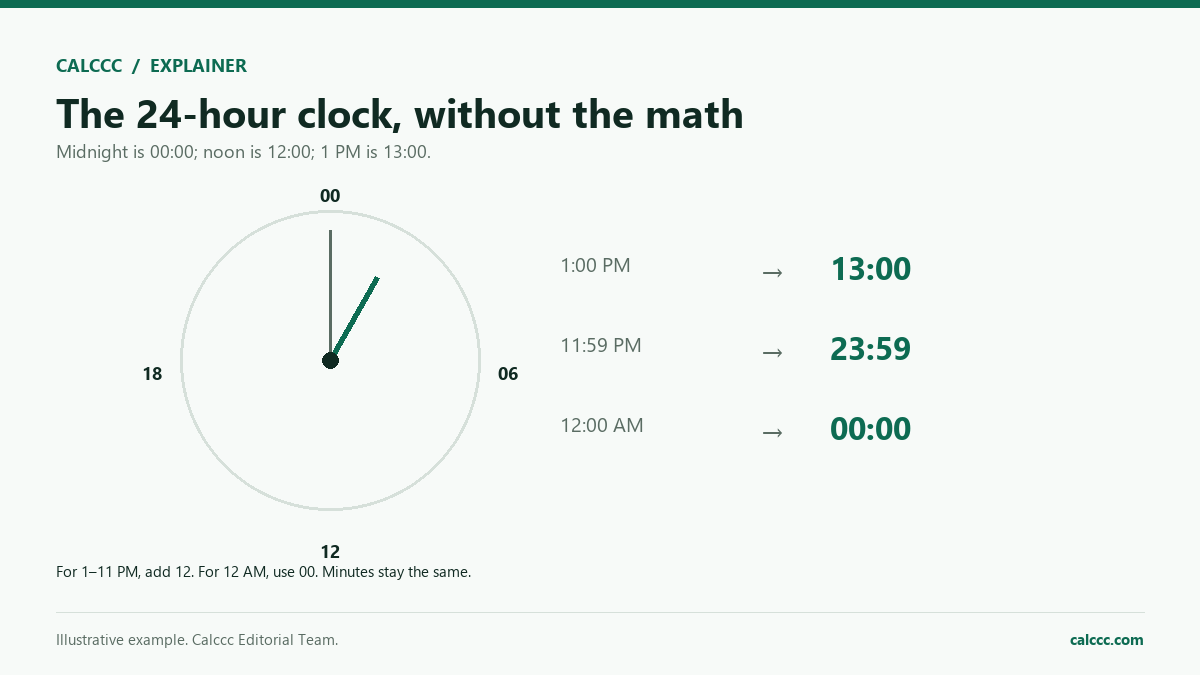
- Midnight is 00:00; noon is 12:00.
- For 1–11 PM, add 12; for 12 AM, use 00.
- Written military time often omits the colon (e.g., 1300).
Why 24-hour time exists
A 24-hour clock removes the ambiguity of AM and PM. “Meet at 7” could mean morning or evening; “meet at 19:00” is unambiguous. Hospitals, airlines, emergency services, and the military use 24-hour time because mistakes are costly.
It is not a different way to measure time. It is the same day divided into 24 hours, just labeled 00–23 instead of 1–12 twice.
The conversion rules
| 12-hour time | 24-hour time | Rule |
|---|---|---|
| 12:00 AM (midnight) | 00:00 | Special case |
| 1:00 AM | 01:00 | Keep the hour, add leading zero |
| 11:00 AM | 11:00 | Keep the hour |
| 12:00 PM (noon) | 12:00 | Special case |
| 1:00 PM | 13:00 | Add 12 |
| 11:00 PM | 23:00 | Add 12 |
How to say it
Military time is often spoken as “thirteen hundred” for 13:00 or “nineteen thirty” for 19:30. In civilian writing, “13:00” or “1:00 PM” is more common. The colon makes the 24-hour format easier to read; the military often omits it.
When speaking, avoid saying “thirteen PM.” The 24-hour format already makes the period clear.
Midnight and noon
Midnight is the boundary between days. In 24-hour time it is 00:00 at the start of the day. Noon is 12:00 in the middle of the day. Be careful with “12 AM” and “12 PM” in 12-hour time; that is where many conversion mistakes happen.
If a deadline says “midnight on Friday,” confirm whether it means the start of Friday (00:00) or the end of Friday (24:00 / 00:00 Saturday). The ambiguity exists in both formats.
Common examples
- 7:30 AM → 07:30
- 12:00 PM → 12:00
- 3:15 PM → 15:15
- 9:45 PM → 21:45
- 12:00 AM → 00:00
Military time and time zones
Military time is not a time zone. It is a format. A time can be written in 24-hour format in any zone. If you are scheduling across zones, include the zone or offset: “19:00 UTC” is unambiguous; “19:00” alone is not.
Converting 24-hour back to 12-hour
If the hour is 00, the time is 12 AM. If the hour is 01–11, the time is that hour in the morning, with AM. If the hour is 12, it is noon, with PM. If the hour is 13–23, subtract 12 and add PM. For example, 14:20 becomes 2:20 PM; 21:05 becomes 9:05 PM; 00:30 becomes 12:30 AM. Keep the minutes unchanged.
Writing both formats on a schedule can help during the transition. After a few days, most people recognize 13:00 as 1 PM without doing the subtraction. If you are writing a schedule for a mixed audience, include both formats once and then stay consistent. A short conversion table at the top of a shift schedule can prevent the same mistake from happening twice. It also gives new staff a quick reference during their first week.
2026 calculator update: what changed
The linked calculator has been upgraded. It now includes a professional worksheet with the inputs used, the method and scope, and a one-variable sensitivity check for finance tools. You can save two input sets as Scenarios A/B and compare the results side by side. The Print / PDF action produces a branded worksheet, and table-producing calculators can export a CSV.
Conversion
Midnight is 0000, noon is 1200. For 1–11 p.m., add 12 to the hour: 1 p.m. = 1300. For 1–11 a.m., keep the hour and add a leading zero if needed: 9 a.m. = 0900. 12 a.m. is 0000, not 1200; 12 p.m. is 1200.
What to compare
Compare the 12-hour time, the 24-hour time, and the date. A midnight conversion is the most common error.
Frequently asked questions
Is 24:00 a valid time?
Some systems use 24:00 to mean the end of the day. In everyday 24-hour time, the day starts at 00:00. For deadlines, confirm the intended meaning.
Is military time the same as 24-hour time?
In everyday use, yes. Military time is a 24-hour format. The military may also use time zone letters, but the clock format is the same.
Why does 12 AM become 00:00?
12 AM is the start of a new day, which is hour zero in the 24-hour clock. Noon is 12:00 because it is 12 hours after the start.
Do I need a leading zero?
It is conventional and clearer: 07:00 rather than 7:00. Some systems require it.
How we checked this guide
We converted each example by hand and checked the results with the military time converter. The 24-hour clock is a notation, not a time zone. The article avoids claiming a single global convention for 24:00.
Further reading