


Key takeaways
- Waste covers cuts, mistakes, damaged planks, and future repairs.
- Straight layouts need less waste than diagonal or patterned layouts.
- Room shape matters as much as total area.
- Buy all boxes from the same lot when possible.
- Keep a spare box; future replacements may not match.
Why flooring needs waste
Flooring is sold in boxes, but rooms are not perfect rectangles. You cut planks at walls, around doorways, and around obstacles. Some cuts leave a piece too short to use. A plank may be damaged, warped, or have a color variation you do not want in the main room. The waste allowance covers those realities.
Waste is not “extra floor for no reason.” It is the difference between a finished room and a second order that may not match the first.
Start with the room area
For a rectangular room, area = length × width. A 12 × 10 ft room is 120 sq ft. For an L-shaped room, split it into rectangles and add them. For a room with bays or angles, measure the main rectangle and add the smaller sections separately. Do not subtract furniture; the floor still runs underneath it.
If you are laying planks in a direction that creates more cuts at the ends, the waste can rise. Long, narrow rooms often produce more offcuts than square rooms.
How much waste by layout
| Layout | Planning waste | Why |
|---|---|---|
| Straight plank, simple room | 5–10% | Few angle cuts; predictable offcuts. |
| Multiple rooms / many doorways | 10–15% | More starting and stopping, more cuts. |
| Diagonal | 15–20% | Every wall cut is angled; more unusable pieces. |
| Herringbone / chevron | 15–25% | Pattern requires precise cuts and more offcuts. |
| Tile with a pattern | 15–25% | Pattern matching and breakage. |
These are planning ranges. A small room with many corners can need more waste than a large open room with a straight layout.
A worked example
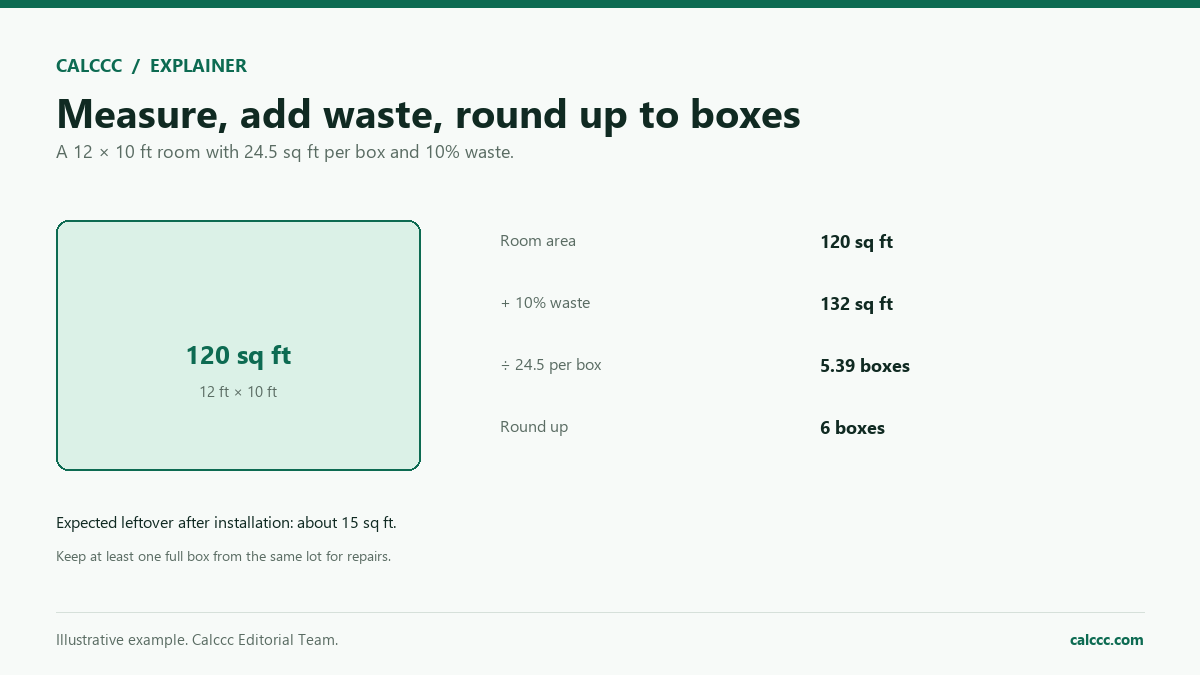
Room: 12 × 10 ft = 120 sq ft. Box coverage: 24.5 sq ft. Waste: 10%. Boxes = 120 × 1.10 ÷ 24.5 = 5.39, round up to 6 boxes. The six boxes cover 147 sq ft; the expected leftover is about 15 sq ft. If the layout is diagonal, use 20% waste: 120 × 1.20 ÷ 24.5 = 5.88, round up to 6 boxes as well. The difference may be one box only when the numbers fall near a boundary.
Always round up at the end, not before. Rounding the area or the boxes too early can leave you short.
What to keep after the job
Keep at least one full box, plus any usable offcuts. Flooring colors and lots can change; a future repair may not match a new box. Store the spare box flat in a dry place, away from sunlight and moisture. Label it with the room and purchase date.
If you plan to move soon, leave the spare box with the home. It is useful for the next owner and shows care.
Waste and the environment
Flooring waste has a real environmental cost. Measure carefully, plan the layout, and return unopened boxes if the retailer allows. Some materials can be recycled or donated; check local rules. The greenest box is the one you do not need to buy.
2026 calculator update: what changed
The linked calculator has been upgraded. It now includes a professional worksheet with the inputs used, the method and scope, and a one-variable sensitivity check for finance tools. You can save two input sets as Scenarios A/B and compare the results side by side. The Print / PDF action produces a branded worksheet, and table-producing calculators can export a CSV.
Waste factor
Waste covers cuts, defects, and pattern matching. Straight lay: 5–10%. Diagonal or herringbone: 10–15%. A room with many corners or a small closet may need more. Order by the full box; a partial box may not be returnable.
An example
A 300 sq ft room with 10% waste needs 330 sq ft. If a box covers 24 sq ft, 330 ÷ 24 = 13.75, so order 14 boxes. Keep one box for repairs. For tile, add 10–15% and check the tile size and grout line.
What to compare
Compare the measured area, waste factor, box coverage, and return policy. A cheap material with high waste and labor can cost more than a mid-price option.
Check the box coverage before ordering.
Frequently asked questions
Is 10% waste enough?
For a straight layout in a simple room, often yes. For diagonal, herringbone, or complex rooms, use 15–20% or more.
Should I buy an extra box?
Yes, if you can. Keep one full box for repairs. It is cheaper than a future mismatched order.
Do I subtract cabinets or furniture?
No. Flooring usually runs under them, and cuts around them create waste. Measure the full room area.
Can I return unused boxes?
Some retailers allow returns on unopened boxes, but policies vary. Ask before ordering, and keep the receipt.
How we checked this guide
We used the flooring calculator’s area, coverage, and waste method to produce the example, then rounded up to whole boxes. The waste ranges are planning guidance, not a manufacturer specification. Layout complexity is the main variable.
Further reading