


Key takeaways
- “Business day” has no single global definition.
- Weekend patterns differ: Monday–Friday, Sunday–Thursday, and Friday–Saturday all exist.
- Public holidays are local and can change year to year.
- Decide whether the start date and end date count.
- For contracts, use the definition in the contract, not a generic calculator.
Why cross-border counting goes wrong
A team in New York asks a supplier in Dubai for delivery “in 10 business days.” New York counts Monday–Friday. Dubai’s working week is Monday–Friday for many private companies, but some government offices use Sunday–Thursday. The same phrase can produce different dates.
Add public holidays, time zones, and local observances, and the gap grows. The solution is not a better guess; it is to specify the calendar.
Weekend patterns around the world
| Pattern | Common examples | Notes |
|---|---|---|
| Monday–Friday | United States, United Kingdom, most of Europe, Canada | The most common business pattern. |
| Sunday–Thursday | Some Middle Eastern government offices | Private companies may differ. |
| Friday–Saturday | Some Gulf states and other regions | Friday is the weekly prayer day in many places. |
| Saturday–Sunday | Many service and retail businesses | Employees may work weekends with different days off. |
This table is a starting point, not a rule. A country can have different practices in the public and private sectors, and a company can choose its own week.
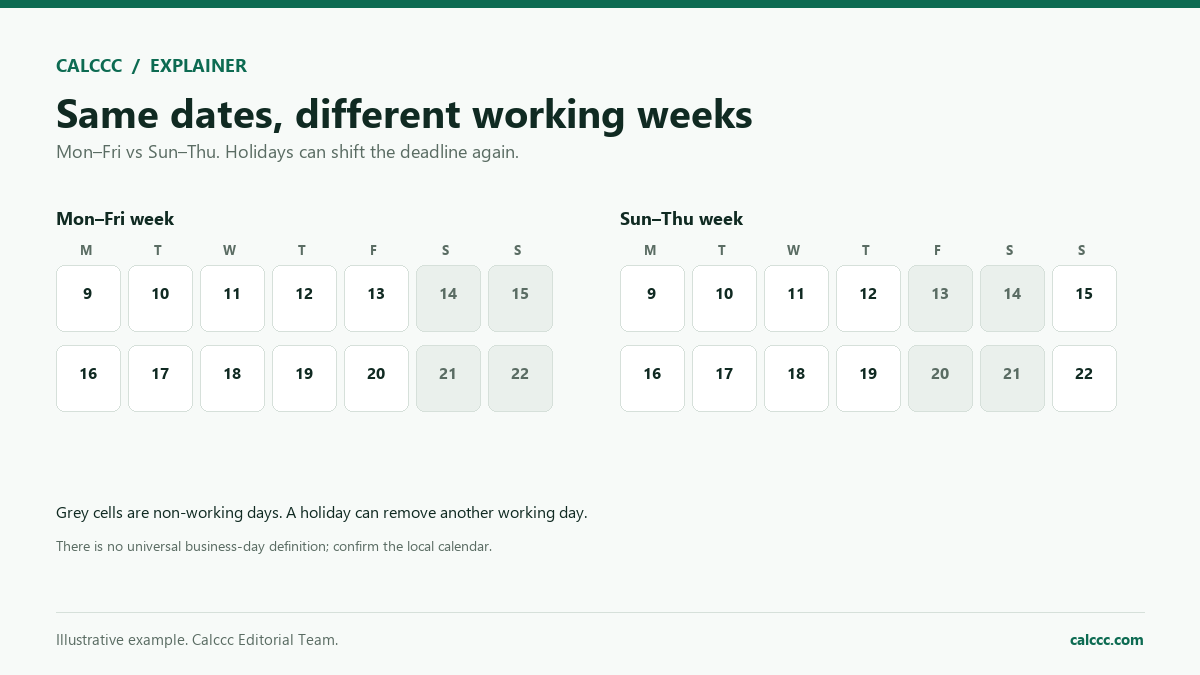
Public holidays are local
National holidays, religious holidays, and regional observances differ. A holiday in one country may be a normal working day in another. Some holidays are fixed by date; others move with a lunar calendar. Substitute days can shift the observed date when a holiday falls on a weekend.
For the US, the Office of Personnel Management publishes federal holidays. For the UK, GOV.UK publishes bank holidays for England and Wales, Scotland, and Northern Ireland separately. For other countries, use the official government or labor ministry calendar.
Counting rules that change the answer
- Does the start date count? Some rules exclude the trigger day and start the next business day.
- Does the end date count? Many date differences exclude the end date; contracts may include it.
- Are holidays excluded? Usually yes if the holiday is observed where the work happens.
- Is a half-day a working day? Some offices close early; the contract may still count it as a full day.
- What about time zones? A deadline at 5 PM local time may already be the next day elsewhere.
A worked example
Start Monday, November 9, 2026, and count 10 business days on a Monday–Friday calendar, excluding Veterans Day (November 11). If November 9 is day 1: 9, 10, 12, 13, 16, 17, 18, 19, 20, 23 → November 23. If the count starts the next day, the tenth business day is November 24. Both are correct under different conventions.
Now use a Sunday–Thursday calendar. The weekends are Friday and Saturday, so the same 10 working days land on a different date. The lesson: agree on the calendar before you count.
International teams and scheduling
For recurring meetings, use a calendar invitation with a time zone, not a bare “9 AM.” For project deadlines, publish the working calendar and holiday list with the schedule. If a deadline crosses a holiday, state whether the holiday extends the deadline.
When in doubt, add a buffer. A deadline that assumes every business day is available is fragile; one that accounts for a local holiday is more realistic.
2026 calculator update: what changed
The linked calculator has been upgraded. It now includes a professional worksheet with the inputs used, the method and scope, and a one-variable sensitivity check for finance tools. You can save two input sets as Scenarios A/B and compare the results side by side. The Print / PDF action produces a branded worksheet, and table-producing calculators can export a CSV.
Country differences
Weekends are not universal: some countries use Friday–Saturday, others Sunday only. Public holidays vary by country and region. A business-day count for one country cannot be reused for another without the holiday calendar.
What to compare
Compare the country, the weekend pattern, and the holiday list. A “business day” is a local legal concept, not a global one.
Frequently asked questions
Is Friday a business day in the Middle East?
It depends on the country and sector. Some governments use Sunday–Thursday; some private companies use Monday–Friday or Friday–Saturday. Check the local calendar.
Do business days include Saturday?
Usually not in office contexts, but retail, logistics, and some services operate on Saturday. The contract or employer policy controls.
Are public holidays always excluded?
Usually, if the holiday is observed where the work is performed. A holiday in another country may not affect the deadline.
How do I count a cross-border deadline?
Choose the governing calendar, list the holidays for that location, decide whether day one and the end date count, then count. Document the assumptions.
How we checked this guide
We compared weekend patterns and holiday guidance with the ILO’s working-time resources, OPM’s US federal holiday list, and GOV.UK’s bank holiday pages. The example was counted by hand under two conventions. Local practice can vary; the article does not claim a universal business-day definition.
Further reading