What this calculator does
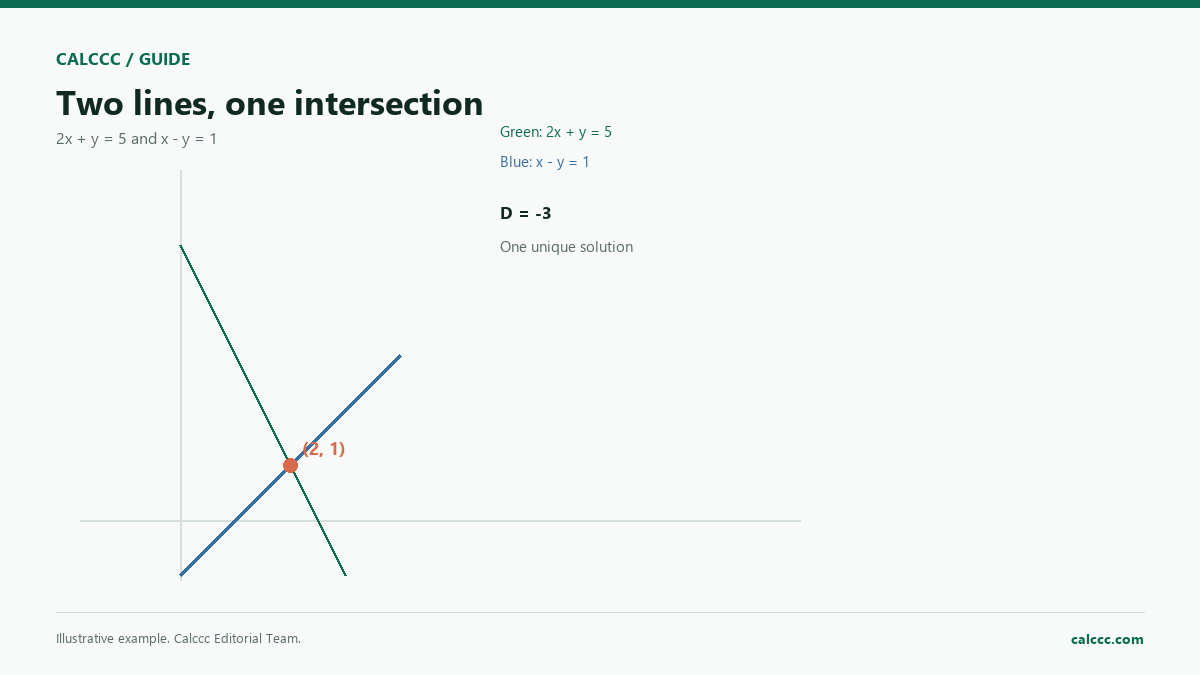
A 2x2 system is two lines in the same plane. Solving the system means finding a point that lies on both lines. Most pairs of lines cross once, but parallel lines never meet and identical lines overlap everywhere. This calculator solves the system with Cramer's rule and uses the determinant to tell those cases apart.
How to use it
- Write each equation in the form ax + by = c.
- Enter a1, b1, and c1 for the first equation.
- Enter a2, b2, and c2 for the second equation.
- Read x and y when the determinant is nonzero.
- If the determinant is zero, check whether the equations are parallel or identical.
How it works
Example calculations
Example 1: unique solution
2x + y = 5 and x - y = 1. D = 2(-1) - 1(1) = -3. x = (5(-1) - 1(1)) / -3 = 2, and y = (2(1) - 1(5)) / -3 = 1. The lines cross at (2, 1).
Example 2: parallel lines
x + y = 3 and x + y = 5 have the same left side but different constants. D = 0 and the system is inconsistent, so there is no solution.
Example 3: same line
x + y = 3 and 2x + 2y = 6 are multiples of each other. D = 0 but the equations are consistent, so every point on the line is a solution.
What the result means
Cramer's rule is compact but not always the fastest hand method. Substitution or elimination can be clearer when one coefficient is 1 or -1. The determinant is also a geometric signal: its absolute value is related to the area of the parallelogram formed by the coefficient vectors, and a zero determinant means the lines are parallel or coincident. Always substitute the answer back into both original equations.
Common mistakes
- Using Cramer's rule when the determinant is zero and reporting a numeric answer.
- Dropping a negative sign when subtracting products.
- Assuming a zero determinant always means no solution; it can mean infinitely many.
- Not checking the solution in both original equations.
Assumptions and limits
- The equations are linear and written in standard form ax + by = c.
- Coefficients may be negative or zero.
- A zero determinant means no unique solution.
- Results are rounded for display.
- The calculator solves a 2x2 system, not a larger system.
Frequently asked questions
What does the determinant tell me?
A nonzero determinant means the lines cross at exactly one point. A zero determinant means the lines are parallel (no solution) or identical (infinitely many solutions).
How do I know if there are infinite solutions?
If the determinant is zero and the equations are multiples of each other, they describe the same line. The calculator reports infinitely many solutions when the consistency check passes.
Can I use this for three variables?
No. A 3x3 system needs a 3x3 determinant or row reduction. This tool is limited to two equations and two unknowns.
Why use Cramer's rule?
It gives a direct formula for x and y and makes the determinant's role visible. For hand work, substitution or elimination may be simpler.
What if a coefficient is zero?
That is allowed. For example, 0x + 2y = 4 is a horizontal line. The determinant formula still works.
Sources
2026 update
How to use the professional output
This page is not just a formula box. The result is designed to be checked, compared, and taken away.
- Professional worksheet. The result includes the inputs used, the method and scope, and a one-variable sensitivity check for finance calculators.
- A/B scenarios. Save two input sets in the browser and compare the primary, secondary, and breakdown figures side by side.
- Print / PDF and CSV. Print a branded worksheet, or export the year-by-year table when the calculator produces one.
The formulas and assumptions above still govern the number. The worksheet makes the estimate auditable; it does not make it a lender quote, tax return, or personalized advice.
Go deeper