


Key takeaways
- Write both equations in the form ax + by = c before comparing them.
- A nonzero determinant means one unique solution.
- A zero determinant needs a consistency check.
- Substitute the answer back into both original equations.
- Cramer’s rule is compact but not always the easiest hand method.
Two lines, one point
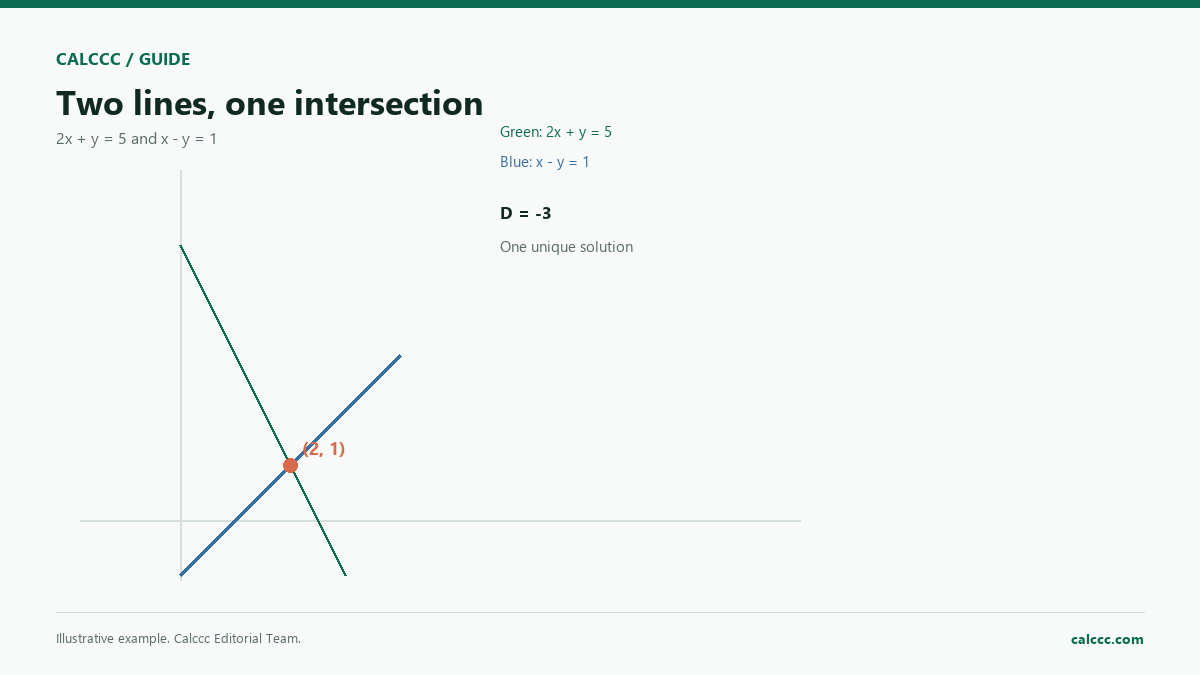
Each linear equation describes a line. Solving the system means finding a point that lies on both lines. If the lines have different slopes, they cross once. If they have the same slope and different intercepts, they are parallel and never meet. If they have the same slope and the same intercept, they are the same line and every point on it is a solution.
The determinant captures this geometry. For a1x + b1y = c1 and a2x + b2y = c2, D = a1b2 − a2b1. If D ≠ 0, the lines are not parallel and there is exactly one solution.
Substitution
Solve one equation for one variable, then substitute into the other. For 2x + y = 5 and x − y = 1, the second equation gives x = y + 1. Substitute into the first: 2(y + 1) + y = 5, so 3y = 3 and y = 1. Then x = 2. The solution is (2, 1). Substitution is often easiest when a coefficient is 1 or −1.
Elimination
Add or subtract the equations to remove a variable. For 2x + y = 5 and x − y = 1, adding gives 3x = 6, so x = 2. Substitute back to get y = 1. Elimination is often fastest when the coefficients are close or already opposite.
Cramer’s rule
With D = a1b2 − a2b1, the formulas are x = (c1b2 − c2b1) / D and y = (a1c2 − a2c1) / D. For the example, D = 2(−1) − 1(1) = −3. x = (5(−1) − 1(1)) / −3 = 2, and y = (2(1) − 1(5)) / −3 = 1. The formulas are compact, but a sign error is easy; check by substitution.
Cramer’s rule also works for larger systems with larger determinants, but the arithmetic grows quickly. For a 2×2 system, substitution or elimination is often clearer.
When the determinant is zero
If D = 0, the equations are dependent or inconsistent. Multiply the first equation by a2 and the second by a1 and compare the constants. If the resulting constants match, the equations describe the same line and there are infinitely many solutions. If they do not match, the lines are parallel and there is no solution.
For example, x + y = 3 and x + y = 5 have D = 0 and different constants, so there is no solution. x + y = 3 and 2x + 2y = 6 are multiples of each other, so every point on the line solves both.
Check the answer
Substitute x and y into both original equations. If either equation fails, recheck the arithmetic. A graph is a useful sanity check: the intersection should match the solution, and parallel lines should be visibly parallel.
Graphing as a check
Graph both lines on the same axes. If they cross, the intersection coordinates are the solution. If they are parallel, the system has no solution. If they lie on top of each other, every point on the line is a solution. Graphing is not precise enough for an exact answer, but it catches sign errors and makes the three cases visible.
Frequently Asked Questions
What is the determinant?
For a 2×2 system, D = a1b2 − a2b1. It tells you whether the lines are parallel and appears in Cramer’s rule.
Can a system have exactly two solutions?
No. Two distinct lines either cross once, are parallel, or are the same line. A 2×2 linear system cannot have exactly two solutions.
What if one equation has no y?
That is fine. For example, 2x = 4 fixes x, and you can substitute that value into the other equation.
Does Cramer’s rule work for three variables?
Yes, with 3×3 determinants, but the arithmetic is larger. For hand work, row reduction is usually cleaner.
How we checked this guide
We solved each example by substitution, elimination, and Cramer’s rule, and checked the determinant cases against their graphs. The article is an educational explanation of linear algebra, not a formal proof.
Word problems
A ticket problem: adult tickets cost $12, child tickets $8, total tickets 100, total revenue $1,000. Equations: a + c = 100; 12a + 8c = 1,000. Substitute c = 100 − a: 12a + 800 − 8a = 1,000, 4a = 200, a = 50, c = 50. Check both equations.
Three variables
Three equations can solve three unknowns. Use elimination to reduce to two equations, then solve the 2×2 system. The pattern is the same; the bookkeeping grows. A matrix or Cramer’s rule can be faster for larger systems.
No solution or infinite solutions
Parallel lines have no solution; the same line has infinitely many. After elimination, a false statement such as 0 = 5 means no solution. A true statement such as 0 = 0 means the equations are dependent.
What to compare
Compare the solution with both original equations. A graph can confirm the intersection or the parallel lines.
Graphing check
Graph both equations. Two lines that intersect give one solution; parallel lines give none; the same line gives infinitely many. The graph is a visual check, not a substitute for the algebra.
2026 calculator update: what changed
The linked calculator has been upgraded. It now includes a professional worksheet with the inputs used, the method and scope, and a one-variable sensitivity check for finance tools. You can save two input sets as Scenarios A/B and compare the results side by side. The Print / PDF action produces a branded worksheet, and table-producing calculators can export a CSV.
Further reading