


Key takeaways
- Roth contributions are made after tax; qualified withdrawals are generally tax-free.
- Time is the largest lever in the projection.
- Contribution limits and income limits change over time.
- Inflation reduces the purchasing power of the future balance.
- A projection is a scenario, not a promise.
How the account works
A Roth IRA is a retirement account, not an investment by itself. You choose the investments inside it. Contributions are made with money that has already been taxed. Qualified withdrawals, including earnings, are generally tax-free. There are rules for qualified distributions, including age and account age requirements.
Because the tax treatment is different from a traditional IRA, comparing the two requires an assumption about future tax rates. For many people, a Roth is valuable when they expect higher taxes later or want tax diversification in retirement.
Compounding over decades
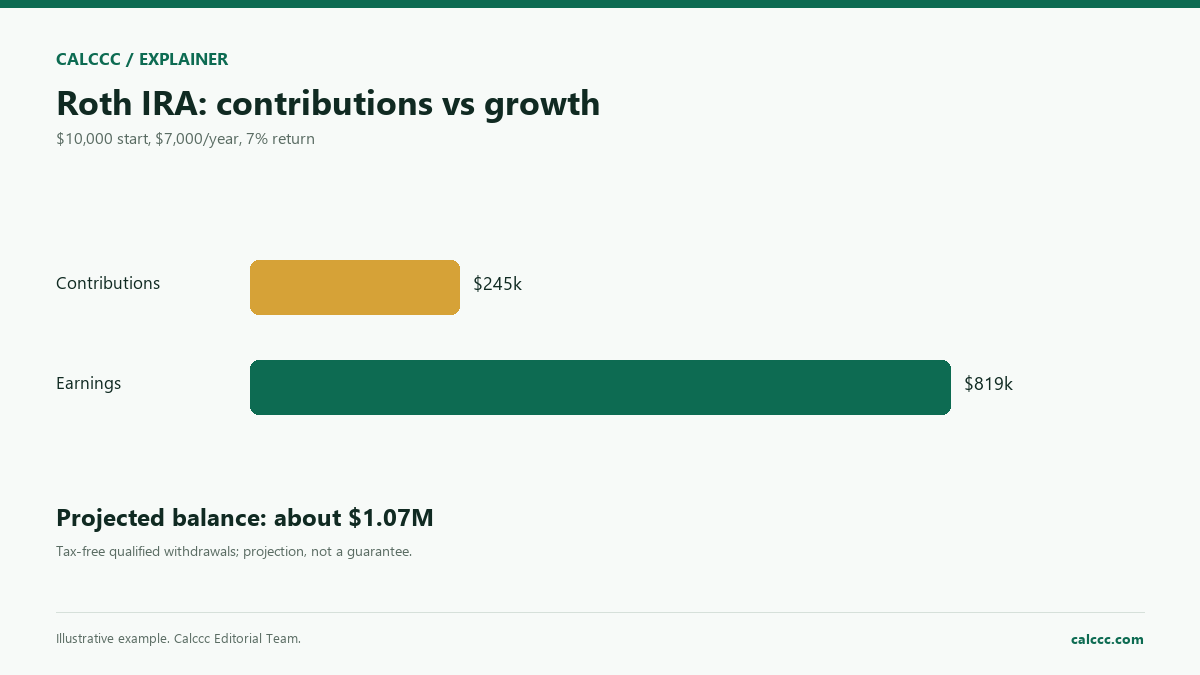
A $10,000 starting balance growing at 7% becomes about $76,000 after 30 years with no additional contributions. Add $7,000 a year and the balance grows much faster. The contributions are easy to see; the growth is the quiet part. In the calculator’s 35-year example, contributions total $245,000 while earnings exceed $800,000.
Contribution limits
The IRS sets annual contribution limits and may allow catch-up contributions for people 50 and older. Eligibility to contribute to a Roth IRA also depends on income. The limits are indexed and can change. The calculator does not enforce them; it is a growth model.
If you contribute more than allowed, the excess can trigger penalties. Check the current limit before making a contribution, especially if you also contribute to a workplace plan.
Contribution increases
A 2% annual contribution increase can be surprisingly powerful over a long career. It also mirrors real life: raises create room to save more. The projection lets you model that. Even a small increase early has more compounding time than a larger increase later.
Inflation
A million dollars in 35 years will not buy what a million dollars buys today. The calculator shows today’s-dollar value by discounting the ending balance at the inflation rate. Use that number when comparing the result with today’s expenses.
Contribution timing and automated investing
The projection assumes contributions at the end of each year. Contributing earlier in the year, or monthly through automatic transfers, gives the money more time in the market. The difference is small in a single year but meaningful over decades. Automatic contributions also remove the need to remember an annual transfer.
Market returns are not a straight line. A real portfolio can fall 20% or more in a year and still recover over time. The calculator uses a constant return to make the math readable; it does not model sequence risk, volatility, or fees. A range of returns is more honest than one number.
Roth versus traditional
A traditional IRA or 401(k) may give a tax deduction today and tax the withdrawals later. A Roth gives no deduction today but generally tax-free qualified withdrawals. The better choice depends on current versus future tax rates, liquidity needs, and tax diversification. Many people benefit from having both.
Withdrawal rules
Qualified Roth distributions generally require the account to have been open for five tax years and the owner to be 59½ or meet another qualifying exception. Contributions can be withdrawn tax- and penalty-free at any time, but earnings have different rules. Check the current IRS guidance before relying on early access.
A note on fees
A fund expense ratio of 0.10% versus 0.60% sounds small, but it compounds against you. On a large balance, the difference can be tens of thousands of dollars over a career. Check the expense ratio, account fees, and whether the custodian charges for trading or advice.
Frequently Asked Questions
Are Roth withdrawals always tax-free?
Qualified withdrawals are generally tax-free. Nonqualified withdrawals can trigger income tax and a penalty on earnings.
Can I have a Roth IRA and a 401(k)?
Yes. Contribution limits apply separately, but income limits for Roth IRA contributions still apply.
Does the calculator include employer matching?
No. Employers do not match Roth IRA contributions. Workplace plans have separate rules.
What return should I assume?
Use a conservative, realistic assumption and test a range. A single return every year is a simplification.
How we checked this guide
We compared the projection with the standard future-value formula and checked the contribution and earnings totals. The tax treatment summary follows IRS guidance; it is not tax advice.
Contributions and conversions
Roth IRA contributions are after-tax; qualified withdrawals are tax-free. The annual contribution limit and income phase-out depend on the year and filing status. A Roth conversion moves traditional money into Roth and is taxable in the year of conversion. The five-year rule affects earnings.
What to compare
Compare current and future tax rates, the conversion tax, and the five-year rules. A conversion is not automatically better.
2026 calculator update: what changed
The linked calculator has been upgraded. It now includes a professional worksheet with the inputs used, the method and scope, and a one-variable sensitivity check for finance tools. You can save two input sets as Scenarios A/B and compare the results side by side. The Print / PDF action produces a branded worksheet, and table-producing calculators can export a CSV.
The page also explains why a bank, lender, broker, or provider can quote a different number: rate versus APR, fees, credit pricing, taxes, insurance, and timing. Use the written quote or Loan Estimate as the binding document, not the calculator estimate.
For retirement, the calculator now separates the accumulation phase from a year-by-year retirement cash-flow table: starting balance, growth, withdrawal, and ending balance. The withdrawal rate is still a planning shortcut, not a guarantee.
Further reading
Keep exploring
Decision path