


Key takeaways
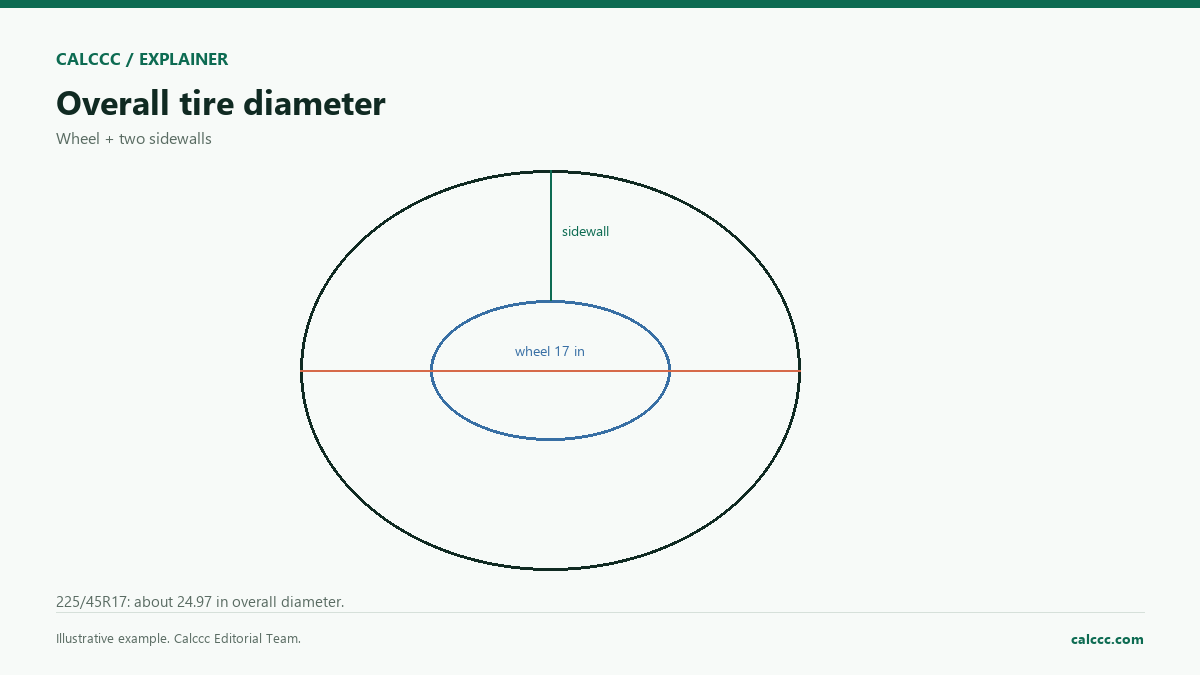
- Overall diameter = wheel diameter + two sidewalls.
- A larger diameter raises the car and changes effective gearing.
- Speedometer error is proportional to diameter change.
- Load index, speed rating, clearance, and wheel width still matter.
- Use a professional fitment check before buying.
Reading the size
In 225/45R17, 225 is the nominal width in millimeters, 45 is the aspect ratio (sidewall height as a percentage of width), R means radial, and 17 is the wheel diameter in inches. The sidewall height is 225 × 0.45 = 101.25 mm. The overall diameter is 17 × 25.4 + 2 × 101.25 = 634.3 mm, or about 24.97 inches.
Comparing two sizes
A 235/45R17 has a sidewall of 105.75 mm and a diameter of about 643.8 mm, roughly 1.42% larger. At an indicated 60 mph, actual speed is about 60.9 mph. The difference is small but real; a larger change can affect gearing and clearance.
Plus sizing
Plus sizing increases the wheel diameter and lowers the aspect ratio to keep the overall diameter close to stock. For example, a 17-inch wheel might move to 18 inches with a lower sidewall. The goal is to preserve the rolling circumference while changing the look and handling balance.
What the calculator does not check
It does not check load index, speed rating, wheel width, offset, brake clearance, or suspension clearance. A tire can have the right diameter and still be wrong for the car. Check the door placard, the owner’s manual, and a tire professional’s fitment guide.
Speed rating and load index
The size is only part of the tire specification. The load index tells you how much weight the tire can carry at a given pressure. The speed rating tells you the maximum sustained speed. A tire with the right dimensions but a lower load index may not be suitable for the vehicle, especially for towing or carrying passengers.
Check the door placard for the recommended size, load index, and pressure. The owner’s manual may list optional sizes. A tire professional can confirm whether a candidate size fits the wheel width and clears the brakes and suspension.
Winter and all-season choices
A smaller wheel with a taller sidewall can be useful for winter tires, but brake clearance and load rating still matter. Do not assume a smaller wheel is always safer or cheaper. The tire compound and tread pattern matter more for winter traction than the nominal size.
Odometer and resale
A larger tire travels farther per revolution, so the odometer may undercount actual miles. That can affect maintenance intervals and resale disclosures. If you change the diameter significantly, note it and recalibrate the speedometer where possible.
Fuel economy and ride comfort
A wider tire can increase rolling resistance, and a heavier wheel can hurt acceleration and fuel economy. A shorter sidewall can improve steering response but make the ride harsher and increase the risk of wheel damage on rough roads. The best size is a balance, not the largest one that fits.
Keep the tire pressure at the vehicle manufacturer’s specification, not the maximum printed on the sidewall. Pressure affects wear, handling, and fuel economy more than a small diameter change.
Check the spare
A different overall diameter can affect a spare tire or a temporary use. If the vehicle has a full-size spare, confirm that it matches the size and load rating. A mismatch should be temporary and driven at reduced speed.
Frequently Asked Questions
How much speedometer error is acceptable?
Even 1–2% can matter. Larger tires read lower than actual speed; smaller tires read higher. Check local rules and the vehicle’s calibration.
Can I change only the width?
Yes, but the overall diameter and clearance change unless the aspect ratio is adjusted. Wider tires may also need a wider wheel.
Does a larger wheel improve performance?
Not automatically. A larger wheel with a lower sidewall can sharpen response, but it can also add weight and reduce ride comfort.
What is the load index?
A code for the maximum load the tire can carry at a specified pressure. Never choose a tire with a lower load index than the vehicle requires.
How we checked this guide
We checked the diameter and speedometer arithmetic with the calculator and NHTSA tire guidance. The article is a size comparison, not a fitment guarantee.
Reading a tire size
P225/45R17: P means passenger, 225 is the section width in millimeters, 45 is the aspect ratio (sidewall height as a percentage of width), R means radial, and 17 is the rim diameter in inches. The sidewall height is 225 × 0.45 = 101.25 mm. Overall diameter = rim diameter + 2 × sidewall height, converted to the same unit.
Plus sizing
A larger rim usually needs a lower aspect ratio to keep the overall diameter close to the original. Changing the diameter can affect speedometer accuracy, clearance, and gearing. Compare the overall diameter and the load/speed rating, not only the rim size.
What to compare
Compare the width, aspect ratio, rim, overall diameter, load index, and speed rating. A size that fits the wheel may not be appropriate for the vehicle.
2026 calculator update: what changed
The linked calculator has been upgraded. It now includes a professional worksheet with the inputs used, the method and scope, and a one-variable sensitivity check for finance tools. You can save two input sets as Scenarios A/B and compare the results side by side. The Print / PDF action produces a branded worksheet, and table-producing calculators can export a CSV.
Further reading