


Key takeaways
- The line is based on equity and LTV. A common formula is home value × maximum combined LTV − mortgage balance.
- The draw payment may be interest-only. It does not reduce principal.
- The repayment payment is amortizing. It can be much higher than the draw payment.
- Most HELOC rates are variable. A rate increase raises both the interest-only payment and the amortizing payment.
- The home is collateral. A HELOC is secured debt, not an unsecured credit card.
How a HELOC is structured
A home equity line of credit is a revolving credit line secured by your home. You can draw money during the draw period, repay some or all of it, and draw again, subject to the lender’s terms. When the draw period ends, the line typically converts to a repayment period with a fixed amortization schedule.
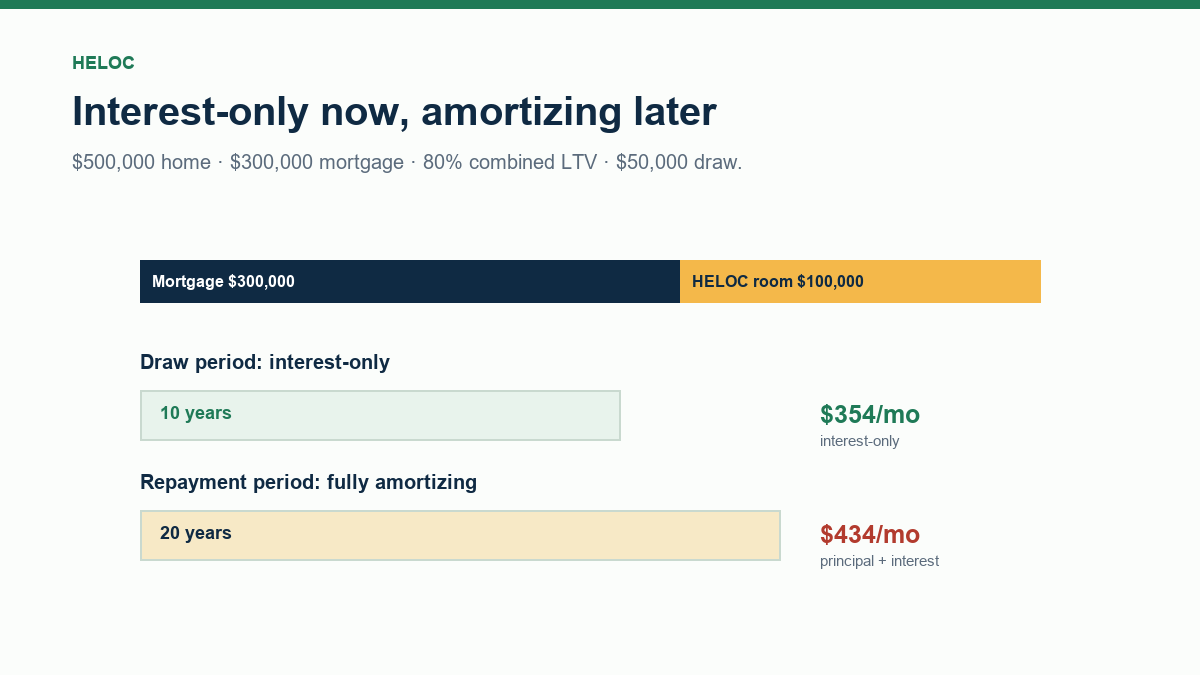
Lenders set a maximum combined loan-to-value ratio, often 80% or 85%. The available line is roughly the home value times that limit, minus the existing mortgage balance. A $500,000 home with a $300,000 mortgage and an 80% limit has about $100,000 of potential HELOC room.
The payment changes after the draw period
During the draw period, many HELOCs require only interest on the outstanding balance. On a $50,000 draw at 8.5%, that is about $354 per month. That payment does not reduce the $50,000 balance.
During repayment, the same balance is amortized over the repayment term. At 8.5% over 20 years, the principal-and-interest payment is about $434 per month. The difference may look modest in this example, but it grows with a larger draw, a higher rate, or a shorter repayment period.
What the calculator includes
The calculator estimates the maximum line, the actual draw, the available credit after the draw, the interest-only draw payment, the amortizing repayment payment, and total interest. It assumes the line is fully drawn at the start, the rate stays constant, and the balance is fully amortized over the repayment period.
It does not include closing costs, annual fees, early-closure penalties, or lender-specific minimum payment rules. Those can change the cost of the line even when the rate is the same.
Risks to check before borrowing
Variable rate. Most HELOCs are tied to a benchmark. If the rate rises, the interest-only payment rises immediately in many contracts, and the repayment payment rises too.
Payment shock. A draw-period payment that covers only interest can make the line feel cheaper than it is. Budget for the fully amortizing payment from the beginning.
Home collateral. If you cannot repay, the lender can foreclose. A HELOC is not a substitute for an emergency fund or an unsecured loan.
Fees and penalties. Some lenders charge closing costs, annual fees, or a fee if you close the line early. Read the disclosure, not just the introductory rate.
How to compare offers
Compare the margin over the index, the initial rate and how long it lasts, the draw period, the repayment period, the maximum LTV, closing costs, annual fees, and whether the rate can be fixed. A lower introductory rate with a short teaser period can cost more than a slightly higher rate with a stable margin.
Ask for a fully amortizing payment illustration at the current rate and at a higher rate. If the higher-rate payment is unaffordable, the line is too large for the budget.
Model a higher rate before you sign
A HELOC illustration at today’s rate is not a stress test. Ask the lender what the payment would be if the rate rose by one or two percentage points, and whether the contract has a lifetime cap. On a $50,000 balance, a 2-point increase adds about $83 per month to an interest-only payment, but the effect on the amortizing payment is larger because the higher rate is applied over the full repayment term.
Also check whether the lender can freeze or reduce the line. A home value decline or a change in the lender’s credit policy can restrict further draws, even if the account is current. Do not rely on an untouched HELOC as an emergency fund unless you understand that risk.
2026 calculator update: what changed
The linked calculator has been upgraded. It now includes a professional worksheet with the inputs used, the method and scope, and a one-variable sensitivity check for finance tools. You can save two input sets as Scenarios A/B and compare the results side by side. The Print / PDF action produces a branded worksheet, and table-producing calculators can export a CSV.
The page also explains why a bank, lender, broker, or provider can quote a different number: rate versus APR, fees, credit pricing, taxes, insurance, and timing. Use the written quote or Loan Estimate as the binding document, not the calculator estimate.
Frequently asked questions
How is a HELOC limit calculated?
A common approach is home value times the lender’s maximum combined LTV, minus the first mortgage balance. The actual approved line can be lower after underwriting.
Is the draw-period payment interest-only?
Many HELOCs offer interest-only payments during the draw period, but terms vary. Some require principal or a minimum payment.
What happens when the draw period ends?
The line converts to a repayment period with a fully amortizing payment. That payment can be much higher than the interest-only payment.
Is a HELOC fixed or variable?
Most are variable, tied to a benchmark. Some lenders offer fixed-rate options or rate locks on part of the balance.
Further reading
Keep exploring
Decision path