


Key takeaways
- Utilization is a ratio, not a dollar amount. The same $4,500 balance is 30% on a $15,000 limit and 9% on a $50,000 limit.
- Both per-card and overall utilization can matter. A maxed-out card can look bad even when the total ratio is low.
- Statement dates drive reporting. Paying before the closing date can change the balance reported to the bureaus.
- 30% is a guideline, not a scoring rule. The exact effect depends on the scoring model and the rest of your profile.
- Closing a card can raise utilization. It reduces total available credit and may shorten your credit history.
The formula
Credit utilization is total revolving balance divided by total revolving credit limit, multiplied by 100. Revolving credit usually means credit cards and lines of credit, not installment loans such as a mortgage or auto loan.
Per-card utilization uses one card’s balance and that card’s limit. Overall utilization combines all cards. A person can have 20% overall utilization and one card at 80%; the per-card number may still matter.
A worked example
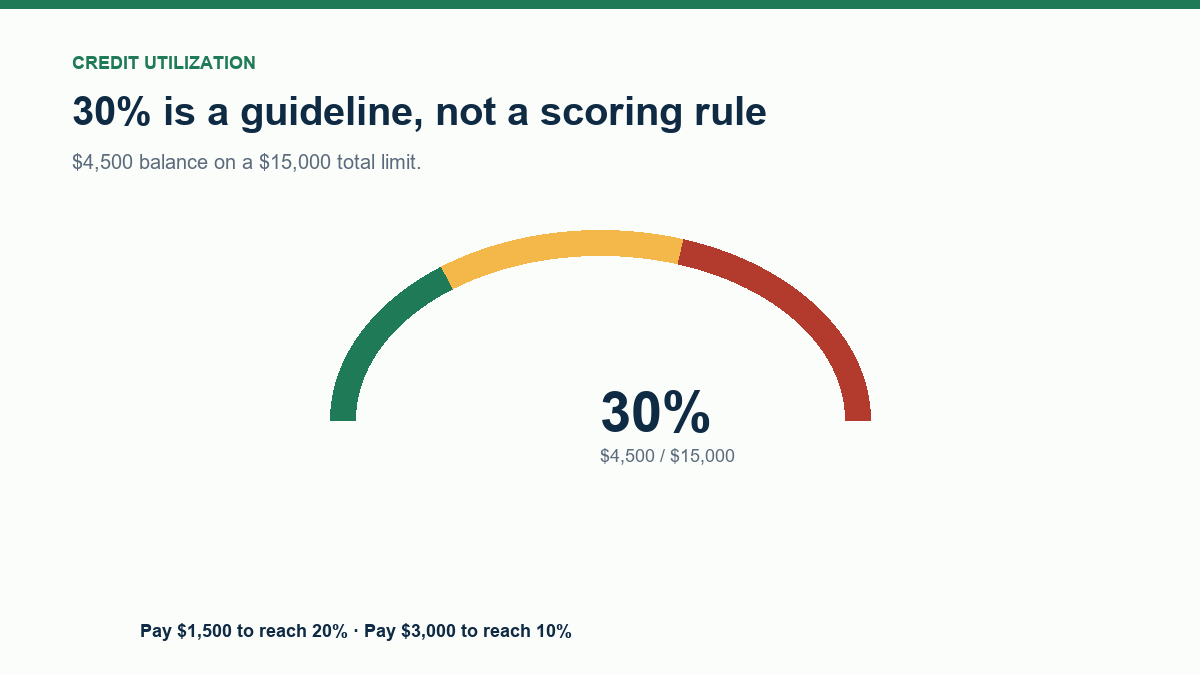
A $4,500 balance on a $15,000 total limit is 30%. Available credit is $10,500. Paying $1,500 brings the balance to $3,000, or 20%. Paying $3,000 brings it to $1,500, or 10%.
The dollar paydown needed to reach a target is not the same as the target percentage. Use the target balance, not the current balance, when planning a payment.
Why statement dates matter
Issuers generally report the balance from your statement, not your balance on every day of the month. If you pay before the statement closing date, the reported balance may be lower. If you pay after the statement closes, the higher balance may already be on its way to the bureaus.
Check your statement closing date and your due date. They are not the same. A payment made before the closing date is the practical way to influence the balance that is reported next.
What the 30% guideline means
Many credit guides suggest keeping utilization below 30%. Some suggest below 10% for the best effect. These are guidelines based on common patterns, not published scoring thresholds. A person with a strong payment history and a long credit history may qualify for a good score with a higher ratio; a thin file may be more sensitive.
Do not obsess over a single month. Utilization is only one factor. Payment history, account age, credit mix, new credit inquiries, and the number of accounts also matter.
Closing cards and raising limits
Closing a card reduces total available credit and can raise overall utilization. It may also shorten the average age of your accounts. If the card has no annual fee and you can keep it open responsibly, closing it may do more harm than good.
A credit limit increase can lower utilization without paying down debt, but it can also encourage more spending. Ask for an increase only if you can keep the balance stable.
How to lower utilization without paying everything
Start with the card that has the highest per-card utilization. Bringing one maxed-out card below 30% can improve the profile even if the overall ratio is unchanged. Then spread payments across cards so no single balance dominates the report.
If you can afford it, make a payment before the statement closing date and leave a small balance for the due date. That keeps the reported balance lower while still paying on time. Do not carry a balance just to “build credit”; interest costs are real and payment history is the more important factor.
2026 calculator update: what changed
The linked calculator has been upgraded. It now includes a professional worksheet with the inputs used, the method and scope, and a one-variable sensitivity check for finance tools. You can save two input sets as Scenarios A/B and compare the results side by side. The Print / PDF action produces a branded worksheet, and table-producing calculators can export a CSV.
The page also explains why a bank, lender, broker, or provider can quote a different number: rate versus APR, fees, credit pricing, taxes, insurance, and timing. Use the written quote or Loan Estimate as the binding document, not the calculator estimate.
Reporting date
Utilization is usually reported at the statement closing date. Paying before that date can lower the reported balance. The scoring effect is not guaranteed, but the timing is a known pattern. Do not close old cards just to change utilization.
What to compare
Compare the balance, the limit, and the statement date. A lower utilization is one factor, not the whole score.
Now check the statement date and the reported balance.
Compare the statement date and the reported balance with the limit.
Frequently asked questions
What is a good credit utilization ratio?
Many guidelines suggest below 30%, and below 10% may be better for some profiles. The exact scoring formula is not public.
Does paying before the statement date help?
It can lower the balance reported to the bureaus, which may lower the utilization that is scored. The statement date is set by the issuer.
Should I close a card with a zero balance?
Closing a card reduces your total available credit and can raise overall utilization. Consider the tradeoff before closing an old account.
Is utilization the only credit factor?
No. Payment history, account age, credit mix, new credit, and other factors also matter.
Further reading
Keep exploring
Decision path