


Key takeaways
- One point usually costs 1% of the loan. On a $320,000 loan, one point is $3,200.
- The rate reduction varies by lender. Do not assume every point lowers the rate by the same amount.
- Break-even = cost / monthly savings. A simple payback, not a guaranteed return.
- Holding period is the deciding variable. Selling or refinancing early can erase the benefit.
- Points are not the same as origination fees. Compare the full Loan Estimate.
What a point is
Mortgage discount points are prepaid interest. You pay the lender at closing in exchange for a lower rate on the loan. One point is normally 1% of the loan amount, but always confirm the lender’s definition and the exact cost on the Loan Estimate.
Points are different from origination fees, application fees, appraisal fees, and title costs. A lender may offer a lower rate with points, a higher rate with lender credits, or a range of combinations. Compare the whole offer, not just the rate.
The break-even calculation
First, calculate the monthly principal-and-interest payment at the current rate. Then calculate the payment at the lower rate after points. The difference is the monthly savings. Divide the point cost by the monthly savings to get the number of months needed to recover the cost.
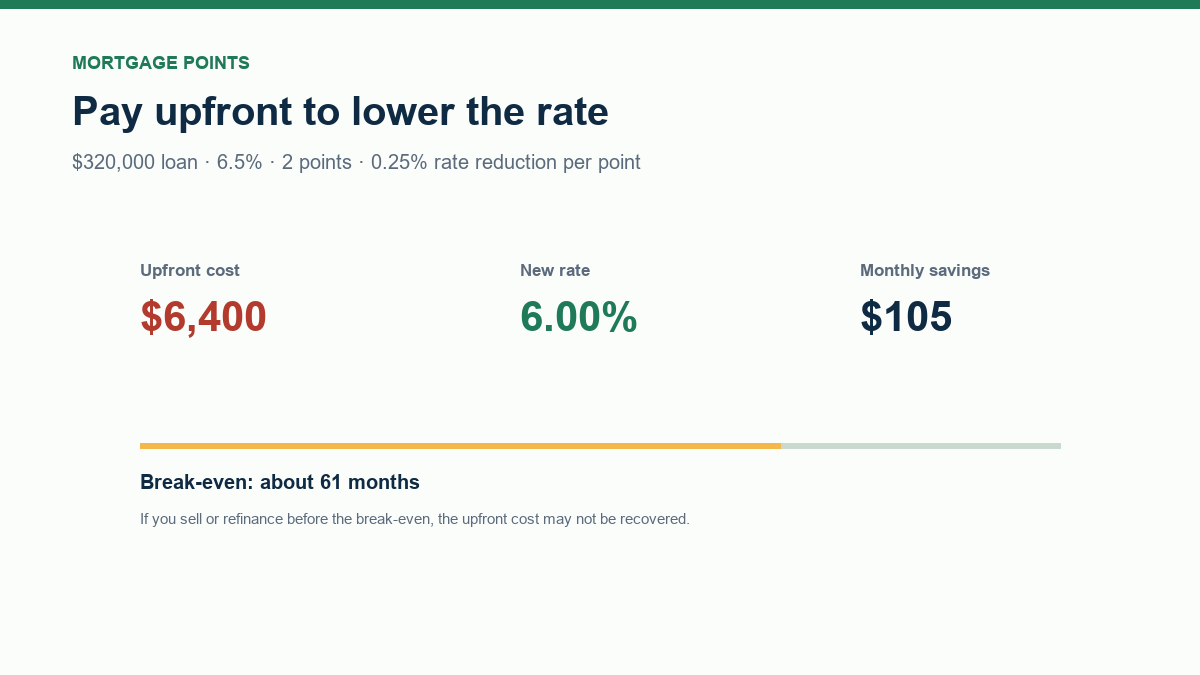
Example: a $320,000 loan at 6.5% for 30 years. Two points cost $6,400. If each point reduces the rate by 0.25%, the new rate is 6.00%. The monthly savings are about $105, so the break-even is about 61 months, or a little over five years.
When points can make sense
Points are more attractive when you plan to keep the loan for a long time, the rate reduction is meaningful, the loan is large, and the upfront cash does not reduce your emergency fund. A borrower who plans to stay for 10 years may recover the cost many times over; a borrower who refinances in three years may not.
Points can also be useful if you expect rates to stay stable and you value a lower fixed payment. But they are not a substitute for a larger down payment, an emergency fund, or paying down higher-interest debt.
When they do not
If cash is tight, points can leave you vulnerable. The upfront cost is gone even if you sell, refinance, or default later. If the rate reduction is small, the break-even may be longer than your expected holding period. If the lender’s fees are high, a no-points loan from another lender may be cheaper overall.
Do not compare a rate with points to a rate without points as if they were the same product. Ask each lender for a Loan Estimate showing the rate, points, closing costs, and monthly payment.
Compare lender credits and points
The opposite of paying points is accepting lender credits: a higher rate in exchange for the lender covering some closing costs. Points lower the rate and raise the upfront cash; credits raise the rate and lower the cash. The right choice depends on how long you will keep the loan and how much cash you need to preserve for reserves, repairs, or an emergency fund.
Ask for multiple Loan Estimates with the same loan amount and closing date. Compare the rate, points, lender credits, total closing costs, and monthly payment. A lower rate is not automatically the cheapest offer if the fees are higher or the credits are smaller.
What happens if you refinance
If you refinance before the break-even, the remaining benefit of the points usually disappears. Some lenders may roll the points into the new loan, but that does not recover the cash you already paid. Treat the break-even as a minimum holding period, not a target, and add a margin for uncertainty.
2026 calculator update: what changed
The linked calculator has been upgraded. It now includes a professional worksheet with the inputs used, the method and scope, and a one-variable sensitivity check for finance tools. You can save two input sets as Scenarios A/B and compare the results side by side. The Print / PDF action produces a branded worksheet, and table-producing calculators can export a CSV.
The page also explains why a bank, lender, broker, or provider can quote a different number: rate versus APR, fees, credit pricing, taxes, insurance, and timing. Use the written quote or Loan Estimate as the binding document, not the calculator estimate.
Points and break-even
One discount point usually costs 1% of the loan and lowers the rate. On a $400,000 loan, one point is $4,000. If the payment falls by $53 a month, the break-even is about 75 months. If you sell or refinance before that, the point may not pay for itself.
What to compare
Compare the point cost, the rate reduction, the monthly savings, and the break-even. A lower rate is not always worth the upfront cost.
Frequently asked questions
What is a mortgage point?
A discount point is an upfront fee equal to 1% of the loan amount that lowers the interest rate. Origination fees are separate.
How do I calculate the break-even?
Divide the point cost by the monthly payment savings. The result is the number of months needed to recover the upfront cost.
Are points tax deductible?
Points may be deductible in some situations. Ask a tax professional about your loan and filing situation.
Should I buy points?
It depends on the break-even, your cash reserves, and how long you expect to keep the loan.
Further reading
Keep exploring
Decision path