


Key takeaways
- Percentage and dollar raises are different. A $4,000 raise is 5.33% on $75,000, but 4% on $100,000.
- Pay frequency changes the paycheck. Biweekly pay has 26 periods; semi-monthly has 24.
- The hourly equivalent is not your hourly wage. It is annual salary divided by 2,080 hours.
- Gross is not net. Taxes, benefits, and retirement contributions reduce take-home pay.
- Compare with inflation. A raise can be positive in dollars and negative in purchasing power.
The basic math
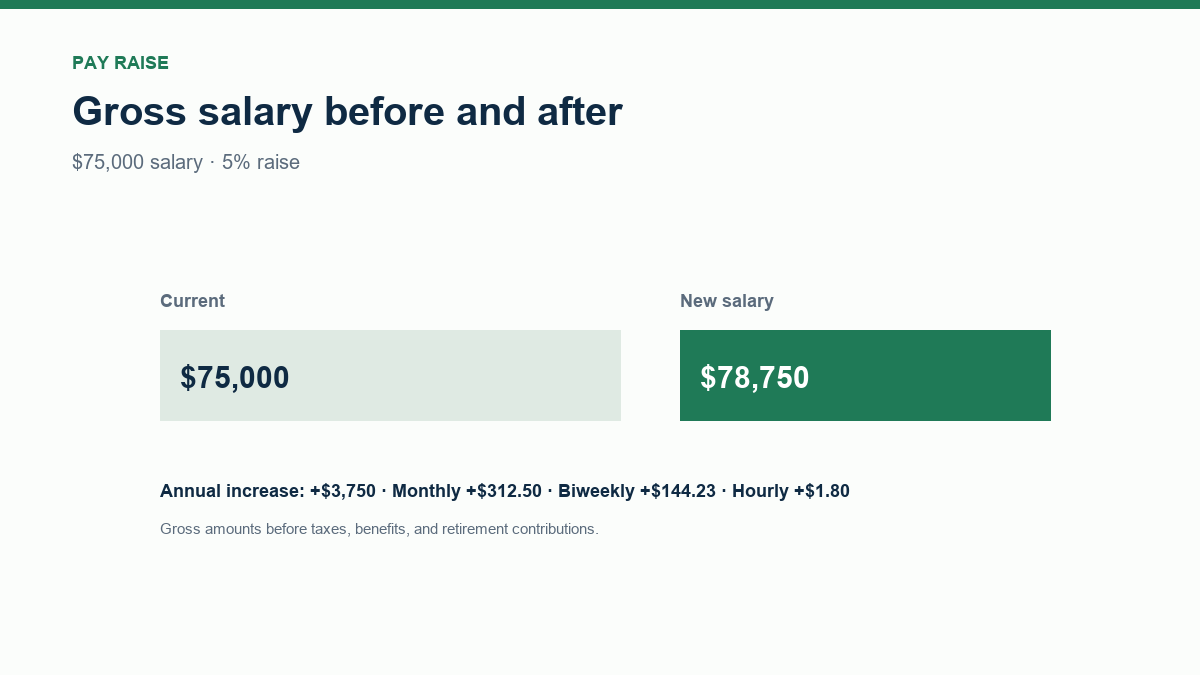
A percentage raise applies to the current salary. If you earn $75,000 and receive a 5% raise, the increase is $3,750, and the new salary is $78,750. A dollar raise is fixed: a $4,000 raise on $75,000 is 5.33%, but the same $4,000 on $100,000 is 4%.
To translate the annual increase into a paycheck, divide by the number of pay periods. Monthly is 12, biweekly is 26, weekly is 52, and semi-monthly is 24. The annual amount is the same, but the per-paycheck amount changes.
Hourly equivalent
Divide the annual salary by 2,080 to get a full-time hourly equivalent. That assumes 40 hours per week for 52 weeks, including paid time off. It is a useful comparison, not a promise that every hour is paid at that rate.
For a $3,750 annual raise, the hourly equivalent is about $1.80. That can look small, but it compounds across future raises and may affect overtime, bonuses, and retirement contributions.
Gross versus net
The calculator shows gross pay. Your take-home increase will be smaller because federal income tax, Social Security, Medicare, state tax, health insurance, and retirement contributions are withheld. A raise can also move part of your income into a higher tax bracket; that does not mean the entire raise is taxed at the higher rate.
If the raise changes benefit eligibility or overtime status, the net effect can be different from the simple percentage. Check the payroll details, not just the offer letter.
Real value and inflation
A 3% raise in a year with 4% inflation is a real pay cut. Compare the raise with the change in your actual costs: rent, food, insurance, transportation, and childcare. A raise that matches the headline inflation rate may still lag your personal basket of expenses.
Use the raise as a chance to adjust savings and debt payments. If lifestyle spending rises by the full amount, the raise does not improve financial resilience.
Negotiating the raise
Before the conversation, gather evidence: scope changes, results, market data for your role, and the additional responsibilities you have taken on. Ask for a specific number and a timeline. A raise can include base pay, a one-time bonus, extra paid time off, a title change, or a remote-work arrangement; the cash value of the package can be greater than the base percentage alone.
If the employer cannot change base pay, ask about a written review date, a bonus structure, or a professional development budget. Get the agreement in writing, including the effective date and any conditions.
Benefits and overtime
A raise can affect overtime pay, shift differentials, bonus targets, and retirement matching. If you are close to an overtime threshold or a benefits cutoff, model the full package rather than the salary line. A higher base can also increase the dollar value of a percentage-based retirement match, which is a real benefit that does not show up in take-home pay.
Comparing two offers
When comparing a raise with a new job offer, compare total compensation: base pay, bonus target, retirement match, health insurance, commute, and paid time off. A higher base can be offset by a worse match or a longer commute. Use the same annualisation method for both offers so the comparison is fair.
If the raise is below inflation, ask whether a one-time payment, an extra review, or a benefits improvement can close the gap. A written plan is better than a verbal promise.
2026 calculator update: what changed
The linked calculator has been upgraded. It now includes a professional worksheet with the inputs used, the method and scope, and a one-variable sensitivity check for finance tools. You can save two input sets as Scenarios A/B and compare the results side by side. The Print / PDF action produces a branded worksheet, and table-producing calculators can export a CSV.
The page also explains why a bank, lender, broker, or provider can quote a different number: rate versus APR, fees, credit pricing, taxes, insurance, and timing. Use the written quote or Loan Estimate as the binding document, not the calculator estimate.
Net raise
A raise increases gross pay, but taxes and deductions reduce the net. A 5% raise on $60,000 is $3,000 gross; after federal, state, and payroll tax, the net may be $2,200–$2,500. A raise can also affect credits and withholding. Compare the annual net, not only the percentage.
What to compare
Compare the gross raise, the net raise, and the change in benefits. A higher salary can be worth less if it reduces a credit.
Frequently asked questions
How do I calculate a percentage raise?
Multiply current salary by the raise percentage, then add the result to the salary. For example, 5% of $75,000 is $3,750.
How much is a $2 raise per hour annually?
At 40 hours per week and 52 weeks, $2 per hour is $4,160 per year before taxes.
Why are biweekly and semi-monthly different?
Biweekly pay has 26 periods; semi-monthly has 24. The annual amount is the same, but the per-paycheck amount differs.
Does this include taxes?
No. The calculator shows gross pay. Use a paycheck calculator for estimated net pay.
Further reading
Keep exploring
Decision path