


Key takeaways
- Weights matter as much as scores.
- High-weight categories move the grade the most.
- The final exam needed can be above 100%.
- Dropped scores and extra credit change the math.
- Check the syllabus before trusting a calculator.
A simple weighted average
Suppose homework is 30% of the grade and you have a 90%, quizzes are 30% and you have 85%, and projects are 20% and you have 80%. The weighted total so far is 90×0.30 + 85×0.30 + 80×0.20 = 27 + 25.5 + 16 = 68.5 out of 80, or 85.63%. The final exam is the remaining 20%.
If you want a 90% course grade, the final must make up the difference. The required score is (90 − 85.63×0.80) / 0.20 = 107.5%. That is above 100%, so the target is not reachable without extra credit.
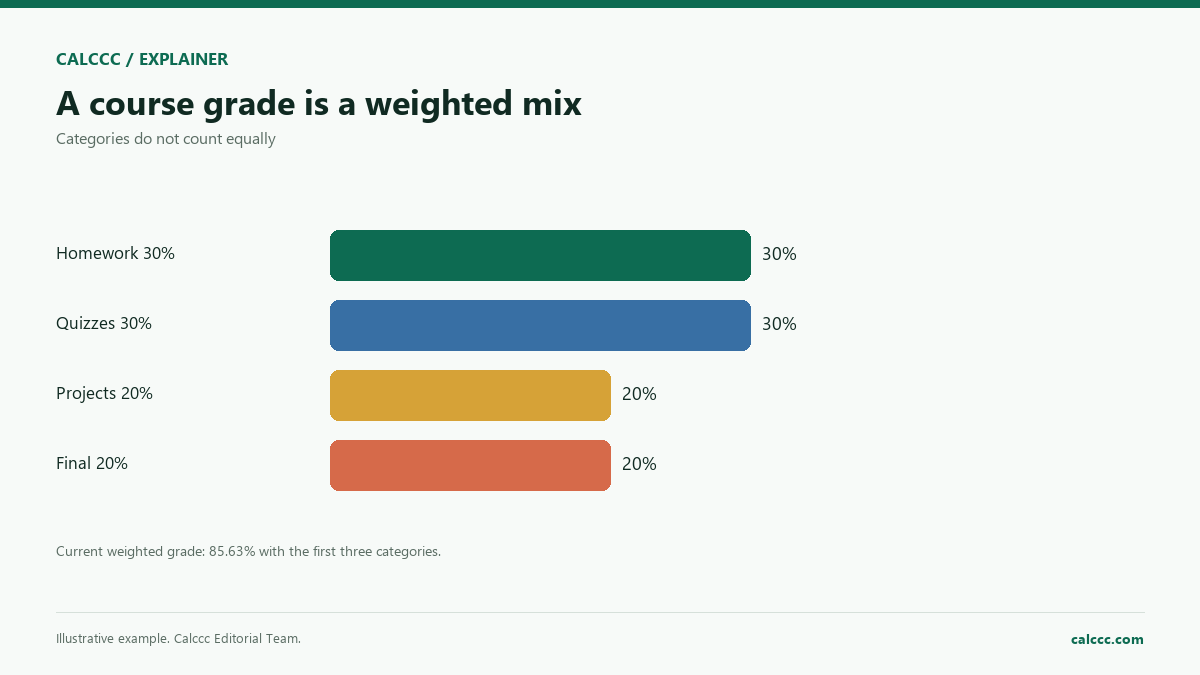
Why weights matter
A 10-point difference in a 40% category moves the course grade four points. The same difference in a 10% category moves it one point. That is why a strong final can rescue a course, and why a missed major project can be hard to recover from.
Finding the final score needed
Let C be the current weighted grade on the completed portion, F the final weight, and D the desired grade. The final score needed is (D − C × (1 − F)) / F, with F as a decimal. If the result is above 100, the target requires extra credit or a different grading policy.
What calculators cannot see
Schools may drop the lowest quiz, replace the final with a higher exam score, curve the class, or weight participation differently. Extra credit may be added after the average. The calculator uses the categories you enter, so it is only as accurate as your syllabus.
Points versus percentages
A category average is usually a percentage, but some syllabi use total points. If homework is 300 points and you earned 270, that is 90%. If the syllabus says homework is 30% of the grade, the 90% is weighted at 30%. Mixing points and percentages without converting is a common error.
Extra credit can be points added to a category or a separate line. It may be capped. Read the policy before assuming an extra-credit assignment will rescue the grade.
What if the final is optional?
Some courses let the final replace the lowest exam score or make it optional. In that case, the final weight is not simply added; the grading formula changes. The calculator assumes a fixed final weight. If your syllabus has a replace-lowest rule, the required score may be different.
Planning the rest of the term
Work backward from the target. If the final is worth 20%, you can see how much each remaining assignment matters. A low-weight quiz may be less important than a major project. That does not mean the quiz is unimportant for learning, but it helps you allocate time.
A target that is actually reachable
If the required final score is above 100%, set a realistic target instead. Ask the instructor whether extra credit is available and how it is weighted. Do not assume a curve will appear at the end of the term; curves are not guaranteed.
If the final is soon, focus on the highest-weight remaining material. A few points in a 30% category can be worth more than a perfect score on a low-weight quiz. Study the syllabus, not just the gradebook.
Check the grade scale
A 90% course grade may be an A at one school and an A− at another. The percentage is not the same as the letter grade. If you need a specific letter, check the school’s scale before setting the target in the calculator.
Frequently Asked Questions
What if my weights do not add to 100%?
Check the syllabus. Some courses use a different denominator, and some have categories not listed. The calculator normalizes the categories you enter.
Can the final score needed be above 100%?
Yes, mathematically. It means the target cannot be reached with the final alone unless extra credit exists.
How do I calculate a GPA?
GPA uses grade points and credit hours, not just percentages. Use a GPA calculator and your school’s grade scale.
Does a higher weight always mean a harder category?
No. It means the category counts more. A low-weight assignment can still be important for learning.
How we checked this guide
We checked the weighted average and final-score algebra by hand and compared the examples with the calculator. The article describes the math; your school’s policy controls the grade.
Weights
A weighted grade multiplies each score by its weight and divides by the total weight. If homework is 20%, quizzes 30%, and the final 50%, a 90, 80, and 70 gives 0.2×90 + 0.3×80 + 0.5×70 = 77. The weights must sum to 100% for the simple calculation.
What to compare
Compare the weighted score, the weights, and the remaining points. A high final weight makes the final exam decisive.
Check the weights in the syllabus before calculating.
Compare the result with the syllabus weights.
Now check it.
Compare the weighted result with the syllabus weights and the remaining points.
2026 calculator update: what changed
The linked calculator has been upgraded. It now includes a professional worksheet with the inputs used, the method and scope, and a one-variable sensitivity check for finance tools. You can save two input sets as Scenarios A/B and compare the results side by side. The Print / PDF action produces a branded worksheet, and table-producing calculators can export a CSV.
Further reading