


Key takeaways
- Both strategies pay minimums on every debt and put the remaining budget toward one target.
- Avalanche targets the highest APR; it is the mathematically cheaper order in most cases.
- Snowball targets the smallest balance; it can create faster psychological wins.
- The fair comparison uses the same total monthly budget and the same balances/rates.
- If the interest difference is small, behavior may matter more than the spreadsheet. If the difference is large, avalanche deserves a hard look.
How the two strategies actually work
Start with the minimum payment on every account. That keeps all debts current. Then take whatever is left in your debt budget and send it to one target. When the target is paid off, its minimum payment rolls into the next target. That is the “snowball” effect in both plans; the difference is the ordering rule.
- Snowball: smallest balance first. Quick closure; less regard for rate.
- Avalanche: highest rate first. More interest saved; the first win may take longer.
A worked comparison
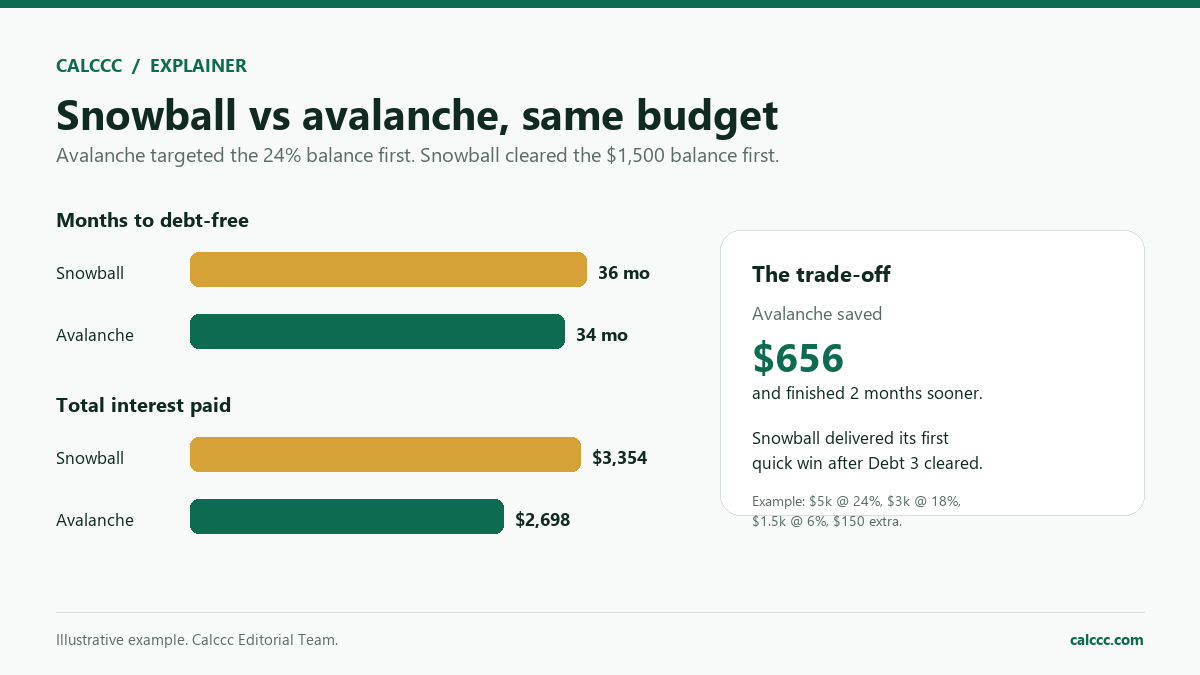
Consider three debts: $5,000 at 24%, $3,000 at 18%, and $1,500 at 6%. Minimums are $100, $75, and $50, and there is $150 extra per month. The total budget is $375.
| Strategy | Payoff order | Months | Total interest |
|---|---|---|---|
| Snowball | Debt 3 → Debt 2 → Debt 1 | 36 | $3,354 |
| Avalanche | Debt 1 → Debt 3 → Debt 2 | 34 | $2,698 |
Avalanche saves about $656 and finishes two months sooner in this example. Snowball closes the $1,500 account first, which may feel more motivating. Neither result is universal: change the balances, rates, or budget and the gap moves.
Why the math favors avalanche
Interest is charged on the balance. A dollar sent to the 24% account saves more future interest than a dollar sent to the 6% account. Avalanche exploits that by removing the most expensive dollars first. This is why personal-finance educators usually describe avalanche as the lower-cost method.
The advantage is not guaranteed to be large. If all rates are close, or the extra payment is large relative to the balances, the two orders can finish at nearly the same time. Run both calculations before assuming one is clearly better.
Why snowball still works for many people
A payoff plan only works if it survives a bad month. Snowball’s case is behavioral: closing an account gives a visible win, and the freed-up minimum can feel like momentum. The CFPB has published behavioral research on “small victories” and debt repayment, which is consistent with the idea that progress can affect persistence, though individual results vary.
That does not make snowball irrational. A slightly higher interest cost can be a reasonable price for a plan someone will maintain. The mistake is pretending the interest difference does not exist, or switching strategies every month and finishing neither.
What the comparison does not include
- New charges. Adding to a card can erase progress; the model assumes no new borrowing.
- Variable APRs. Rates can change with the prime rate or the issuer’s terms.
- Fees and hardship programs. Late fees, settlement offers, and hardship plans change the math.
- Taxes. Interest may be deductible in some situations; the calculator does not model taxes.
- Cash flow. A plan that leaves no emergency buffer can force new debt when a repair or medical bill arrives.
How to choose without overthinking it
- List every debt: balance, APR, minimum, due date.
- Set a total monthly debt budget you can sustain for at least six months.
- Run both strategies with that same budget.
- Compare total interest, months to debt-free, and the first payoff date.
- Pick one, automate the payments, and review only when a balance is cleared or income changes.
2026 calculator update: what changed
The linked calculator has been upgraded. It now includes a professional worksheet with the inputs used, the method and scope, and a one-variable sensitivity check for finance tools. You can save two input sets as Scenarios A/B and compare the results side by side. The Print / PDF action produces a branded worksheet, and table-producing calculators can export a CSV.
The page also explains why a bank, lender, broker, or provider can quote a different number: rate versus APR, fees, credit pricing, taxes, insurance, and timing. Use the written quote or Loan Estimate as the binding document, not the calculator estimate.
2026 calculator upgrade: both methods, one screen
The updated debt calculators now show a snowball-versus-avalanche comparison table and an annual balance schedule. The same budget is applied to both methods, so the difference in months and interest is a like-for-like comparison. Use A/B scenarios to compare extra-payment amounts.
Frequently asked questions
Is avalanche always better?
It is usually cheaper in interest, but not always by much. If the gap is small, the plan you will maintain can matter more. If the gap is large, avalanche is the stronger financial choice.
Should I stop investing to pay debt?
That depends on the rate, the employer match, and the emergency fund. A 24% credit card is usually a more urgent priority than a low-rate retirement loan. Capture any employer match you would otherwise forfeit, then compare the debt rate with the expected after-tax return.
What if I cannot cover the minimums?
Do not rely on a payoff calculator for a cash-flow crisis. Contact the lender or a nonprofit credit counselor; the CFPB has guidance on debt and credit counseling. Missing payments damages credit and can trigger fees.
Does the calculator handle more than three debts?
The current form supports three debts. Combine smaller debts or use the three largest for an estimate, then check the result with a fuller budget.
How we checked this guide
We ran both strategies through the same payoff engine with identical balances, APRs, minimums, and extra payment. The figures above come from that run. We also reviewed the CFPB’s consumer debt materials and Federal Reserve consumer-credit data for context. The example is illustrative, not a prediction of your payoff date.
Further reading
Keep exploring
Decision path