


Key takeaways
- Minimum payments are calculated to satisfy the issuer, not to clear the balance quickly.
- High APR makes a low payment expensive over time.
- The gap between the minimum and a fixed payment is often the fastest lever.
- New charges can erase progress; stop adding to the balance first.
- Ask for the issuer’s payoff estimate and the interest rate in writing.
What “minimum payment” means
Credit card statements show a minimum payment, often a small percentage of the balance or a flat floor such as $25. The issuer sets the formula. The minimum is designed to keep the account in good standing and to collect interest over a long period.
When you pay only the minimum, most of the payment goes to interest and a small amount goes to principal. As the balance falls, the minimum may also fall, which stretches the payoff further. This is why a balance can feel like it never moves.
The math on a $5,000 balance
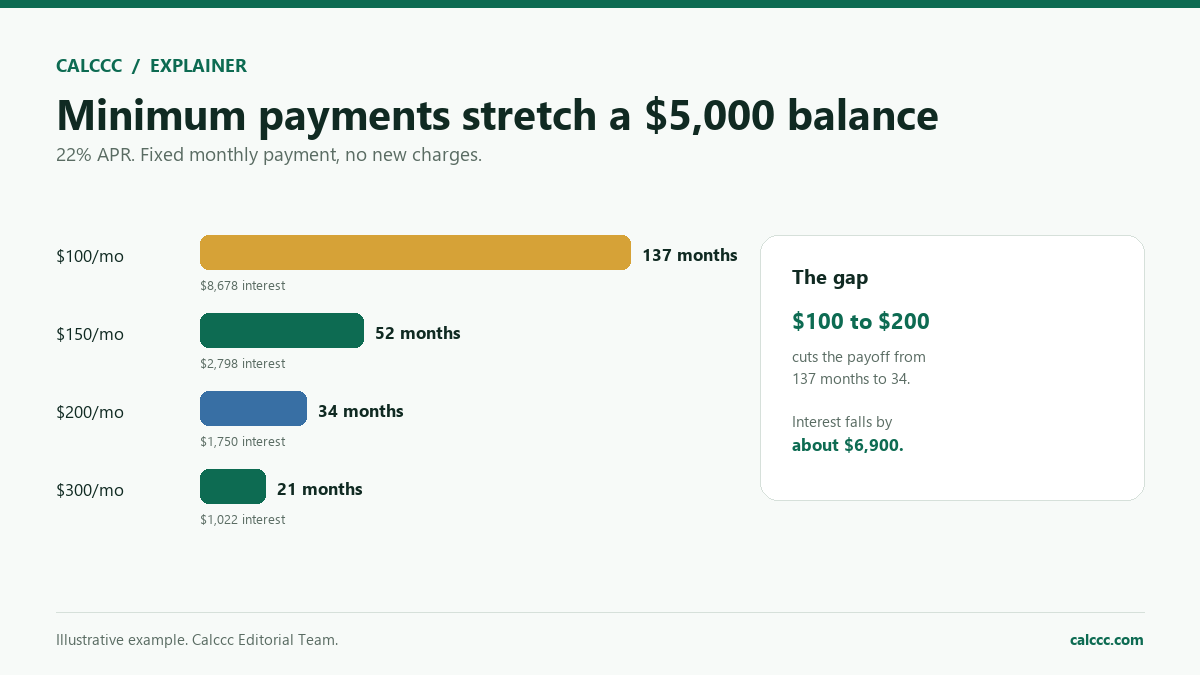
Assume a 22% APR and a fixed payment. Using a fixed payment makes the comparison clearer; a percentage-based minimum would decline over time and could take even longer.
| Monthly payment | Months to pay off | Total interest |
|---|---|---|
| $100 | 137 | $8,678 |
| $150 | 52 | $2,798 |
| $200 | 34 | $1,750 |
| $300 | 21 | $1,022 |
At $100 a month, the balance takes more than 11 years to clear. At $200, it takes less than three. The difference is not just discipline; it is the compounding cost of carrying a high APR.
Why the minimum feels smaller over time
Many issuers calculate the minimum as a percentage of the balance, such as 1–3%, subject to a floor. As the balance drops, the minimum drops too. That is convenient for cash flow but bad for payoff speed. If you can, pay a fixed amount above the minimum instead of letting the required payment shrink.
Three practical ways out
1. Pick a fixed payment you can sustain
Use the calculator to find a payment that clears the balance in a timeframe you can live with. Automate it on payday so it happens before spending. Even $50 more than the minimum can make a visible difference.
2. Stop adding new charges
A payoff plan assumes the balance goes down. If you keep charging, the plan is leaking. Switch recurring bills to a debit card or cash while you pay down the card, or use a separate card with a strict limit.
3. Attack the most expensive balance first
If you have several cards, list the APRs. The avalanche method sends extra money to the highest rate. The snowball method targets the smallest balance for a quick win. Both work; the best one is the one you will follow. The credit card payoff calculator can compare the order.
Balance transfers and consolidation
A 0% balance transfer can save interest, but it usually charges a transfer fee (often 3–5%) and a higher rate after the promotional period. It can be useful if you can pay the balance before the promo ends. It is not a fix if you keep spending on the old card.
A debt consolidation loan replaces multiple payments with one. Compare the new APR, term, and fees with the weighted average of your current debts. A longer term can lower the payment while increasing total interest.
What not to do
- Do not pay only the minimum while charging new purchases.
- Do not use a cash advance to pay a credit card; the fees and rate are usually worse.
- Do not ignore a statement; late fees and penalty APRs can undo progress.
- Do not choose a plan that leaves no emergency buffer; a small emergency can push you back to the card.
2026 calculator update: what changed
The linked calculator has been upgraded. It now includes a professional worksheet with the inputs used, the method and scope, and a one-variable sensitivity check for finance tools. You can save two input sets as Scenarios A/B and compare the results side by side. The Print / PDF action produces a branded worksheet, and table-producing calculators can export a CSV.
The page also explains why a bank, lender, broker, or provider can quote a different number: rate versus APR, fees, credit pricing, taxes, insurance, and timing. Use the written quote or Loan Estimate as the binding document, not the calculator estimate.
2026 calculator upgrade: see the minimum-payment cost
The updated credit card payoff calculator now compares your payment with a minimum-payment scenario. Set the minimum percentage and dollar floor in Advanced options, then review the comparison table: months, total interest, and total paid. The gap is the cost of paying only the minimum.
Frequently asked questions
Is it bad to pay only the minimum?
It keeps the account current, but it is an expensive way to carry a balance. If you can pay more, do. If you cannot, contact the issuer about hardship options before you miss a payment.
Will paying more hurt my credit?
Paying more and lowering utilization usually helps credit over time. Closing the account can hurt utilization and history length; paying it off does not require closing it.
Should I pay the smallest balance or the highest rate first?
Avalanche (highest rate) usually saves the most interest. Snowball (smallest balance) can provide motivation. The calculator can show both with the same budget.
Can I negotiate a lower APR?
Sometimes. Call the issuer, ask for a hardship or retention review, and get any change confirmed in writing. A lower rate can shorten the payoff noticeably.
How we checked this guide
We calculated each payoff with the same balance and APR, using a fixed monthly payment so the comparison is fair. Real issuer minimums may be percentage-based and may change. The CFPB’s minimum-payment guidance and the Federal Reserve’s consumer-credit data were used for context.
Further reading
Keep exploring
Decision path