


Key takeaways
- Minimum payments keep the account current but can stretch a balance for years.
- Avalanche targets the highest APR; snowball targets the smallest balance.
- Balance transfers can reduce interest but add fees and a deadline.
- Consolidation simplifies payments; compare the new APR and term.
- The best plan is the one you can automate and sustain.
Start with the numbers
Before choosing a method, list every card: balance, APR, minimum payment, due date, and credit limit. Then add up the minimums. The difference between your total minimum and the amount you can actually pay is your “extra.” That extra is the engine of every payoff plan.
If the minimums already exceed your budget, a payoff calculator is not the first tool. Contact the issuers or a nonprofit credit counselor; missed payments and penalty APRs make everything harder.
Method 1: pay only the minimum
This is the slowest and most expensive option. It keeps the account in good standing, but the payment is designed to satisfy the issuer, not to clear the balance quickly. On a high APR, most of the minimum goes to interest.
Minimums can also fall as the balance drops, which stretches the timeline. If you use this method, at least keep the payment fixed at the original amount.
Method 2: snowball
Pay the minimum on every card, then send the extra to the smallest balance. When it is gone, roll its payment into the next smallest. The math is simple, and the first closed account can be motivating.
The trade-off is interest. A small balance may have a low rate, while a larger balance has a high one. Snowball may cost more than avalanche, but a plan you finish is better than an optimal plan you abandon.
Method 3: avalanche
Pay the minimum on every card, then send the extra to the highest APR. This usually minimizes interest and can shorten the payoff. The first win may take longer because the highest-rate balance may not be the smallest.
Avalanche is the stronger mathematical choice when the rate gap is large. If the gap is small, the behavioral advantage of snowball may outweigh the interest difference.
Method 4: balance transfer
A balance transfer moves debt to a new card, often with a 0% promotional APR for a set period. It can save real interest if you pay the balance before the promo ends. Watch the transfer fee (often 3–5%), the regular APR after the promo, and the credit limit.
A balance transfer is not a payoff plan by itself. If you keep spending on the old card or miss the promo deadline, the new rate can be worse than what you had.
Method 5: consolidation loan
A personal loan can replace multiple card payments with one fixed payment. It may have a lower APR than the cards, especially for borrowers with good credit. Compare the total cost, not just the monthly payment: a longer term can lower the payment while increasing interest.
Also check whether the loan has an origination fee and whether paying off the cards hurts your credit utilization. Keeping the accounts open (but unused) may help your credit history, but only if you can resist using them.
| Method | Best for | Main risk |
|---|---|---|
| Minimum only | Temporary cash-flow crunch | Years of interest; slow progress |
| Snowball | Motivation and simplicity | Higher interest than avalanche |
| Avalanche | Minimizing interest | First win may take longer |
| Balance transfer | Short-term 0% window | Fees and promo deadline |
| Consolidation | Simplifying multiple payments | Longer term can cost more |
How to choose in five minutes
- Add up the minimums and decide your total monthly debt budget.
- List APRs and balances.
- Run snowball and avalanche with the same budget.
- Check whether a balance transfer or consolidation actually lowers the total cost after fees.
- Pick one, automate it, and review when a balance is cleared.
2026 calculator update: what changed
The linked calculator has been upgraded. It now includes a professional worksheet with the inputs used, the method and scope, and a one-variable sensitivity check for finance tools. You can save two input sets as Scenarios A/B and compare the results side by side. The Print / PDF action produces a branded worksheet, and table-producing calculators can export a CSV.
The page also explains why a bank, lender, broker, or provider can quote a different number: rate versus APR, fees, credit pricing, taxes, insurance, and timing. Use the written quote or Loan Estimate as the binding document, not the calculator estimate.
2026 calculator upgrade: compare fixed and minimum payments
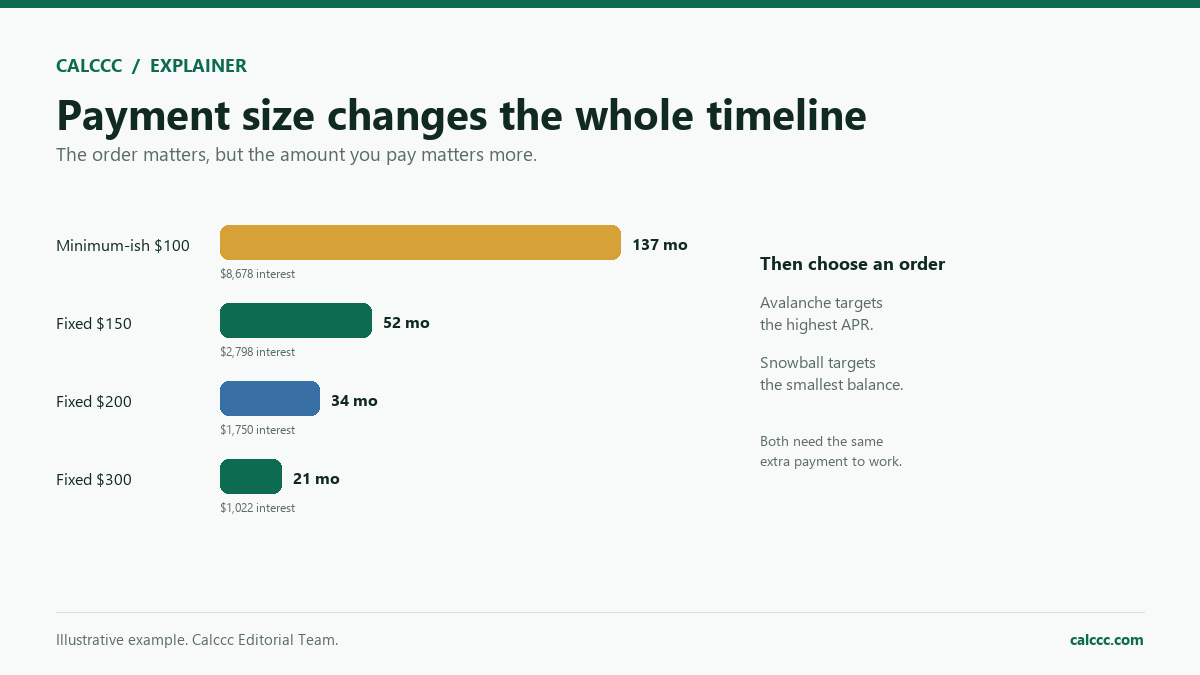
The payoff calculator now shows a minimum-payment comparison alongside the fixed-payment schedule. Use A/B scenarios to compare two payment amounts, and check the year-by-year table before choosing a method. The minimum-payment estimate uses your percentage and dollar floor; issuer rules vary.
Frequently asked questions
Which method pays off the fastest?
Avalanche usually finishes fastest when the highest-rate balance is large, because it reduces the most expensive interest. Snowball can finish close behind if balances are similar.
Is a balance transfer worth it?
It can be, if the fee is low, the promo period is long enough, and you can pay the balance before the regular APR starts. It is not worth it if you keep adding new charges.
Should I close the cards after paying them off?
Closing can reduce your available credit and hurt utilization. Keeping them open with a small recurring charge can help history length, but only if you pay in full each month.
What if I cannot pay the minimums?
Contact the issuers before you miss a payment and consider a nonprofit credit counselor. The CFPB has consumer resources on debt and credit cards.
How we checked this guide
We compared payoff terms for a $5,000 balance at 22% APR using fixed monthly payments, then reviewed the CFPB’s credit-card and debt-consolidation guidance. The chart shows payment size, not a claim that one order is universally best. Real APRs and fees vary.
Further reading
Keep exploring
Decision path