


Key takeaways
- Primer improves adhesion, blocks stains, and helps cover a strong color.
- Bare drywall, patched areas, and glossy surfaces usually need primer.
- A “paint and primer in one” product is not the same as a dedicated primer.
- Primer has its own coverage; budget it separately.
- Ventilation and lead-safe precautions matter, especially in older homes.
What primer actually does
Primer is a preparatory coating. It creates a consistent surface for the topcoat, helps paint stick, and can block stains or odors. Think of it as the base layer that makes the finish coat look better and last longer.
Primer is not just “cheap paint.” It has different resins and pigments for different jobs. A drywall primer is not the same as a stain-blocking primer or a bonding primer for glossy surfaces.
When primer is usually worth it
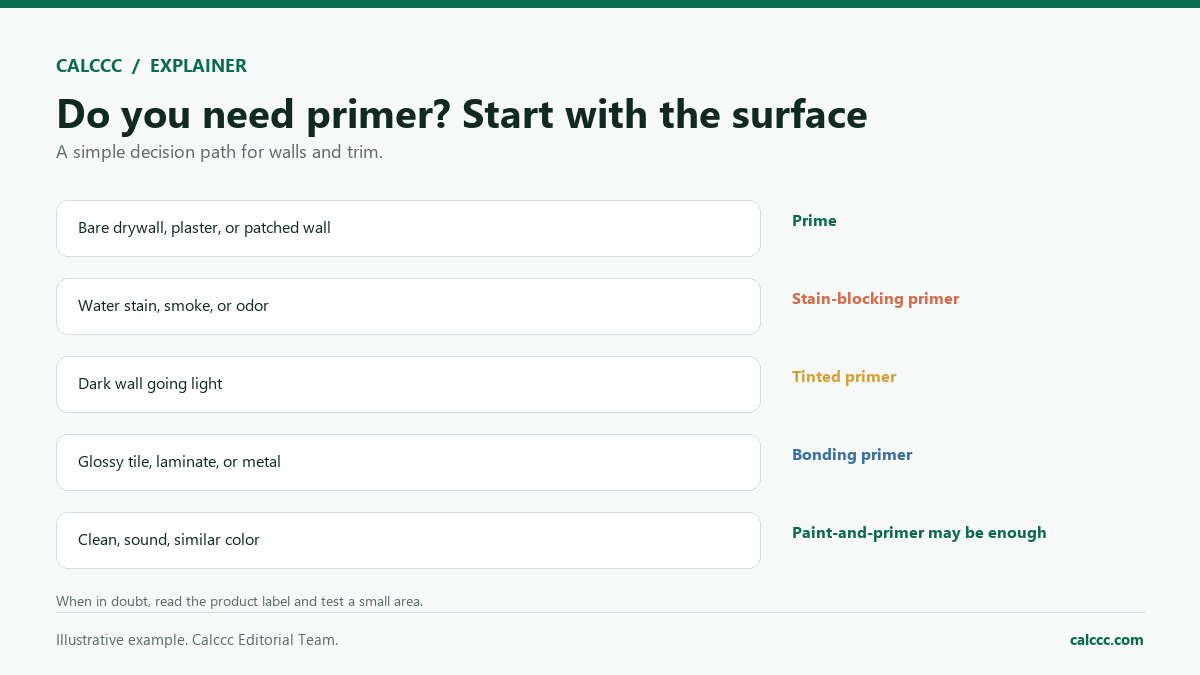
- Bare drywall or plaster: porous surfaces absorb paint unevenly.
- Patched or repaired walls: patching compound can flash through the topcoat.
- Dark-to-light color changes: a tinted primer can reduce the number of finish coats.
- Stains and odors: water stains, smoke, and pet odors may need a stain-blocking primer.
- Glossy or slick surfaces: a bonding primer helps paint adhere.
- Bare wood or metal: the right primer prepares the surface and can inhibit rust.
When you can usually skip it
If the wall is clean, sound, previously painted, and you are applying a similar color with a quality interior paint, a separate primer may not be necessary. “Paint and primer in one” products are formulated to perform both jobs in many routine repaints. They are convenient, but they are not a dedicated stain blocker or bonding primer.
Skip primer only when the surface is already stable. Painting over grease, dust, peeling paint, or mold is not a shortcut; it is a future failure.
Primer types in plain English
| Primer type | Use it for | Notes |
|---|---|---|
| Drywall primer | New or patched drywall | Seals porosity and evens absorption. |
| Stain-blocking primer | Water stains, smoke, tannin, odors | Shellac- or oil-based options may be needed. |
| Bonding primer | Glossy tile, laminate, metal, slick surfaces | Improves adhesion; surface prep still matters. |
| Tinted primer | Dark-to-light color changes | Can reduce topcoat count; ask the paint desk to tint. |
| Exterior primer | Bare wood, masonry, metal outdoors | Weather resistance and adhesion differ from interior. |
Primer coverage and cost
Primer has its own coverage, often similar to paint but sometimes lower on porous surfaces. Do not assume the paint estimate covers the primer. Measure the area, check the primer label, and add a waste allowance. A separate primer coat can add a day and a can of product, but it can also save a finish coat and improve durability.
If you are covering a dark wall with a light color, a tinted primer can be cheaper than three coats of premium paint. If you are repainting a clean white wall white, the primer may be unnecessary.
Safety and older homes
Paint and primer fumes can irritate eyes, nose, and throat. Ventilate the room, use the manufacturer’s recommended respirator if needed, and keep children and pets away until the area is dry. In homes built before 1978, assume lead-based paint may be present until tested. Do not dry-sand or dry-scrape lead paint; use lead-safe work practices or hire a certified professional.
2026 calculator update: what changed
The linked calculator has been upgraded. It now includes a professional worksheet with the inputs used, the method and scope, and a one-variable sensitivity check for finance tools. You can save two input sets as Scenarios A/B and compare the results side by side. The Print / PDF action produces a branded worksheet, and table-producing calculators can export a CSV.
Primer coverage
Primer seals the surface and improves adhesion. It can be tinted toward the topcoat. Coverage is usually 300–400 sq ft per gallon, similar to paint. Bare drywall, repairs, and dark-to-light changes may need a primer; a clean, previously painted wall may not.
What to compare
Compare the surface, the primer type, and the coverage. A primer is not a substitute for surface preparation.
Now compare the surface, primer type, and coverage.
Compare the surface condition, the primer type, and the coverage rate before buying.
Frequently asked questions
Is primer always needed on bare drywall?
Yes, generally. Bare drywall is porous and can absorb paint unevenly. A drywall primer seals it and gives the topcoat a consistent surface.
Can I use primer as paint?
No. Primer is not formulated for durability, washability, or color. It is a base coat, not a finish.
Does paint-and-primer-in-one replace primer?
It can for routine repainting, but not for bare surfaces, stains, or adhesion problems. Use a dedicated primer when the surface needs one.
Can primer go over old paint?
Yes, if the old paint is clean, sound, and properly prepared. If it is peeling or chalky, repair or remove the loose material first.
How we checked this guide
We compared common primer guidance with EPA indoor-air and lead-paint resources, then checked the paint calculator’s area and coverage assumptions. Product labels vary; the article does not recommend a specific brand. The decision flow is a planning aid, not a substitute for reading the label.
Further reading