


Key takeaways
- One cubic yard = 27 cubic feet.
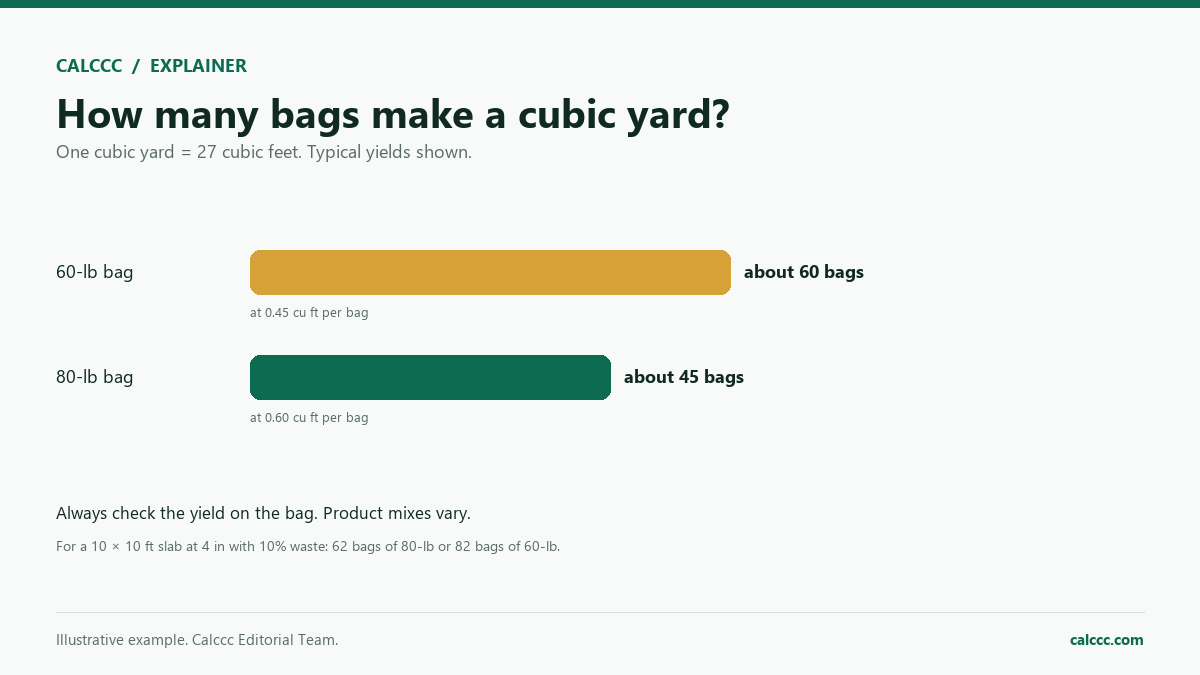
- 60-lb bags usually yield about 0.45 cu ft; 80-lb bags about 0.60 cu ft.
- Divide total cubic feet by bag yield, then round up.
- Add a waste allowance for spillage and uneven subgrade.
- Bags suit small jobs; ready-mix is usually better for large slabs.
Why bag size matters
Concrete is sold by volume, but bags are sold by weight. The same weight of different mixes can yield different volumes because the ingredients and density differ. That is why the yield on the bag is more reliable than a generic “one bag equals X” rule.
A 60-lb bag is easier to carry and mix. An 80-lb bag yields more per bag, which can mean fewer bags and less handling for a larger job. The trade-off is weight and mixing capacity.
The yield math
Bags = total cubic feet ÷ yield per bag
Example: a 10 × 10 ft slab, 4 inches thick. Volume = 100 × 4 ÷ 12 = 33.33 cubic feet. Add 10% waste = 36.67 cubic feet. At 0.60 cubic feet per 80-lb bag: 36.67 ÷ 0.60 = 61.1, so buy 62 bags. At 0.45 cubic feet per 60-lb bag: 36.67 ÷ 0.45 = 81.5, so buy 82 bags.
| Bag size | Typical yield | Bags per cubic yard |
|---|---|---|
| 60 lb | 0.45 cu ft | About 60 |
| 80 lb | 0.60 cu ft | About 45 |
Why the label wins
Different mixes have different proportions of cement, sand, gravel, and additives. A high-strength mix may weigh more per cubic foot, so a bag may yield less volume. A fast-setting mix may have a different yield. The bag label is the manufacturer’s tested number for that product.
If you cannot find the yield, use a conservative estimate and buy extra. Running short mid-pour is worse than having a few unopened bags left.
Bags vs. ready-mix
Bagged concrete is convenient for small jobs, fence posts, and repairs. For a large slab, ready-mix delivered by truck is usually faster and more consistent. It is ordered by the cubic yard, often with a minimum charge and a short-load fee. Compare the total cost, including delivery, mixing, and your time.
Mixing 60 bags by hand is a lot of work. If you are mixing in a wheelbarrow, plan the batch size so the concrete does not start setting before you place it.
Slab thickness and volume
Thickness drives volume. A 4-inch slab uses one-third of a foot of depth; a 6-inch slab uses half a foot. Going from 4 to 6 inches increases volume by 50%, not 2 inches of “extra.” Always convert inches to feet before multiplying.
For irregular shapes, divide the area into rectangles or use the area calculator, then apply the same depth. Add a separate allowance for footings or thickened edges.
Safety
Concrete dust contains silica. Wear eye protection, gloves, and a suitable respirator when mixing, and work in a well-ventilated area. Wet concrete is alkaline and can irritate or burn skin; wash promptly and protect your eyes. Follow the product’s safety data sheet.
2026 calculator update: what changed
The linked calculator has been upgraded. It now includes a professional worksheet with the inputs used, the method and scope, and a one-variable sensitivity check for finance tools. You can save two input sets as Scenarios A/B and compare the results side by side. The Print / PDF action produces a branded worksheet, and table-producing calculators can export a CSV.
Yield and waste
Bag yield is the volume mixed per bag. A 60 lb bag may yield about 0.45 cu ft; an 80 lb bag about 0.60 cu ft. Divide the total volume by the bag yield, then round up. Add 5–10% waste for spillage and uneven subgrade.
What to compare
Compare the bag yield, the volume, and the waste factor. Bag weights and yields vary by mix; read the label.
Compare the bag yield with the total volume before ordering.
Now compare it with the order quantity.
Compare the bag yield with the total volume and add a waste factor.
Frequently asked questions
How many 80-lb bags are in a yard?
At 0.60 cubic feet per bag, about 45 bags per cubic yard. At 0.45 cubic feet per 60-lb bag, about 60 bags.
How many bags for a 10 × 10 slab?
At 4 inches thick and 10% waste, about 62 bags of 80-lb mix or 82 bags of 60-lb mix, using the typical yields above.
Can I mix different bag sizes?
Yes, if the mixes are compatible and you calculate the total yield. Do not mix different product types without checking with the manufacturer.
Is ready-mix cheaper?
It depends on the job size, delivery fees, and your time. For large slabs, ready-mix is often more practical; for small repairs, bags are simpler.
How we checked this guide
We used the calculator’s volume method and the common 0.45/0.60 cubic-foot yields for 60-lb and 80-lb bags, then rounded up. Because yield varies by product, the article tells readers to use the bag label. Safety guidance is general and not a substitute for the product’s instructions.
Further reading