What this calculator does
Concrete for a slab is ordered by the cubic yard, while bags are sold by weight, so a conversion is needed before you buy. This calculator multiplies slab area by thickness, adds a waste allowance, and converts the result into cubic yards. It also estimates how many 60-lb or 80-lb bags would produce the same volume. For small jobs, bags are practical; for larger slabs, ready-mix delivered by truck is faster and more consistent.
How to use it
- Enter slab length, width, and thickness in inches.
- Set a waste allowance.
- Add a ready-mix price per cubic yard or a price per 80-lb bag.
- Review cubic yards, cubic feet, bag counts, and cost.
- Confirm slab thickness, reinforcement, and delivery with the supplier.
How it works
Example calculations
Example 1: 10 x 10 slab at 4 inches, 10% waste
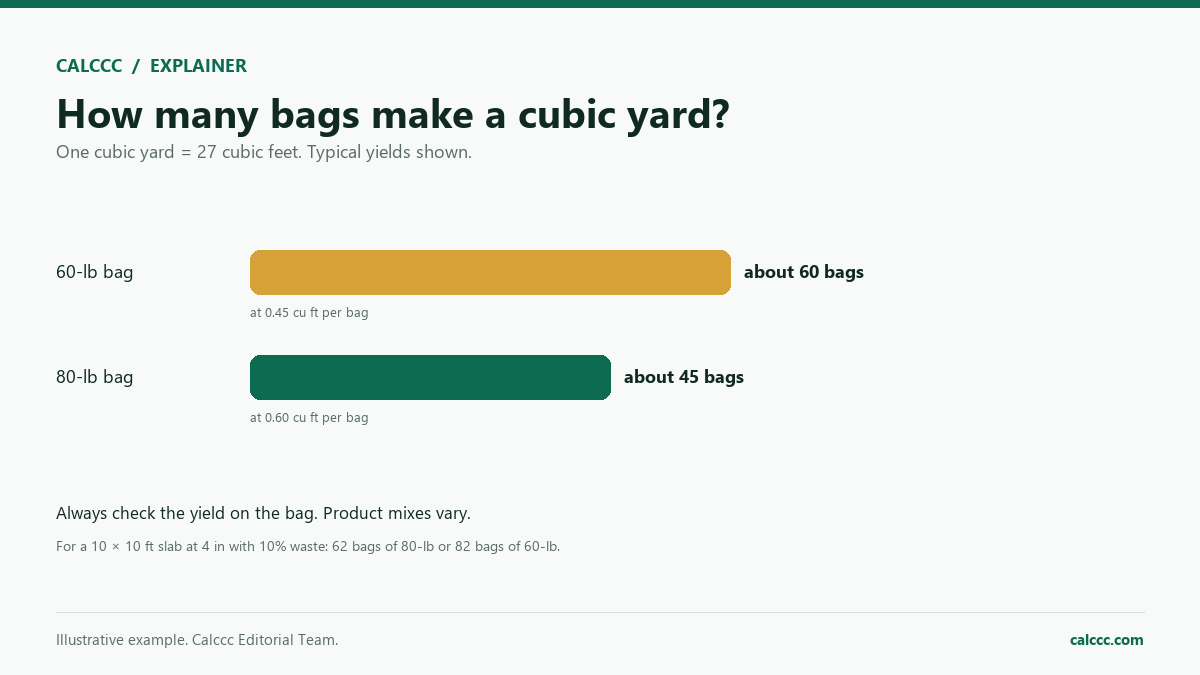
The slab has 100 square feet at 4 inches, or 33.33 cubic feet before waste. With 10 percent added, that is 36.67 cubic feet, or 1.36 cubic yards, which takes 82 bags of 60 lb or 62 bags of 80 lb.
Example 2: 20 x 20 slab at 6 inches, 5% waste
The slab has 400 square feet at 6 inches, or 200 cubic feet before waste. Five percent brings it to 210 cubic feet, or 7.78 cubic yards, which takes 467 bags of 60 lb or 350 bags of 80 lb.
Example 3: 12 x 8 slab at 3 inches, no waste
The slab has 96 square feet at 3 inches, which is 24 cubic feet, or 0.89 cubic yards. With no waste allowance, that is 54 bags of 60 lb or 40 bags of 80 lb.
What the result means
Cubic yards are the unit concrete suppliers use, so that is the number to quote for ready-mix. Bag counts are a convenience estimate: a 60-lb bag and an 80-lb bag contain different amounts of mixed concrete, and yield falls if you add extra water. Extra water also weakens the concrete, so mix to the stated consistency. For anything larger than a small patio, ready-mix is sold by the cubic yard with a minimum charge and a short delivery window, so have forms and help ready. Order a little extra rather than exactly the calculated volume, since running short mid-pour is costly.
Common mistakes
- Using slab area as volume without multiplying by thickness.
- Entering thickness in feet instead of inches.
- Rounding bag counts down instead of up.
- Buying bags with no spare for spillage and uneven subgrade.
- Adding extra water to stretch the mix and reducing its strength.
Assumptions and limits
- The slab is rectangular and of uniform thickness.
- The subgrade is level and properly prepared.
- The waste percentage covers spillage and minor over-excavation.
- Reinforcement, forms, and finishing materials are separate.
Frequently asked questions
How many 80-lb bags make a yard?
About 45 bags at 0.60 cubic feet per bag, but yield varies by mix and condition.
Should I order ready-mix or bags?
Bags suit small jobs; ready-mix is usually better for larger slabs. Compare cost, delivery, and mixing capacity.
Does thickness include the base?
No. Thickness is the concrete slab only; gravel base and reinforcement are separate.
How much waste should I add?
A common starting point is 5–10%, depending on formwork, spillage, and uneven subgrade.
Does this include delivery?
No. Delivery, short-load fees, and taxes are not included.
Sources
2026 update
How to use the professional output
This page is not just a formula box. The result is designed to be checked, compared, and taken away.
- Professional worksheet. The result includes the inputs used, the method and scope, and a one-variable sensitivity check for finance calculators.
- A/B scenarios. Save two input sets in the browser and compare the primary, secondary, and breakdown figures side by side.
- Print / PDF and CSV. Print a branded worksheet, or export the year-by-year table when the calculator produces one.
The formulas and assumptions above still govern the number. The worksheet makes the estimate auditable; it does not make it a lender quote, tax return, or personalized advice.
Go deeper