What this calculator does
Business days are the weekdays most offices actually work, and they matter for delivery windows, contract deadlines, bank processing, and school schedules. This calculator counts them between two dates without making you tick days off a paper calendar. It also shows the total number of calendar days, how many of those fall on a weekend, and how many weeks the span covers.
How to use it
- Enter the start date.
- Enter the end date.
- Review business days, total calendar days, weekend days, and weeks.
- Check whether your deadline includes the start date or the end date.
- Subtract any holidays your workplace observes, since the count does not.
How it works
Example calculations
Example 1: New Year to the start of March
From January 1, 2026, to March 1, 2026, is 59 total calendar days. Of those, 42 are business days and 17 are weekend days. The span is about 8.4 weeks. New Year's Day falls on a Thursday and is counted, because federal holidays are not removed.
Example 2: a fall quarter across the holidays
From September 15, 2026, to December 25, 2026, is 101 calendar days, or about 14.4 weeks. The range contains 73 business days and 28 weekend days. Thanksgiving, on Thursday, November 26, is counted like any other weekday; Christmas Day is the end date, so it sits outside the count.
Example 3: a summer quarter
From June 1, 2026, to September 1, 2026, is 92 calendar days, with 66 business days and 26 weekend days. That is about 13.1 weeks. Independence Day falls on a Saturday that year, so it does not reduce the weekday count, and Labor Day comes after the range ends.
What the result means
The exclusion rule is the part people get wrong. The end date is a boundary, not a day in the count, so January 1 to March 1 gives 59 days rather than 60. If a deadline says within 30 business days of the start date, the start date is often treated as day one, which is a different rule from the one used here. The holiday caveat matters just as much: a weekday holiday is still counted, so a range that crosses Thanksgiving, Christmas, or New Year's Day overstates the working days your office really has. The weekend figure is a quick check, because business days plus weekend days always equal total calendar days.
Common mistakes
- Counting the end date as a business day when the rule excludes it.
- Assuming U.S. federal holidays are already removed from the total.
- Using business days for a deadline that is actually stated in calendar days.
- Forgetting that a weekend at either end of the range changes the weekday count.
- Confusing weeks with business weeks, which count five days each.
Assumptions and limits
- Both dates are valid dates in the Gregorian calendar.
- The start date is included in the count and the end date is not.
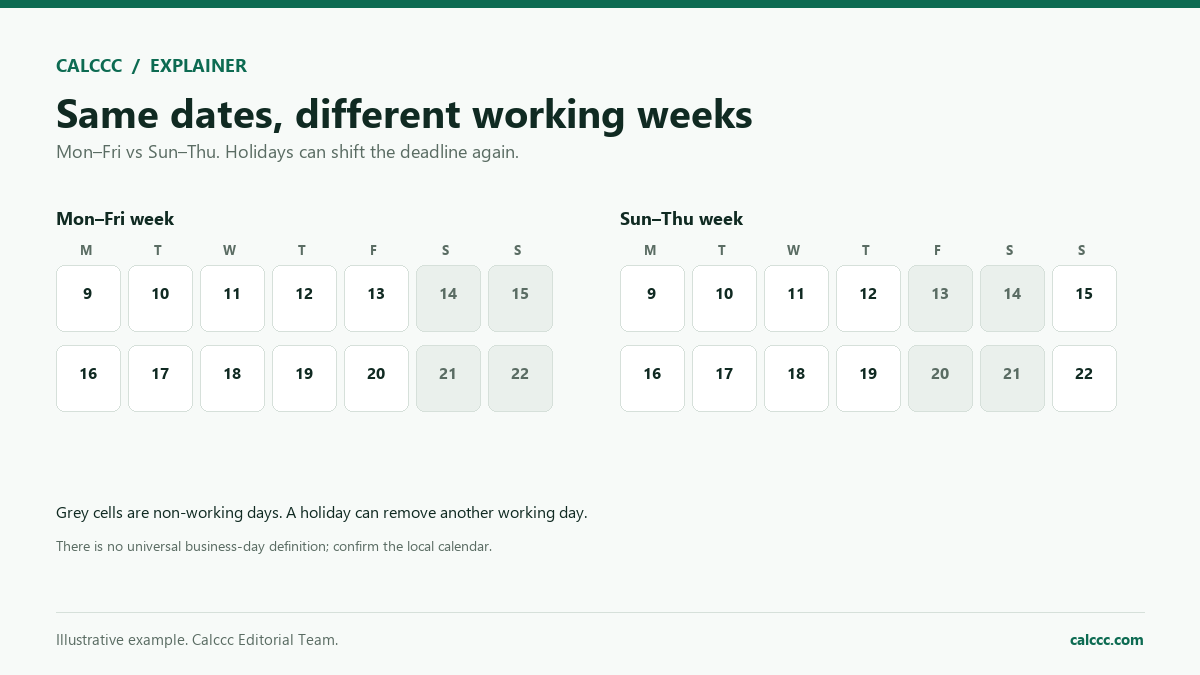
- Saturday and Sunday are the only weekend days; no other weekly rest day is applied.
- No federal, state, local, or company holidays are removed.
- Each date is a whole day starting at midnight, with no time zone or partial-day adjustment.
Frequently asked questions
Is the start date counted?
Yes. If the start date is a weekday, it counts as the first business day. The end date does not count, so the range ends on the day before it.
Are weekends excluded?
Yes. Saturday and Sunday are skipped. That is why the business-day figure is lower than the total calendar days, and why the weekday count plus the weekend count always matches the total.
Are U.S. federal holidays excluded?
No. A holiday that falls on a weekday is counted like any other weekday. If your office closes for New Year's Day, Martin Luther King Jr. Day, Thanksgiving, or Christmas, subtract those dates yourself.
What does weeks mean?
It is total calendar days divided by 7, shown to one decimal place. A span of 59 days is about 8.4 weeks. It is a calendar measure, not a count of five-day work weeks.
Why does this differ from my payroll or HR system?
Payroll systems usually remove company holidays and may use a different work week, such as Sunday through Thursday. They may also count the end date. Compare the rules before relying on either number.
Can I use this for a within 10 business days deadline?
You can get the raw weekday count, but read the deadline wording carefully. Decide whether day one is the start date or the following day, then subtract any holidays your organization observes.
Sources
2026 update
How to use the professional output
This page is not just a formula box. The result is designed to be checked, compared, and taken away.
- Professional worksheet. The result includes the inputs used, the method and scope, and a one-variable sensitivity check for finance calculators.
- A/B scenarios. Save two input sets in the browser and compare the primary, secondary, and breakdown figures side by side.
- Print / PDF and CSV. Print a branded worksheet, or export the year-by-year table when the calculator produces one.
The formulas and assumptions above still govern the number. The worksheet makes the estimate auditable; it does not make it a lender quote, tax return, or personalized advice.
Go deeper