


Key takeaways
- The federal default is 1.5x the regular rate after 40 hours in a workweek.
- The regular rate can include bonuses, shift differentials, and commissions.
- A salary does not automatically mean no overtime.
- Some states require daily overtime or a higher multiplier.
- A blended hourly rate averages regular and overtime pay; it is not the overtime rate.
Start with the workweek
Overtime is generally counted in a fixed, repeating workweek of 168 hours. It does not have to match the calendar week or a pay period. If a pay period covers two workweeks, each week stands on its own. Mixing hours from two weeks can hide overtime or create it where none exists.
For a standard full-time schedule, hours one through 40 are regular hours and hours above 40 are overtime hours. The calculator lets you enter both parts separately. That matters because the premium applies only to the overtime portion, not to every hour on the clock.
What counts in the regular rate
The regular rate is the hourly rate actually paid for the workweek. It can include nondiscretionary bonuses, shift differentials, production bonuses, and some commissions. If those payments are tied to performance or expected as part of the job, they may need to be spread across the hours worked before overtime is calculated.
Discretionary bonuses are different. A truly discretionary bonus is not announced in advance and is not part of a promise or contract. The distinction is fact-specific, so a payroll specialist or the U.S. Department of Labor should be consulted when the answer is unclear.
A worked example
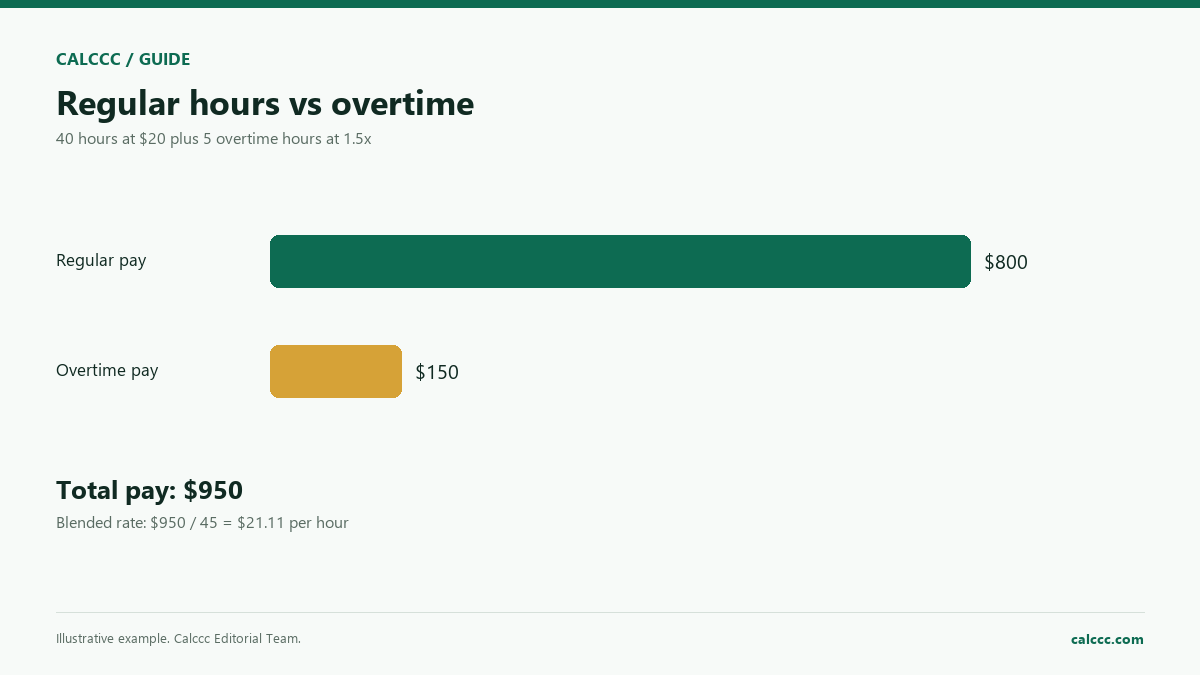
Suppose an employee earns $20 per hour and works 45 hours in a workweek. Regular pay is 40 × $20 = $800. Overtime pay is 5 × $20 × 1.5 = $150. Total pay is $950. The blended hourly rate is $950 ÷ 45 = $21.11, which is useful for comparing weekly pay but is not the rate used to calculate the overtime premium.
If the same employee worked 50 hours with 10 overtime hours at double time, regular pay would be $800 and overtime pay would be 10 × $20 × 2 = $400, for $1,200 total.
| Hours | Rate | Pay |
|---|---|---|
| 40 regular | $20.00 | $800.00 |
| 5 overtime at 1.5x | $30.00 | $150.00 |
| Total | $950.00 | $950.00 |
Salary is not the test
Being paid a salary does not automatically make an employee exempt. The exemption usually depends on the duties performed and whether the salary meets the applicable threshold. Some salaried employees are entitled to overtime; some hourly employees may be exempt in specific roles. Job titles are not decisive either.
If you are unsure, keep records of hours, pay, and the basis for any bonus. A payroll professional can test the classification against the current rules. The calculator can show the arithmetic, but it cannot decide whether overtime is legally owed.
State and daily overtime
Federal law is a floor, not a ceiling. Some states require overtime after eight hours in a day, after a certain number of consecutive days, or at a higher multiplier. A few require both daily and weekly calculations, and the employee generally receives the higher amount. If you work in a state with daily overtime, a 10-hour day can create two overtime hours even if the week stays under 40.
Contracts and union agreements can also provide more than the legal minimum. Read the pay policy and the applicable agreement before assuming the federal default is the whole story.
Checking a paycheck
Compare the hours on the stub with your own record. Check the regular rate, the overtime multiplier, and whether bonuses were included. If the stub shows a blended rate, confirm that it was not used to calculate the premium. Ask for a breakdown if the pay does not reconcile; payroll systems can apply a different rounding rule or week boundary.
Frequently Asked Questions
Is overtime always 1.5x?
No. Federal law sets 1.5x for many covered employees, but state law, a contract, or a policy can require more. Some employers offer double time voluntarily or for specific days.
Does a salary mean no overtime?
No. Exemption depends on duties and salary basis/threshold, not the label alone.
Are bonuses included?
Nondiscretionary bonuses often must be included in the regular rate. Truly discretionary bonuses may be treated differently. The details matter.
Can my employer give comp time instead?
Private-sector employers generally cannot substitute comp time for overtime pay for non-exempt employees. Public agencies have limited exceptions.
How we checked this guide
We compared the calculator’s arithmetic with the U.S. Department of Labor’s overtime guidance and Fact Sheet #23, and checked the worked examples by hand. The article describes the federal default; it does not give legal advice or decide an individual’s exemption status.
2026 calculator update: what changed
The linked calculator has been upgraded. It now includes a professional worksheet with the inputs used, the method and scope, and a one-variable sensitivity check for finance tools. You can save two input sets as Scenarios A/B and compare the results side by side. The Print / PDF action produces a branded worksheet, and table-producing calculators can export a CSV.
The page also explains why a bank, lender, broker, or provider can quote a different number: rate versus APR, fees, credit pricing, taxes, insurance, and timing. Use the written quote or Loan Estimate as the binding document, not the calculator estimate.
Further reading
Keep exploring
Decision path