What this calculator does
Renting and buying are different financial products, not just two monthly payments. A mortgage builds equity, but it also brings closing costs, property tax, insurance, maintenance, and selling costs. Renting is simpler, but rent can rise and none of it becomes equity. This model puts both paths on the same timeline so the comparison is visible.
How to use it
- Enter the home price, down payment, mortgage rate, and term.
- Set the years you expect to stay and the current monthly rent.
- Add rent growth, property tax, insurance, maintenance, HOA, and PMI.
- Add buying and selling costs, home appreciation, and the return on cash if you rent instead.
- Review the monthly ownership cost, net cost comparison, break-even year, and year-by-year table.
How it works
Example calculations
Example: $450,000 home vs $2,200 rent
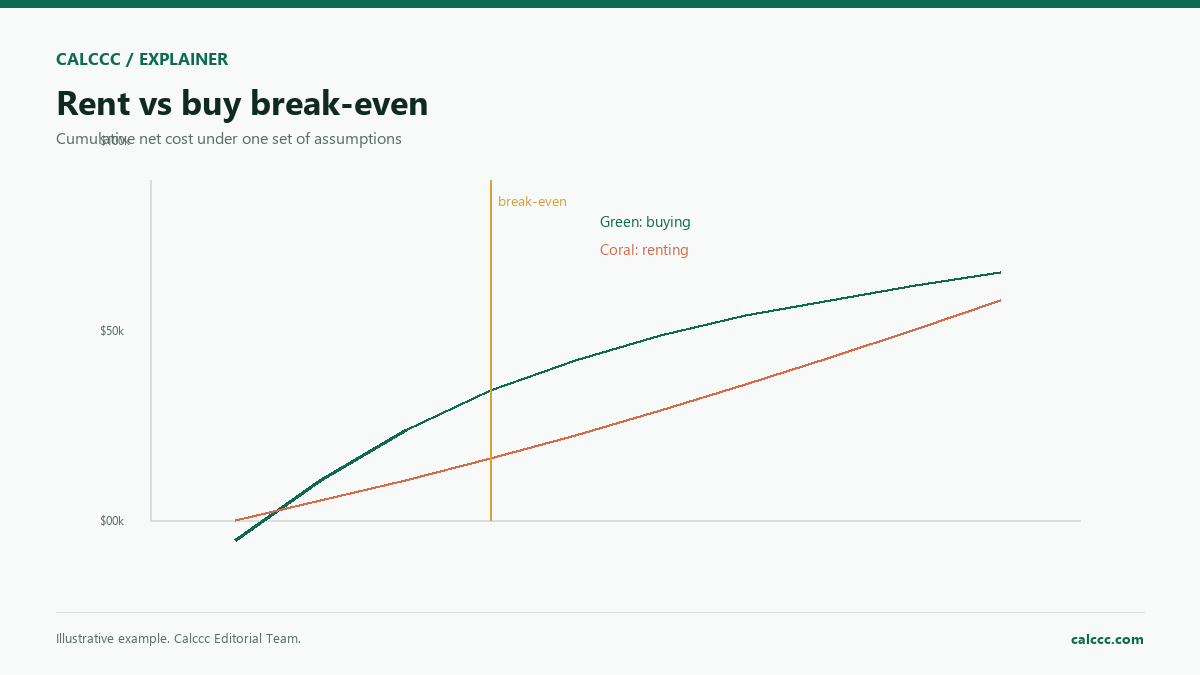
With 20% down, a 6.5% 30-year loan, 1.2% property tax, $1,800 insurance, 1% maintenance, 3% appreciation, 3% closing, 6% selling, and a 5% investment return, the model finds a break-even around year 4 over a 10-year horizon.
Short horizon
If you move in two years, closing and selling costs usually outweigh the equity built, so renting often wins.
What the result means
The result is sensitive to appreciation, rent growth, and how long you stay. A high appreciation assumption can make buying look excellent; a flat market can make the transaction costs dominate. The investment return on the down payment is an opportunity cost, not a guaranteed return. Use your own assumptions and test a pessimistic case.
Common mistakes
- Comparing only the mortgage payment with rent.
- Ignoring maintenance, taxes, insurance, and selling costs.
- Assuming home prices always rise.
- Forgetting that a short stay can make buying expensive.
Assumptions and limits
- Rent and mortgage payments are compared over the same horizon.
- The investment return is applied to the cash used at purchase.
- PMI is held constant and does not automatically drop at 80% LTV.
- Taxes and tax deductions are not modeled.
- Home appreciation and rent growth are constant annual assumptions, not forecasts.
Frequently asked questions
Does buying always beat renting over time?
No. The result depends on the horizon, home appreciation, rent growth, maintenance, transaction costs, and the opportunity cost of the down payment.
What is the break-even year?
The first year the net cost of buying is no higher than the net cost of renting under the assumptions.
Why include HOA and PMI?
They are real monthly ownership costs. Leaving them out overstates the buying advantage.
Why include opportunity cost?
The down payment and closing cash could be invested instead. Ignoring that return overstates the benefit of buying.
Sources
2026 update
How to use the professional output
This page is not just a formula box. The result is designed to be checked, compared, and taken away.
- Professional worksheet. The result includes the inputs used, the method and scope, and a one-variable sensitivity check for finance calculators.
- A/B scenarios. Save two input sets in the browser and compare the primary, secondary, and breakdown figures side by side.
- Print / PDF and CSV. Print a branded worksheet, or export the year-by-year table when the calculator produces one.
- Quote differences. The section below explains why a bank, lender, broker, or provider can quote a different number.
The formulas and assumptions above still govern the number. The worksheet makes the estimate auditable; it does not make it a lender quote, tax return, or personalized advice.
Before you use a quote
Why your bank, lender, or provider’s number may differ
A mortgage quote can differ from this estimate even when the loan amount and rate look the same. The lender’s Loan Estimate is the document that controls the actual offer.
What changes the quote
- Rate versus APR. Points, lender credits, and closing costs can make the APR different from the note rate.
- Escrow and insurance. Property tax, homeowners insurance, PMI, and HOA are local and lender-specific.
- Loan-level pricing. Credit score, down payment, occupancy, property type, and loan size can change the rate.
- Timing. Rates can change daily; a quote is not a lock until it is locked in writing.
How to compare offers
- Compare the APR and total cost, not only the monthly payment.
- Ask for a written quote or Loan Estimate with all fees itemized.
- Use the same loan amount, term, date, and assumptions for every offer.
- Check what is excluded: taxes, insurance, closing costs, maintenance, or provider fees.
- Keep an emergency reserve; the lowest payment is not always the safest choice.
Reference: CFPB Loan Estimate explainer.
Part of a decision center
Mortgage & Home Buying Center
See the companion tools, decision guides, and patterns that go with this calculator.
Go deeper