


Key takeaways
- Tax is a percentage of the pre-tax bill.
- Tip can be calculated on the pre-tax or post-tax total; state the choice.
- Divide the total, not just the food subtotal.
- Rounding up prevents the group from leaving the bill short.
- Uneven shares should be agreed before the bill arrives.
The order of operations
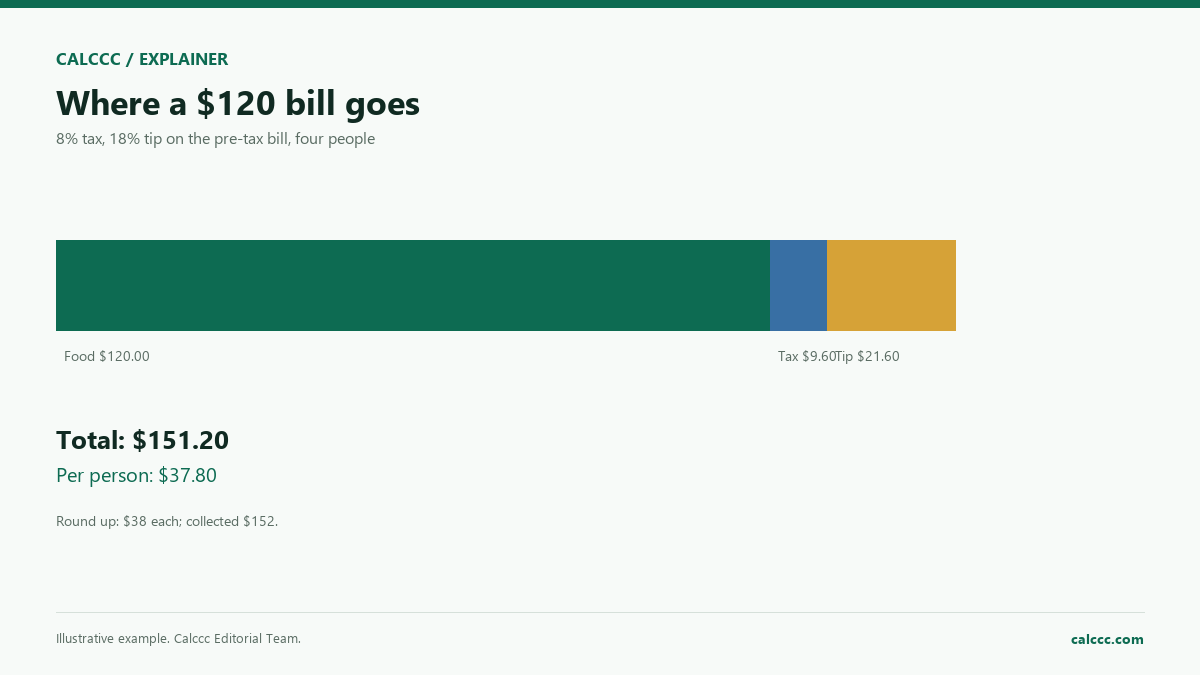
Start with the food and drink subtotal. Add tax. Calculate the tip on the chosen base. Add the tip to get the total. Divide by the number of people. If you divide first and add tax later, you can still get the right answer, but the intermediate numbers are less transparent and easier to mess up.
The calculator shows each component separately so everyone can see where the money goes. That is useful when the group disagrees about the tip or when one person paid for an appetizer.
Tip base: pre-tax or post-tax
Tipping on the pre-tax bill is the traditional approach. Tipping on the post-tax total gives a slightly higher tip. Either can be fair; the important thing is to agree. A 20% tip on a $120 bill is $24; on the same bill with 8% tax, it is $25.92 if calculated after tax.
Rounding
If four people owe $37.80 each, rounding to $38 each collects $152 instead of $151.20. The extra 80 cents is small, but it prevents the group from being short. Decide in advance whether the surplus goes to the server or stays with the group.
Uneven shares
If one person did not drink or shared less, a proportional split is fairer than an equal one. Add that person’s items, apply tax and tip proportionally, and subtract from the group total. This requires itemizing, which is easier before the bill is paid.
Service charges and automatic gratuity
Large parties sometimes have an automatic service charge. That charge may or may not go to the staff. Read the bill and ask if it is unclear. If a service charge is already included, do not add a second full tip by accident. The calculator’s tip field can be set to zero if the service charge replaces it.
Delivery orders, takeout, and counter service have different norms. A delivery fee is not always a driver tip. Check the receipt and tip the person who provided the service.
Tax, discounts, and comped items
A discount usually reduces the taxable subtotal. A comped item may still affect the tip if the service was provided. The order of operations matters: apply the discount, calculate tax on the discounted amount, then add the tip on the agreed base. The calculator assumes no discount, so adjust the bill amount if one applies.
Keeping the group honest
The fairest split is the one everyone understands before the bill arrives. Say the tip percentage out loud, confirm whether it is on the pre-tax or post-tax amount, and decide how to handle a shared appetizer. A short conversation prevents a long argument.
When someone pays the whole bill
If one person pays and the others reimburse, the group still needs the same math. The payer should share the itemized total and the tip percentage. Reimbursement apps can divide the total, but they cannot decide whether the tip was on the pre-tax or post-tax amount. State the number before sending the request.
For a large group, a simple photo of the receipt with the total and the per-person share prevents confusion later. Keep the service charge visible so nobody tips twice.
A note on delivery and takeout
Delivery fees and service fees are not always passed to the driver or the kitchen. Read the breakdown before adding a tip. For takeout, a smaller tip is common, but the math for splitting the total is the same.
Frequently Asked Questions
Should the tip be on the pre-tax or post-tax amount?
Both are common. Pre-tax is the traditional base; post-tax gives a little more. Agree with the group.
How do I split unevenly?
Total each person’s items, apply the same tax and tip percentages, and add the shares. Reconcile to the final bill.
What if the restaurant adds a service charge?
A service charge is not always a tip. Check the bill and ask whether the staff receives it. Do not double-tip by accident.
How do I handle a shared appetizer?
Split that item equally among the people who shared it, then apply tax and tip.
How we checked this guide
We checked the arithmetic with the calculator and a hand example. Tipping norms are cultural and local; the article explains the math, not a mandatory percentage.
Equal vs itemized
Equal splitting is simple but can overcharge people who ordered less. Itemized splitting is fairer but takes more work. Add tax and tip proportionally to each share. For a large group, agree on the method before ordering.
What to compare
Compare the equal share, the itemized share, and the total. Check the service charge before adding a tip.
Compare the equal split with the itemized share before paying.
Now compare the shares.
Compare the equal split with the itemized share before paying the bill.
Now compare the shares and pay.
2026 calculator update: what changed
The linked calculator has been upgraded. It now includes a professional worksheet with the inputs used, the method and scope, and a one-variable sensitivity check for finance tools. You can save two input sets as Scenarios A/B and compare the results side by side. The Print / PDF action produces a branded worksheet, and table-producing calculators can export a CSV.
Further reading