


Key takeaways
- Salary is only the base of the cost.
- Employer taxes and benefits are real cash costs.
- PTO reduces productive hours.
- Overhead includes space, equipment, software, and management.
- Cost per productive hour is a better pricing input than salary.
Start with salary
Salary is the agreed annual pay before employer costs. It is the largest single line for most roles, but it is not the total. A budget that stops at salary will underestimate the hire and may underprice services.
Employer taxes
In the United States, employers pay Social Security and Medicare taxes, federal and state unemployment taxes, and workers’ compensation insurance. The rates and wage bases vary by state and by year. The calculator uses a single percentage for simplicity; use your payroll provider’s actual rates.
Benefits and insurance
Health insurance, retirement contributions, paid leave, and other benefits are part of the package. Some are required, some are competitive. Add the employer’s actual annual cost, not the employee’s payroll deduction.
Overhead and productive hours
Overhead includes office space, equipment, software, utilities, management, and recruiting. Allocating it as a percentage of salary is a practical approximation. Productive hours are paid hours minus PTO and other non-working time. A role with 40 paid hours a week and 15 PTO days has about 1,960 productive hours, not 2,080.
A worked example
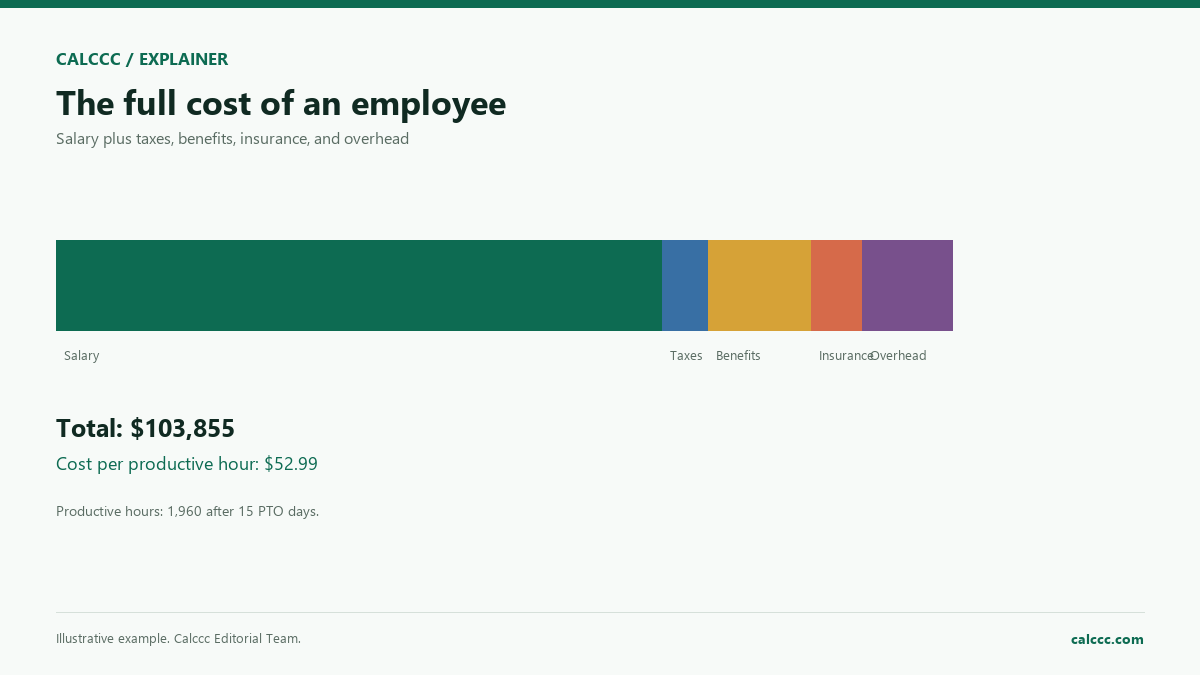
A $70,000 salary with 7.65% employer payroll tax, $12,000 benefits, $6,000 insurance, 15% overhead, 40 paid hours, and 15 PTO days costs about $103,855 a year. That is $52.99 per productive hour and a 1.48× multiplier on salary.
Full-time, part-time, and contractor costs
A part-time employee may have a lower salary but a similar fixed cost for equipment, software, and management. A contractor has no employer payroll tax or benefits in the same way, but the rate is usually higher and the classification rules are strict. Misclassifying an employee as a contractor can create tax and legal exposure.
For budgeting, separate fixed costs from variable costs. Benefits and insurance are often fixed per employee; overtime and bonuses are variable. A hiring plan should show both.
First-year versus steady-state cost
The first year may include recruiting, onboarding, training, and equipment. Those costs can be 10–20% of salary or more. The steady-state cost is lower but still includes benefits, taxes, and overhead. Use a first-year budget for cash planning and a steady-state budget for pricing.
Pricing implications
If an employee costs $52.99 per productive hour, a service priced at $60 per hour leaves only $7 for profit, non-billable time, and business development. That is why many service businesses use a multiplier of 2–3× the cost per hour for billable rates. The right multiplier depends on utilization and overhead.
Budgeting for vacancies and turnover
A vacant role still has recruiting and management costs. Turnover adds separation, hiring, and training costs, and it can reduce team productivity. A simple cost model should include a recruiting allowance and a training ramp. Those costs are often larger than the benefits line for a first-year hire.
For a growing team, model the cost at several headcount levels. Fixed overhead can step up when a new office, manager, or software tier is needed. A per-employee average can hide those step changes.
Review the model quarterly
Payroll tax rates, insurance renewals, and benefits costs change. A budget built once can drift. Review the actual cost per employee each quarter and update the rates, especially before setting prices for the next year.
Use actual payroll data
The calculator is a planning tool. Once the employee is on payroll, replace the estimates with actual tax, benefit, and insurance invoices. The difference can be several thousand dollars a year, especially for roles with commissions or overtime.
Frequently Asked Questions
What overhead rate should I use?
Use your accounting data. A generic percentage is only a starting point; space and management costs vary widely.
Should I include recruiting and training?
For a first-year budget, yes. They are easy to forget and can be material.
Is cost per hour the same as a billable rate?
No. A billable rate must also cover profit, non-billable time, and business development.
Do benefits count if the employee declines them?
Only the employer’s actual cost counts. A declined benefit may reduce cost, but some benefits are mandatory.
How we checked this guide
We checked the total-cost arithmetic with the calculator and compared the categories with BLS employer cost data and IRS employer tax guidance. The rates are examples, not tax advice.
Fully loaded cost
A $70,000 salary can cost $98,000–$112,000 fully loaded. The multiplier depends on benefits and location.
What to compare
Compare salary, benefits, taxes, and overhead. A contractor rate is not comparable with an employee cost without the burden.
2026 calculator update: what changed
The linked calculator has been upgraded. It now includes a professional worksheet with the inputs used, the method and scope, and a one-variable sensitivity check for finance tools. You can save two input sets as Scenarios A/B and compare the results side by side. The Print / PDF action produces a branded worksheet, and table-producing calculators can export a CSV.
The page also explains why a bank, lender, broker, or provider can quote a different number: rate versus APR, fees, credit pricing, taxes, insurance, and timing. Use the written quote or Loan Estimate as the binding document, not the calculator estimate.
Further reading
Keep exploring
Decision path