


Key takeaways
- Molarity uses liters of solution.
- Convert milliliters to liters before dividing.
- Molar mass bridges mass and moles.
- Molarity changes with temperature; molality does not.
- Dilutions use C1V1 = C2V2.
The core equation
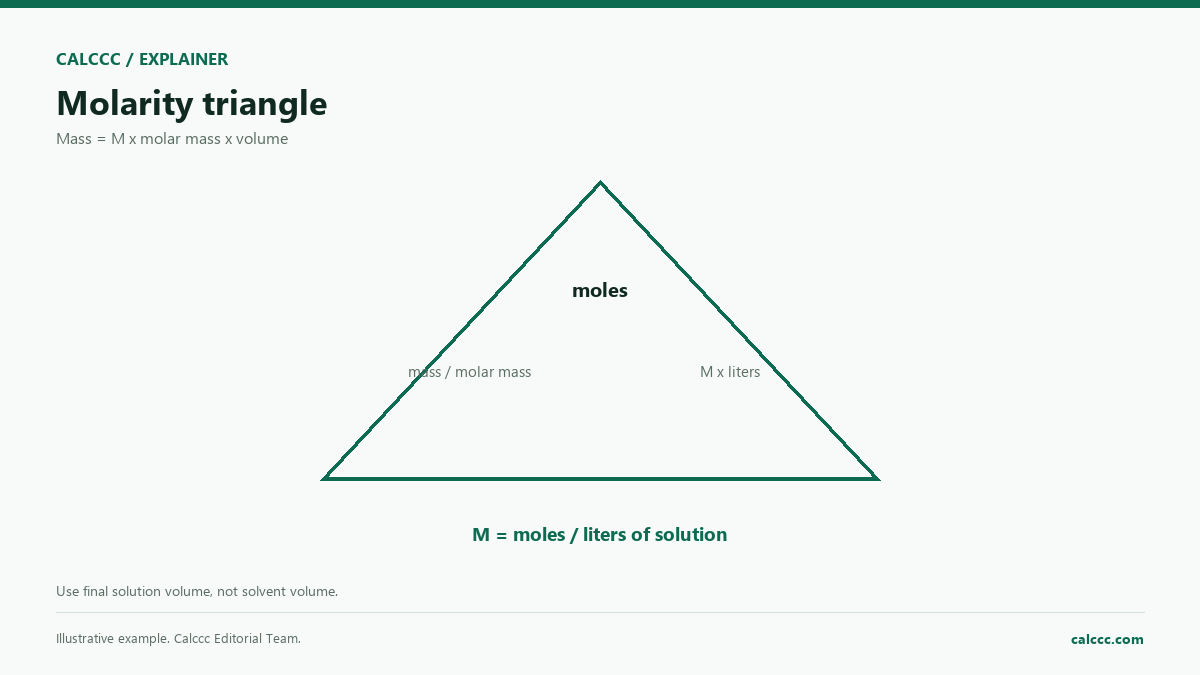
Molarity is defined as M = n / V, where n is moles of solute and V is liters of solution. If you have grams, convert to moles first. For 5 g of sodium chloride with a molar mass of 58.44 g/mol, n = 5 / 58.44 = 0.08556 mol. In 250 mL (0.250 L), M = 0.08556 / 0.250 = 0.3422 mol/L.
Solving for mass or volume
Rearranging gives mass = M × molar mass × V and V = mass / (M × molar mass). The calculator exposes all three forms so you do not have to remember which rearrangement applies. The units are the main source of error.
The solvent-volume trap
If you add 5 g of solute to 250 mL of water, the final volume is not exactly 250 mL. The solution volume changes when the solute dissolves. For accurate work, dissolve the solute and then bring the solution to the final volume in a volumetric flask. The calculator assumes the entered volume is the final solution volume.
Temperature and molality
Solution volume expands with temperature, so molarity changes slightly when the solution warms or cools. Molality, moles per kilogram of solvent, is temperature-independent. It is preferred in some physical chemistry calculations for that reason.
Dilutions
To dilute a stock solution, use C1V1 = C2V2, where C is concentration and V is volume. If you need 500 mL of 0.1 M from a 1 M stock, V1 = 0.1 × 0.5 / 1 = 0.05 L, or 50 mL of stock, then add solvent to 500 mL.
Preparing a solution accurately
Weigh the solute, transfer it to a volumetric flask, add some solvent, swirl to dissolve, then add solvent to the calibration mark. Do not fill the flask to the mark before the solute dissolves, because the volume may change. Mix thoroughly after topping up. For small volumes, use a volumetric pipette and a volumetric flask rather than a beaker.
Record the actual mass and the final volume. If the molar mass is uncertain, the concentration is uncertain too. Hydrates contain water in the formula, so the molar mass must include it.
Units and significant figures
Molarity is moles per liter, not moles per milliliter. A 0.1 M solution contains 0.1 mol in 1 L, or 0.0001 mol in 1 mL. Convert milliliters to liters before dividing. Keep enough significant figures in the molar mass and the balance reading; round the final concentration only after the calculation.
Beyond simple solutions
For reactions, molarity lets you convert volume to moles using the balanced equation. For dilution, C1V1 = C2V2. For solutions with multiple solutes, calculate each concentration separately. For very concentrated or nonideal solutions, activity may differ from concentration.
Common lab examples
To prepare 500 mL of 0.9% saline, you would weigh the sodium chloride, dissolve it, and bring the final volume to 500 mL. The percentage concentration and molarity are different expressions; convert carefully. For a 0.15 M solution, the mass depends on the molar mass of the salt.
When a procedure gives a concentration in g/L or %, convert to molarity using the molar mass. When it gives moles, use the volume to find molarity. Write the units at every step; most mistakes are unit mistakes.
Check the final volume
After dissolving, let the solution reach room temperature before topping up to the mark. A warm solution occupies more volume and can give a concentration that is slightly off when it cools. Mix and measure at a consistent temperature.
Frequently Asked Questions
What is the difference between molarity and molality?
Molarity is moles per liter of solution; molality is moles per kilogram of solvent. Molality is temperature-independent.
Do I use the volume of water or the final volume?
Use the final volume of the solution after the solute is dissolved and the flask is topped up.
How do I find molar mass?
Add the atomic masses of the formula. For hydrates, include the water of hydration.
Can molarity be negative?
No. If a calculation gives a negative value, check the units and the inputs.
How we checked this guide
We checked the rearrangements and example arithmetic by hand and compared the unit conventions with NIST measurement guidance. The article is an educational chemistry explanation.
Molarity and dilution
Molarity (M) = moles of solute ÷ liters of solution. To make a dilution, use M1V1 = M2V2. If you need 500 mL of 0.1 M solution from 1 M stock: V1 = (0.1 × 0.5) ÷ 1 = 0.05 L, or 50 mL of stock, then dilute to 500 mL. Add solute to a smaller volume, then bring to the final mark; volumes are not always additive.
Units and temperature
Molarity depends on solution volume, which changes with temperature. Molality (moles per kg solvent) does not. For precise work, specify the temperature and use volumetric glassware. Do not confuse moles with grams; divide by molar mass first.
What to compare
Compare the moles, the final volume, and the concentration. A dilution calculation that uses the wrong final volume is the most common error.
2026 calculator update: what changed
The linked calculator has been upgraded. It now includes a professional worksheet with the inputs used, the method and scope, and a one-variable sensitivity check for finance tools. You can save two input sets as Scenarios A/B and compare the results side by side. The Print / PDF action produces a branded worksheet, and table-producing calculators can export a CSV.
Further reading