


Key takeaways
- Gross yield ignores expenses. It is useful for a quick comparison, not for deciding whether a property pays for itself.
- Net yield uses net operating income. NOI is effective rental income minus operating expenses, before debt service.
- Cap rate and net yield can be the same number. Both divide NOI by price when the definitions match.
- The mortgage is financing, not an operating expense. Two buyers with different loans should still get the same property-level yield.
- Yield is not cash flow. A property can have a decent yield and still lose money after debt service and capital costs.
What rental yield measures
Rental yield compares the income a property produces with the capital tied up in it. It answers a simple question: for every dollar of purchase price, how much annual income does the property generate? The answer is a percentage, which makes it easier to compare a small unit, a larger building, or a property in another neighborhood.
There are two common versions. Gross yield uses the rent before expenses. Net yield uses the income left after vacancy and operating costs. The difference between them is often large enough to change the ranking of two properties.
The formulas
Gross annual rent is monthly rent multiplied by 12. Gross yield is gross annual rent divided by purchase price, multiplied by 100.
To get net yield, start with gross annual rent. Subtract vacancy loss, which is the rent you expect to lose while the unit is empty. The result is effective rental income. Subtract operating expenses such as property tax, insurance, maintenance, management, HOA dues, and owner-paid utilities. The result is net operating income, or NOI. Net yield is NOI divided by purchase price, multiplied by 100.
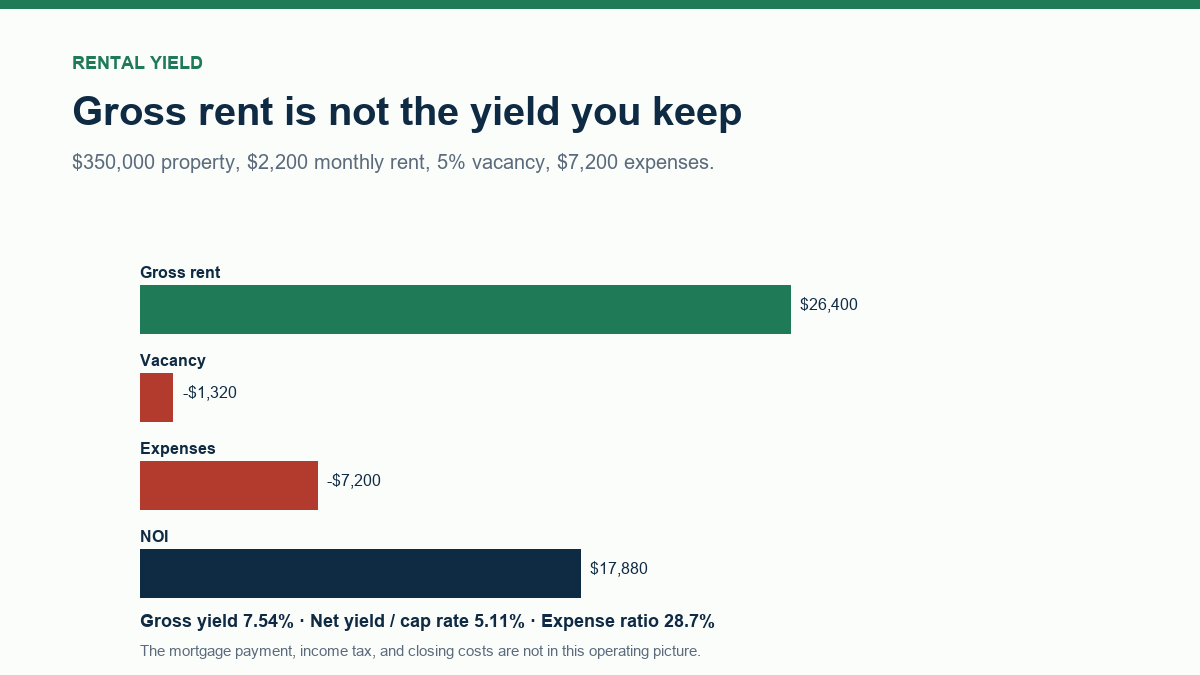
Example: a $350,000 property rents for $2,200 per month. Gross rent is $26,400. At a 5% vacancy rate, the loss is $1,320, leaving $25,080. If annual operating expenses are $7,200, NOI is $17,880. Gross yield is 7.54%; net yield is 5.11%.
Why the mortgage is excluded
NOI describes the property, not the owner’s financing. If two buyers pay the same price but use different down payments and interest rates, the property’s operating income is unchanged. Including one buyer’s mortgage would make the yield impossible to compare across buyers and would mix an operating return with a financing decision.
Cash flow is a different calculation. To estimate cash flow, subtract the mortgage payment, capital expenditure reserve, and income tax from NOI. A property with a 5% cap rate can have positive cash flow with a large down payment and negative cash flow with a small one.
What belongs in operating expenses
Operating expenses are the recurring costs of keeping the property available to rent. They include property tax, landlord insurance, repairs and maintenance, property management, HOA dues, landscaping, pest control, and utilities paid by the owner. They do not include the mortgage principal and interest, income tax, depreciation, or major capital improvements that add value or extend the property’s life.
Capital expenditure is a real cost, but it is lumpy. A roof replacement, HVAC replacement, or kitchen renovation should be budgeted separately, often as an annual reserve per unit. Ignoring capital reserves can make a property look better than it is.
How to compare properties
Use the same expense assumptions for every property. If you use a 5% vacancy rate and a 10% maintenance reserve for one building, use the same logic for the next. Then compare gross yield, net yield, and the expense ratio side by side.
Do not compare a yield in a high-tax state with one in a low-tax state without adjusting taxes. Do not compare a newer building with a 40-year-old building without adjusting maintenance and capital reserves. And do not compare a stabilized rent with a below-market rent unless you model the path to market.
What yield does not tell you
Yield does not tell you whether the property will appreciate, whether the neighborhood will improve, whether the tenant will pay, or whether the building will need a new roof next year. It does not include closing costs, renovation costs, or the tax treatment of depreciation. It is one input, not a verdict.
A high yield can be a warning sign. It may reflect higher vacancy, deferred maintenance, a declining area, or a rent that cannot be sustained. A low yield can be reasonable in a market with strong appreciation, but that is a separate bet on price growth.
2026 calculator update: what changed
The linked calculator has been upgraded. It now includes a professional worksheet with the inputs used, the method and scope, and a one-variable sensitivity check for finance tools. You can save two input sets as Scenarios A/B and compare the results side by side. The Print / PDF action produces a branded worksheet, and table-producing calculators can export a CSV.
The page also explains why a bank, lender, broker, or provider can quote a different number: rate versus APR, fees, credit pricing, taxes, insurance, and timing. Use the written quote or Loan Estimate as the binding document, not the calculator estimate.
Frequently asked questions
What is the difference between gross yield and net yield?
Gross yield uses annual rent before expenses. Net yield subtracts vacancy loss and operating expenses, so it reflects the property’s operating income more closely.
Is net rental yield the same as cap rate?
In this calculator, yes. Both use net operating income divided by purchase price. Some markets use different conventions, so compare the same formula.
Should I include the mortgage payment?
No. Net operating income is calculated before debt service. Mortgage payments depend on the buyer’s loan and down payment, not on the property alone.
What vacancy rate should I use?
Use a local, property-specific estimate. One month of vacancy per year is a common starting point, but the right number depends on the market and unit type.
Further reading