What this calculator does
Discount points are an upfront fee that lowers the mortgage rate. One point usually costs 1% of the loan amount. Whether points save money depends on how long you keep the loan: you need to stay past the break-even month to recover the upfront cost.
How to use it
- Enter the loan amount, not the home price.
- Enter the rate without points.
- Enter the number of points you are considering.
- Ask the lender for the rate reduction per point.
- Compare the monthly savings with the upfront cost and break-even.
How it works
Example calculations
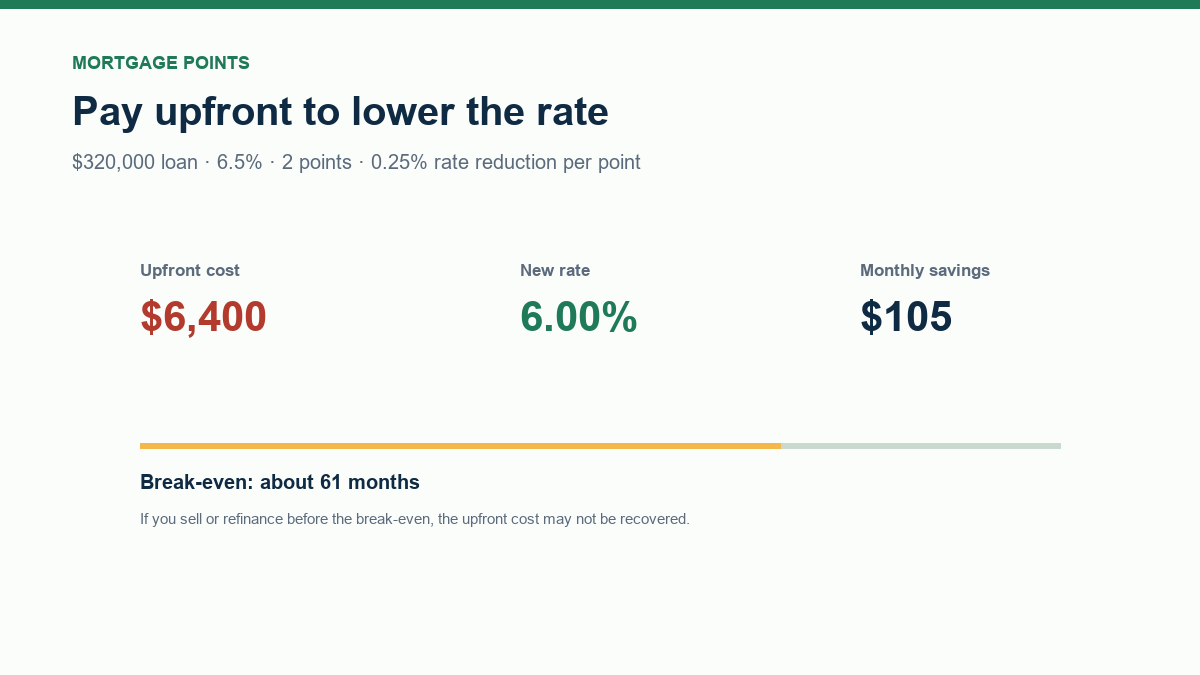
Example: $320,000 loan, 6.5%, 2 points
Two points cost $6,400. If each point lowers the rate by 0.25%, the new rate is 6.00%. The monthly savings are about $105, so the break-even is about 61 months.
Short holding period
If you expect to sell or refinance in three years, the upfront cost may not be recovered before the loan ends.
What the result means
Points are not automatically good or bad. A long holding period, a large loan, and a meaningful rate reduction make them more attractive. A short holding period, limited cash, or a small rate reduction make them less attractive. Compare the break-even with your expected time in the home.
Common mistakes
- Confusing points with origination fees.
- Assuming the advertised rate reduction applies to every lender.
- Ignoring the opportunity cost of the upfront cash.
- Forgetting that selling or refinancing can cut the break-even period short.
Assumptions and limits
- The loan is held for the full term in the interest-savings calculation.
- The rate reduction per point is constant.
- The point cost is paid in cash at closing.
- Tax treatment, closing costs, and lender fees are excluded.
Frequently asked questions
What is a mortgage point?
A discount point is an upfront fee equal to 1% of the loan amount that lowers the interest rate. Origination fees are separate.
How do I calculate the break-even?
Divide the point cost by the monthly payment savings. The result is the number of months needed to recover the upfront cost.
Are points tax deductible?
Points may be deductible in some situations. Ask a tax professional about your loan and filing situation.
Should I buy points?
It depends on the break-even, your cash reserves, and how long you expect to keep the loan.
Sources
2026 update
How to use the professional output
This page is not just a formula box. The result is designed to be checked, compared, and taken away.
- Professional worksheet. The result includes the inputs used, the method and scope, and a one-variable sensitivity check for finance calculators.
- A/B scenarios. Save two input sets in the browser and compare the primary, secondary, and breakdown figures side by side.
- Print / PDF and CSV. Print a branded worksheet, or export the year-by-year table when the calculator produces one.
- Quote differences. The section below explains why a bank, lender, broker, or provider can quote a different number.
The formulas and assumptions above still govern the number. The worksheet makes the estimate auditable; it does not make it a lender quote, tax return, or personalized advice.
Before you use a quote
Why your bank, lender, or provider’s number may differ
A mortgage quote can differ from this estimate even when the loan amount and rate look the same. The lender’s Loan Estimate is the document that controls the actual offer.
What changes the quote
- Rate versus APR. Points, lender credits, and closing costs can make the APR different from the note rate.
- Escrow and insurance. Property tax, homeowners insurance, PMI, and HOA are local and lender-specific.
- Loan-level pricing. Credit score, down payment, occupancy, property type, and loan size can change the rate.
- Timing. Rates can change daily; a quote is not a lock until it is locked in writing.
How to compare offers
- Compare the APR and total cost, not only the monthly payment.
- Ask for a written quote or Loan Estimate with all fees itemized.
- Use the same loan amount, term, date, and assumptions for every offer.
- Check what is excluded: taxes, insurance, closing costs, maintenance, or provider fees.
- Keep an emergency reserve; the lowest payment is not always the safest choice.
Reference: CFPB Loan Estimate explainer.
Part of a decision center
Mortgage & Home Buying Center
See the companion tools, decision guides, and patterns that go with this calculator.
Go deeper