


Key takeaways
- The first two years are different. A puppy is not a small adult; development is front-loaded.
- Size matters. Small dogs often age more slowly than giant breeds after maturity.
- The estimate is not a health test. It cannot diagnose illness or predict lifespan.
- Breed and lifestyle matter. Genetics, dental care, nutrition, and veterinary care all affect aging.
- Watch the dog, not the number. Mobility, weight, behavior, and lab work are better health signals.
Why the seven-year rule is wrong
The seven-year rule is easy to remember, but it ignores the first two years of rapid development and the differences between breeds. A one-year-old dog is sexually mature and physically near adult size, which is not equivalent to a seven-year-old human. A 12-year-old small dog and a 12-year-old giant dog are also not at the same life stage.
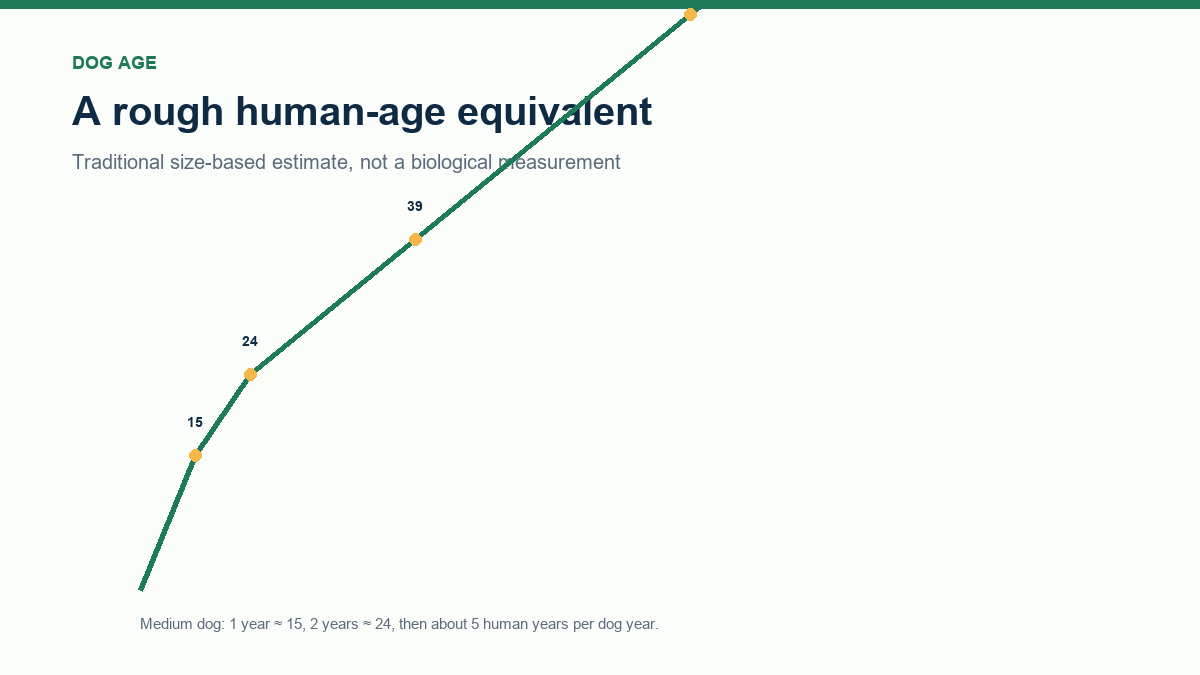
A more realistic estimate uses a curve: roughly 15 human years for the first year, about 9 more for the second, then a size-dependent rate after age two.
The size-based estimate
The calculator uses a common traditional method. After age two, it adds about four human years per dog year for small dogs, five for medium dogs, six for large dogs, and seven for giant breeds. These are rough population estimates, not individual predictions.
Example: a five-year-old medium dog is estimated at 24 + 3 × 5 = 39 human years. A ten-year-old large dog is estimated at 24 + 8 × 6 = 72 human years.
What the number is useful for
A human-age estimate can help a pet owner think about life stage: puppy, young adult, adult, or senior. It can be a reminder to schedule senior wellness checks, watch for arthritis, or review dental care. It is not a substitute for a veterinarian’s assessment.
For senior dogs, useful conversations include mobility, pain, weight, dental disease, kidney and liver values, and quality of life. Those are clinical questions, not arithmetic ones.
What the number cannot tell you
It cannot tell you how long a dog will live. Lifespan varies widely by breed, size, genetics, and care. It cannot diagnose a disease or decide whether a dog is “too old” for treatment. It also cannot compare two dogs precisely; a large dog can be healthy at an age when another large dog has multiple conditions.
Use the estimate as a rough communication tool. If you are worried about a change in appetite, mobility, behavior, or weight, contact a veterinarian.
Breed and lifestyle matter
Two dogs of the same size and age can be at different life stages. Breed predispositions, body condition, dental health, joint health, and activity level all influence how a dog ages. A lean, active dog with regular veterinary care may stay mobile longer than a sedentary dog of the same age. The human-age estimate cannot capture those differences.
Use the estimate to start a conversation about preventive care, not to rank dogs or predict lifespan. Regular wellness visits, dental care, parasite prevention, and weight management are more useful than a single converted number.
Senior-dog checklist
For a dog entering the senior years, watch for changes in appetite, thirst, weight, mobility, sleep, house training, and interaction. Ask the veterinarian about pain screening, dental disease, kidney and liver values, thyroid function, and arthritis management. These observations are more actionable than the human-age result.
What if the age is unknown?
Rescue dogs often have an estimated age based on teeth, eyes, coat, and body condition. Those estimates can be off by a year or more. If the age is uncertain, treat the calculator result as a broad range and focus on the dog’s health and behavior rather than a precise human-age number.
A veterinarian can estimate age during a wellness exam and track changes over time. That ongoing record is more useful than a single conversion.
2026 calculator update: what changed
The linked calculator has been upgraded. It now includes a professional worksheet with the inputs used, the method and scope, and a one-variable sensitivity check for finance tools. You can save two input sets as Scenarios A/B and compare the results side by side. The Print / PDF action produces a branded worksheet, and table-producing calculators can export a CSV.
Size and aging
Small dogs often age more slowly in the early years and faster later; large dogs age faster. The 7-year rule is a rough average, not a formula. Use a size-aware chart and the vet’s assessment for health decisions.
What to compare
Compare the dog’s size, breed, and health, not only the calendar age. A vet can estimate life stage better than a single multiplier.
Ask the vet for a life-stage assessment at the annual visit.
Compare the age chart with the vet’s assessment.
Now compare both.
Compare the chart with the veterinarian’s assessment at the annual visit.
Now compare both at the visit.
Frequently asked questions
Is one dog year really seven human years?
No. That is a rough shortcut. Dogs mature faster in the first two years, and size affects later aging.
Why do large dogs age faster?
Large and giant breeds often have shorter lifespans and different age-related health patterns. The estimate uses a faster rate for larger dogs.
Does this calculator work for puppies?
It gives a rough first-year estimate, but puppy development is not linear. Use veterinary guidance for growth and vaccination schedules.
Can I use this to decide senior care?
No. Ask a veterinarian. Senior-care decisions depend on health, mobility, dental condition, and lab work.
Further reading