


Key takeaways
- One U.S. standard drink contains 0.6 fl oz of pure alcohol.
- Time is the only thing that lowers BAC; coffee and cold showers do not.
- Food can slow absorption but does not remove alcohol.
- Impairment can occur below 0.08%.
- Legal limits vary by place and by driver type.
What BAC measures
BAC is usually expressed as a percentage. A BAC of 0.08% means 0.08 grams of alcohol per 100 milliliters of blood. The number reflects alcohol absorbed into the bloodstream, not how many drinks are on the table. Different drinks can contain different amounts of alcohol, so “one drink” is not a reliable unit unless it is a standard drink.
The Widmark estimate
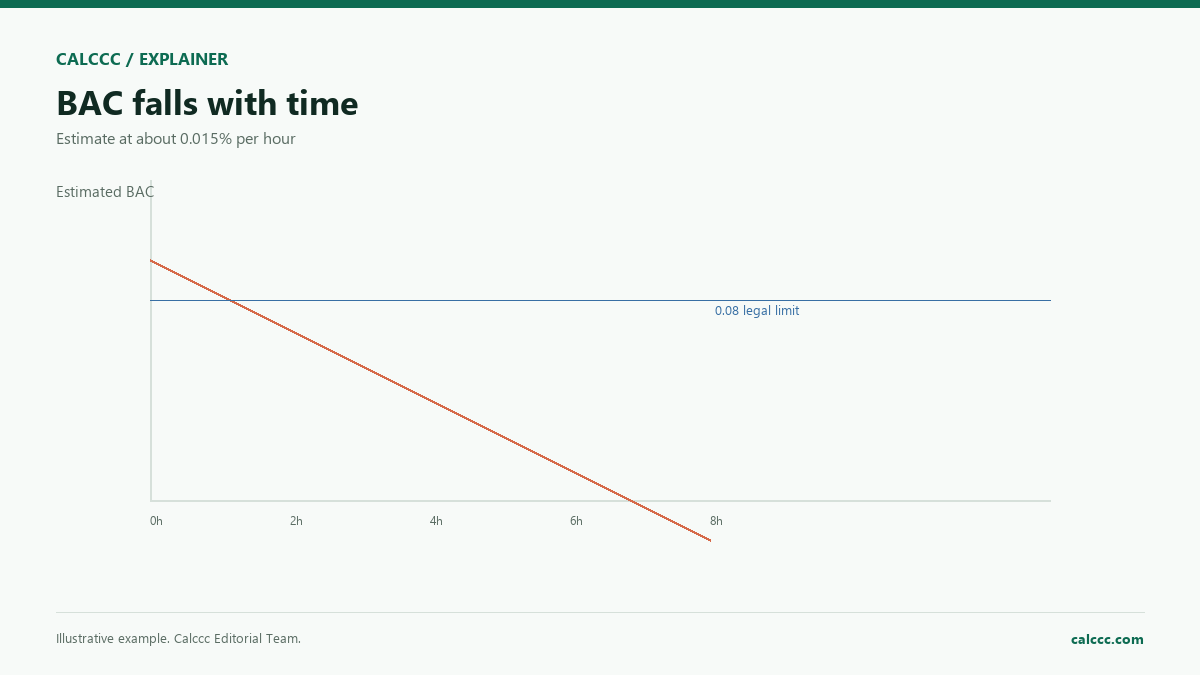
The Widmark formula is BAC = (A × 5.14 / (W × r)) − (0.015 × H), where A is ounces of pure alcohol, W is body weight in pounds, r is a distribution factor (about 0.73 for the male formula and 0.66 for the female formula), and H is hours since the first drink. The 0.015 term is an average elimination rate per hour.
The formula ignores food, drinking speed, liver health, medications, and genetics. It also uses a single distribution factor for a whole population. That is why it is an estimate, not a measurement.
Standard drinks
In the United States, a standard drink is 12 fl oz of regular beer at about 5% alcohol, 5 fl oz of wine at about 12%, or 1.5 fl oz of distilled spirits at about 40%. Craft beer, wine, and cocktails can be stronger. A mixed drink may contain more than one standard drink.
Hours and elimination
On average, the body clears about 0.015% per hour. Three standard drinks for a 180-pound person might estimate near 0.04% after two hours. The same drinks one hour earlier would estimate higher; one hour later, lower. The calculator shows an approximate time to zero, but the actual time can be longer.
Why not use it to drive
Impairment begins before the legal limit. Reaction time, judgment, and coordination can be affected at low BAC. The only safe plan is a designated driver, public transit, or a ride service. Do not use an online estimate as a substitute for a calibrated test or for judgment.
Why body weight and sex are imperfect inputs
The Widmark formula uses body weight and a distribution factor to estimate how much alcohol is in the blood. Two people at the same weight can have different body composition, liver function, and tolerance. The formula cannot see those differences. It also cannot tell how fast a person drank, which strongly affects the peak.
Eating before drinking can slow absorption, but it does not neutralize alcohol. Carbonated drinks may speed absorption for some people. Medications and health conditions can change the effect. None of these details are in the formula, which is why the result is only a planning estimate.
Impairment is not a number
Driving skills degrade before a person feels drunk. Lane keeping, braking, and attention can be affected at low BAC. The legal limit is a threshold for prosecution, not a safety line. The safest choice is a designated driver or a ride service, regardless of the estimate.
If someone may be in danger
Alcohol poisoning is a medical emergency. Confusion, vomiting, slow breathing, low body temperature, or inability to wake are warning signs. Call emergency services and stay with the person. Do not leave someone to “sleep it off” without checking on them.
Frequently Asked Questions
Does coffee sober you up?
No. Caffeine can make you feel more alert, but it does not lower BAC or restore impaired driving skills.
Does food lower BAC?
Food can slow absorption and change the peak, but it does not remove alcohol already in the body.
Is 0.08% the legal limit everywhere?
No. Limits vary by country and state, and lower limits may apply to commercial drivers or novice drivers.
Can I be impaired below 0.08%?
Yes. Impairment varies by person, and any alcohol can affect driving.
How we checked this guide
We compared the formula with NIAAA and CDC public guidance and checked the example arithmetic by hand. The article is educational and does not provide a legal or medical measurement.
What BAC depends on
BAC depends on body weight, sex, time, food, and the number of drinks. A standard drink is about 14 g of pure alcohol. The calculator is an estimate; individual absorption varies. Do not use it to decide whether to drive.
What to compare
Compare the number of standard drinks, the time, and the estimate. Never drive after drinking; use a designated driver or rideshare.
Compare the estimate with the time and the standard drinks.
Now check the estimate.
Compare the estimate with the number of standard drinks and the time.
2026 calculator update: what changed
The linked calculator has been upgraded. It now includes a professional worksheet with the inputs used, the method and scope, and a one-variable sensitivity check for finance tools. You can save two input sets as Scenarios A/B and compare the results side by side. The Print / PDF action produces a branded worksheet, and table-producing calculators can export a CSV.
For health tools, the worksheet makes the inputs and assumptions visible, but it does not replace a clinician. Use the print view when you want to discuss the result with a professional.
Further reading