


Key takeaways
- Normal is below 120 and below 80 mmHg for adults in standard office categories.
- Stage 1 and stage 2 are defined by either number, not an average.
- Above 180 systolic or above 120 diastolic is the crisis range and needs urgent attention.
- Measurement technique can change the number by several points.
- Pulse pressure and mean arterial pressure are useful context, not substitutes for the reading.
Two numbers, two phases
The heart cycle has two main phases. During systole, the ventricles contract and push blood into the arteries; the peak pressure is the systolic number. During diastole, the ventricles relax and refill; the lowest pressure is the diastolic number. The cuff measures both, and the pair is more informative than either number alone.
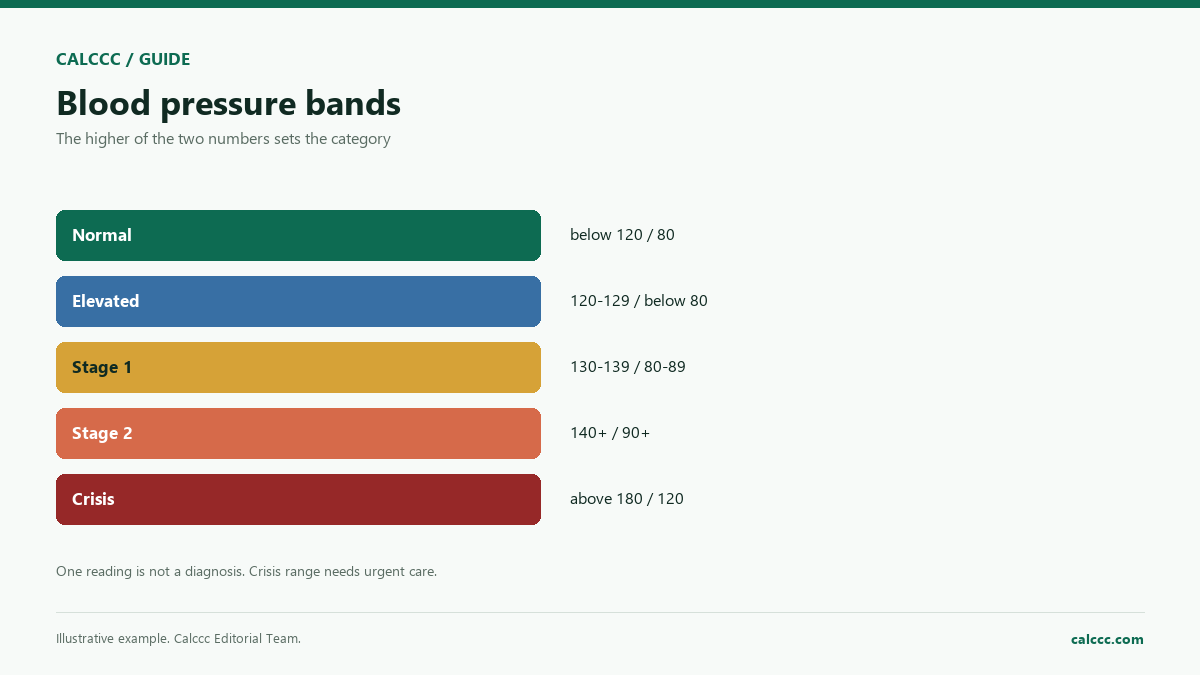
A reading of 135/85 means systolic 135 and diastolic 85. The category uses the higher band: systolic 135 is in the stage 1 range, and diastolic 85 is also stage 1. If one number is normal and the other is high, the higher category applies.
The standard adult categories
| Category | Systolic | Diastolic |
|---|---|---|
| Normal | Below 120 | Below 80 |
| Elevated | 120–129 | Below 80 |
| Stage 1 | 130–139 | 80–89 |
| Stage 2 | 140 or higher | 90 or higher |
| Hypertensive crisis | Above 180 | Above 120 |
These are standard adult office thresholds. Pregnancy, children, and some chronic conditions use different targets. A clinician may also consider home readings, ambulatory monitoring, and overall cardiovascular risk.
Measure it properly
A number is only as good as the measurement. Sit quietly for five minutes, keep your back supported and feet flat, and rest your arm at heart level. Empty your bladder first. Avoid caffeine, exercise, and smoking for 30 minutes before the reading. Use a validated upper-arm cuff and the correct size; a cuff that is too small can read high.
Do not talk during the measurement. Take two readings a minute apart and average them if your device or clinician advises it. Home readings may be lower or higher than office readings, so bring your log to appointments rather than relying on a single number.
One reading is not a diagnosis
Blood pressure changes throughout the day. Stress, pain, a full bladder, talking, and the setting can raise it. Clinicians usually confirm hypertension with repeated readings over time. A single high number is a reason to recheck and, if it is very high or symptoms are present, to seek care promptly.
This calculator labels a reading. It does not know your history, medicines, kidney function, pregnancy status, or cardiovascular risk. Do not start, stop, or change medication based on one result.
When to get urgent help
A reading above 180 systolic or above 120 diastolic is in the crisis range. If it comes with chest pain, shortness of breath, weakness or numbness, trouble speaking, vision changes, or confusion, call emergency services. Do not drive yourself. If you feel well but the reading is in the crisis range, contact a clinician promptly for advice.
Pulse pressure and MAP
Pulse pressure is systolic minus diastolic. A wider pulse pressure can be associated with stiffer arteries, especially in older adults, but it is not a standalone diagnosis. Mean arterial pressure (MAP) approximates the average pressure during the cardiac cycle; the common estimate is (systolic + 2 × diastolic) ÷ 3. Both are context, not replacements for the two measured numbers.
Frequently Asked Questions
Which number is more important?
Both matter. Systolic often carries more weight in older adults, while diastolic can be an earlier signal in younger adults. The higher category usually guides the label.
Can stress raise blood pressure?
Yes, temporarily. Chronic stress and poor sleep can also contribute over time. A single stressed reading is not a diagnosis.
Is low blood pressure a problem?
It can be, especially with dizziness, fainting, or dehydration. This calculator focuses on high blood pressure categories; discuss low readings with a clinician.
Do home cuffs work?
Validated upper-arm cuffs can be useful. Check the device against a clinical reading and bring your log to appointments.
How we checked this guide
We compared the category boundaries with NHLBI and CDC patient guidance and checked the calculator against the higher-of-two rule. The article is educational and does not replace a clinical assessment.
Reading a reading
Blood pressure is written systolic/diastolic, such as 120/80 mmHg. The top number is the pressure when the heart beats; the bottom is the pressure between beats. One reading is not a diagnosis. Take multiple readings at rest and follow the clinician’s guidance.
What to compare
Compare the reading with the category ranges and the trend over time. Seek urgent care for very high readings with symptoms.
Log the readings and share them with the clinician.
Compare the reading with the category ranges.
Now review it.
Compare the reading with the category ranges and the trend over time.
2026 calculator update: what changed
The linked calculator has been upgraded. It now includes a professional worksheet with the inputs used, the method and scope, and a one-variable sensitivity check for finance tools. You can save two input sets as Scenarios A/B and compare the results side by side. The Print / PDF action produces a branded worksheet, and table-producing calculators can export a CSV.
For health tools, the worksheet makes the inputs and assumptions visible, but it does not replace a clinician. Use the print view when you want to discuss the result with a professional.
Further reading