


Key takeaways
- BMI is quick, inexpensive, and useful for tracking weight relative to height across populations.
- BMI does not distinguish muscle, fat, or bone, and it does not show fat distribution.
- WHtR is a simple central-fat screening measure; the NHS advises keeping waist size to less than half your height.
- Measure waist consistently and use the same unit as height.
- Use both numbers as context, not as a verdict. Athletes, pregnant people, children, and older adults need different interpretation.
What BMI measures
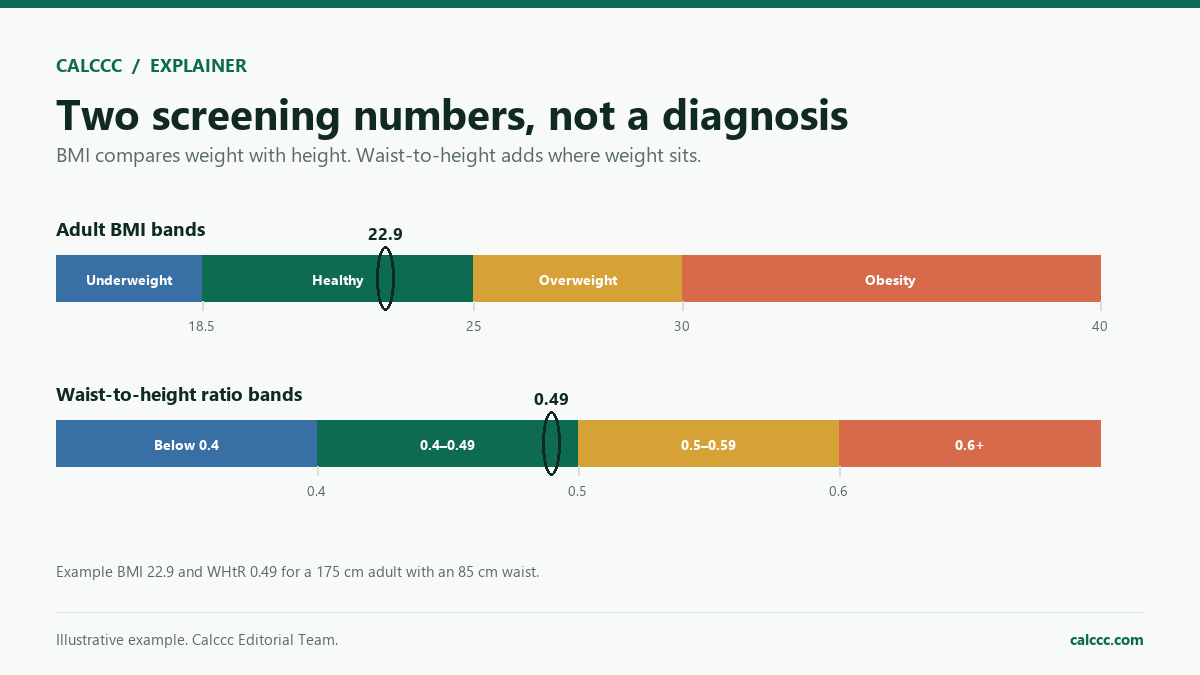
BMI = weight in kilograms ÷ height in meters squared. In imperial units, the same result comes from weight in pounds ÷ height in inches squared × 703. The CDC describes BMI as a quick, low-cost screening measure for underweight, healthy weight, overweight, and obesity in adults.
| Adult BMI | Category used by CDC |
|---|---|
| Below 18.5 | Underweight |
| 18.5–24.9 | Healthy weight |
| 25.0–29.9 | Overweight |
| 30.0 and above | Obesity |
These bands are for adults 20 and older. Children and teens use age- and sex-specific percentiles, not the adult table. Pregnancy also changes the interpretation.
What BMI misses
The CDC is explicit: BMI does not directly measure body fat, does not distinguish fat from muscle or bone, and does not indicate where fat is stored. A muscular athlete can be classified as overweight. An older adult with low muscle mass can have a “normal” BMI while carrying excess fat.
BMI is still useful because it is cheap, repeatable, and correlated with health risk at the population level. The mistake is treating one reading as a diagnosis. A single BMI should be read with medical history, blood pressure, glucose, cholesterol, physical activity, sleep, and family history.
What waist-to-height ratio adds
WHtR = waist circumference ÷ height, using the same unit for both. The NHS says the goal is to keep your waist size to less than half your height, and describes WHtR as a way to understand whether you are carrying too much fat around your tummy.
| WHtR | Screening band | How to read it |
|---|---|---|
| Below 0.4 | Below the common band | May indicate low central fat, but also warrants context if weight is low. |
| 0.40–0.49 | Healthy range | Commonly described as lower risk in screening terms. |
| 0.50–0.59 | Increased | Above the “half your height” guide; check trends and other risk factors. |
| 0.60 and above | High | Higher central-fat screening band; discuss with a clinician. |
These bands are screening guides, not diagnostic thresholds. The NHS calculator is not intended for people under 5, pregnant people, people with an eating disorder or growth disorder, or adults with a BMI over 35. If you are under 17, use it with a parent or carer.
How to measure waist consistently
- Use a flexible tape that is not stretched.
- Stand relaxed and breathe out normally; do not suck in.
- Measure at a consistent landmark. Protocols differ (navel vs. narrowest point); pick one and repeat it.
- Keep the tape snug but not compressing the skin.
- Record the date and the measurement; trend matters more than one reading.
The NHS calculator explains the measurement method it expects. If you are comparing your number with a clinical cutoff, use the protocol that produced the cutoff.
BMI vs WHtR: a practical comparison
| Question | BMI | Waist-to-height |
|---|---|---|
| What it uses | Weight and height | Waist and height |
| Strength | Fast, standardized, widely tracked | Adds central fat distribution |
| Weakness | Cannot separate muscle, fat, or bone | Measurement protocol matters; not a diagnosis |
| Best use | Population screening and trends | Additional context for central fat |
| Not for | Children using adult bands; pregnancy | Pregnancy, eating disorders, some clinical groups |
Worked example
An adult is 175 cm tall and weighs 70 kg. BMI = 70 ÷ (1.75 × 1.75) = 22.9. If their waist is 85 cm, WHtR = 85 ÷ 175 = 0.49. Both sit in the common healthy screening bands, but that does not prove metabolic health; blood pressure and blood work may tell a different story.
2026 calculator update: what changed
The linked calculator has been upgraded. It now includes a professional worksheet with the inputs used, the method and scope, and a one-variable sensitivity check for finance tools. You can save two input sets as Scenarios A/B and compare the results side by side. The Print / PDF action produces a branded worksheet, and table-producing calculators can export a CSV.
For health tools, the worksheet makes the inputs and assumptions visible, but it does not replace a clinician. Use the print view when you want to discuss the result with a professional.
Frequently asked questions
Is BMI accurate for athletes?
Often not. Muscle is denser than fat, so a muscular person can have a high BMI without excess fat. Waist ratio and body composition testing add context.
What is a healthy waist-to-height ratio?
The NHS guide is to keep waist size below half your height, which corresponds to a ratio below 0.5. Screening bands vary by source; use the one your clinician uses.
Should children use this calculator?
No. Children and teens need age- and sex-specific BMI percentiles. Use a pediatric growth chart or a clinician.
Does a normal BMI mean I am healthy?
No. BMI does not measure blood pressure, blood sugar, cholesterol, fitness, or body composition. It is one screening input.
How we checked this guide
We compared the CDC’s adult BMI guidance with the NHS waist-to-height guidance and the calculator’s formulas. We kept the example deliberately simple and labeled every band as a screening guide. We did not use a proprietary body-composition threshold or imply that either number is diagnostic.
Further reading
Keep exploring
Decision path