


Key takeaways
- Scale all ingredients by the same factor, not just the main ones.
- Convert mixed numbers to improper fractions before multiplying.
- Use a common denominator for addition and subtraction.
- Volume and weight are not interchangeable for every ingredient.
- Taste, texture, and pan size can change when you scale.
Why recipe fractions feel harder than they are
Recipes mix whole numbers, fractions, and units. “1 1/2 cups” is a mixed number. “3/4 teaspoon” is a fraction. When you double the recipe, you multiply both parts by the same number. The tricky part is often the unit conversion, not the fraction itself.
Think of a recipe as a ratio. If the original uses 1 part flour to 2 parts milk, doubling means 2 parts flour to 4 parts milk. The ratio stays the same; the total amount changes.
Scaling a recipe: the factor method
New amount = original amount × scaling factor
If the original recipe serves 4 and you need 6, the factor is 6 ÷ 4 = 1.5. Multiply every ingredient by 1.5. If it serves 4 and you need 2, the factor is 0.5.
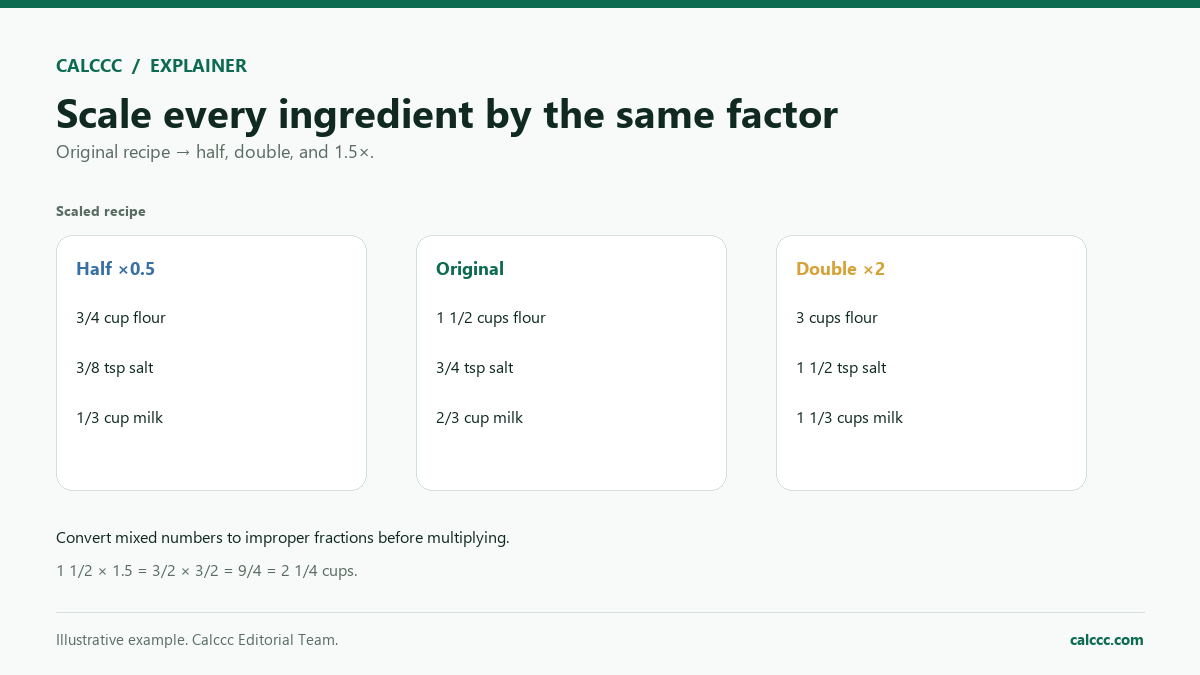
| Original | Half (×0.5) | Double (×2) | 1.5× |
|---|---|---|---|
| 1 1/2 cups flour | 3/4 cup | 3 cups | 2 1/4 cups |
| 3/4 tsp salt | 3/8 tsp | 1 1/2 tsp | 1 1/8 tsp |
| 2/3 cup milk | 1/3 cup | 1 1/3 cups | 1 cup |
Multiplying mixed numbers
Convert “1 1/2” to 3/2 before multiplying. Then multiply the numerators and denominators. For 1.5 × 1 1/2: 3/2 × 3/2 = 9/4 = 2 1/4. This is why the flour amount becomes 2 1/4 cups, not 1 1/2 × 1 1/2 = 2 1/4 by accident. The method makes the result predictable.
Adding fractions with different denominators
If a recipe calls for 1/2 cup of one ingredient and 1/3 cup of another, you cannot add them by adding tops and bottoms. Convert to sixths: 1/2 = 3/6, 1/3 = 2/6, total = 5/6 cup. The fraction calculator can do this, but the kitchen skill is worth knowing.
Volume vs. weight
Flour is the classic trap. A cup of flour can weigh very differently depending on how it is scooped and packed. For baking, a scale is more reliable than volume. If you scale by volume, your “double” batch may not be exactly double in flour mass.
Liquids are more forgiving, but dairy, honey, and thick sauces can cling to the measuring cup. Use the same measuring method for the original and the scaled batch.
Pan size and cooking time
Doubling a cake recipe does not mean doubling the pan size in one dimension. A larger pan changes the depth and the surface area, which changes baking time. Use a pan with roughly double the area, or bake in two pans. Check doneness earlier than the original recipe suggests.
For stovetop recipes, a larger batch may crowd the pan and steam instead of brown. Cook in batches or use a wider pan.
Common measuring equivalents
Some fractions are easier to measure in smaller units. Three teaspoons make one tablespoon; four tablespoons make a quarter cup; sixteen tablespoons make one cup. A half cup is eight tablespoons, and a third cup is five tablespoons plus one teaspoon. These equivalents help when a scaled fraction is awkward on a measuring cup, such as 3/8 cup.
2026 calculator update: what changed
The linked calculator has been upgraded. It now includes a professional worksheet with the inputs used, the method and scope, and a one-variable sensitivity check for finance tools. You can save two input sets as Scenarios A/B and compare the results side by side. The Print / PDF action produces a branded worksheet, and table-producing calculators can export a CSV.
Scaling fractions
To double a recipe, multiply every fraction by 2. 3/4 cup becomes 1 1/2 cups. To halve, divide by 2. 1/3 cup becomes 1/6 cup, which is 2 tablespoons plus 2 teaspoons. Convert to a common denominator before adding or subtracting.
What to compare
Compare the scaled ingredient, the measuring tool, and the total batch. A small rounding error in a spice can matter more than in flour.
Now compare the scaled ingredient and the measuring tool.
Compare the scaled ingredient with the measuring tool and the total batch size before mixing.
Frequently asked questions
How do I double 3/4 cup?
3/4 × 2 = 6/4 = 1 1/2 cups.
How do I halve 1/3 cup?
1/3 × 1/2 = 1/6 cup. Use a 1/6-cup measure or convert to tablespoons (about 2 tablespoons plus 2 teaspoons).
Can I scale yeast like flour?
Usually, but fermentation time and temperature matter. A double batch may not need exactly double the yeast, and the rise time can change.
Why did my doubled recipe not fit?
Volume, pan size, and evaporation do not scale linearly. Use a larger vessel and check the cooking time.
How we checked this guide
We verified each fraction example by converting to a common denominator and reducing the result. The pan and baking cautions are practical guidance, not a formula. The calculator handles the arithmetic; the cook still has to judge texture and doneness.
Further reading
Keep exploring
Decision path