


Knowledge base
Guides & Explainers
Practical explainers, worked examples, and buying guides that sit behind the calculators.

Auto Lease Guide: Cap Cost, Residual, Money Factor, and Total Cost
Understand the three parts of a lease payment, how the money factor works, and why the advertised monthly payment is not the whole cost.
Auto Loan Guide: APR, Term, Trade-In, and the Real Cost of the Car
How to read an auto loan beyond the monthly payment: amount financed, sales tax, fees, APR, term, total interest, and extra payments.
Home Affordability in 2026: PITI, DTI, and the Price You Can Actually Carry
Go beyond the 30% rule: estimate PITI, front-end and back-end DTI, taxes, insurance, HOA, PMI, and a maximum home price that fits both limits.
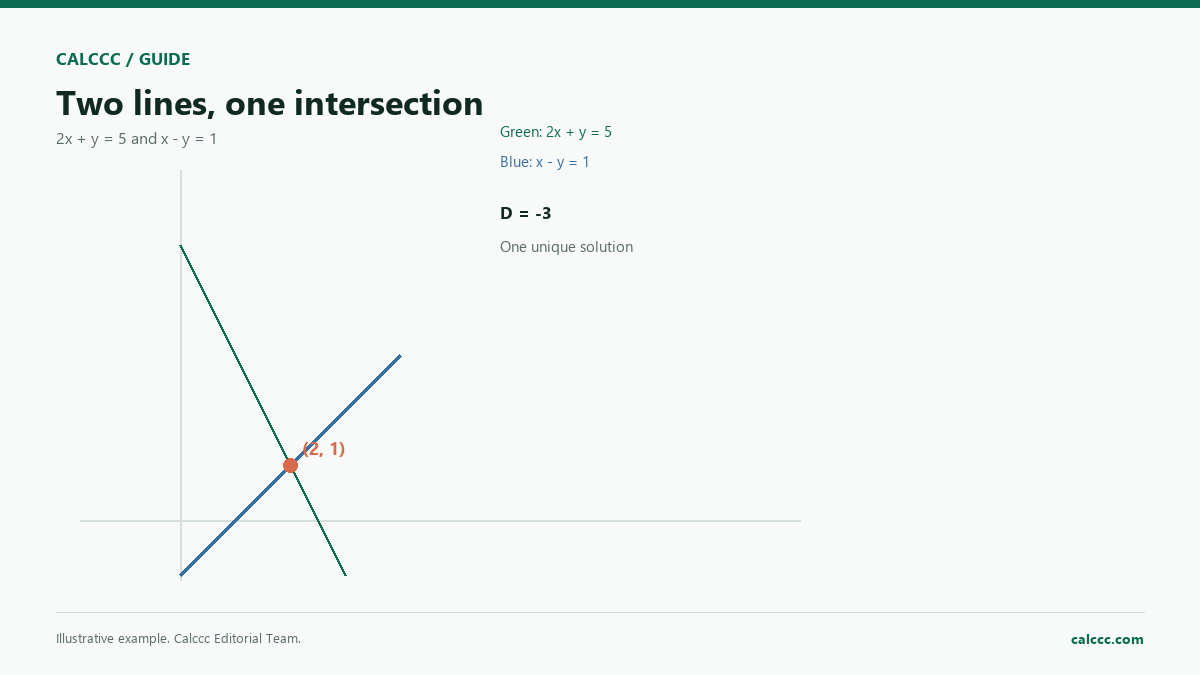
Solving Two Equations Without Guesswork
Substitution, elimination, and Cramer's rule explained with a worked 2x2 system, including the zero-determinant cases.
State and Local Tax Rules: What the Federal Calculator Cannot See
State income tax, local tax, property tax, sales tax, and cross-border rules can change the answer. A practical guide to what varies and what to check.
Withholding Is Not Tax Liability: Why Your Refund Is Not a Bonus
Understand the difference between paycheck withholding and the tax you actually owe, how a refund happens, and how to check your W-4 without overpaying.
Investment Fee Guide: How 1% a Year Becomes a Large Lifetime Cost
Understand fee drag, expense ratios, AUM fees, and why a small annual percentage can remove a large share of long-term growth.
Retirement Withdrawal Guide: The 4% Rule, Returns, and Inflation
A year-by-year look at retirement withdrawals: how the withdrawal rate, portfolio return, and inflation interact, and why sequence risk matters.
Paycheck Taxes Explained: Gross Pay, Withholding, FICA, and Net Pay
A practical guide to the gap between gross and net pay, including federal and state withholding, FICA, pre-tax deductions, and employer cost.
The Refinance Reset: Why a Lower Payment Can Cost More
A refinance restarts the clock. Compare the break-even month, remaining term, closing costs, and cash-out risk before choosing a lower payment.