


Key takeaways
- The coefficient is usually between 1 and 10.
- A positive exponent means a large number; a negative exponent means a small number.
- Moving the decimal left increases the exponent; right decreases it.
- Multiply coefficients and add exponents; divide coefficients and subtract exponents.
- Keep significant figures in mind when reporting a result.
Why scientists use it
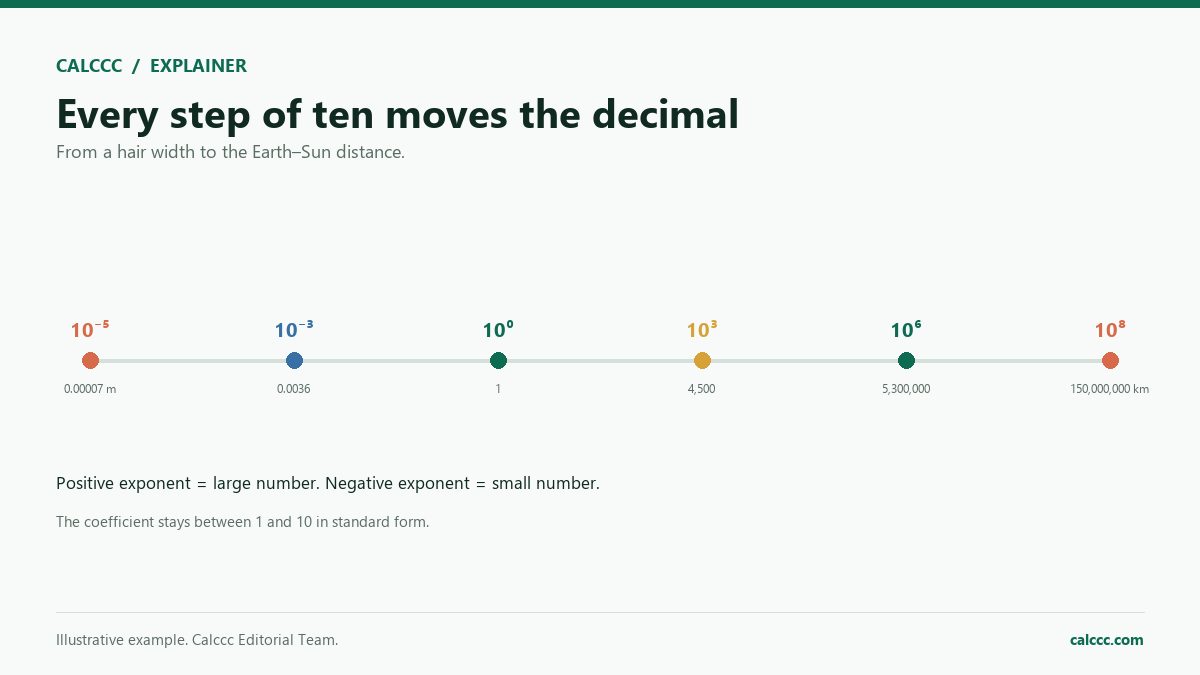
Scientific notation makes very large and very small numbers easier to read, compare, and calculate. The distance from Earth to the Sun is about 150,000,000 km, or 1.5 × 10⁸ km. The width of a human hair is about 0.00007 m, or 7 × 10⁻⁵ m. Writing all those zeros invites mistakes.
The format is also compact in calculators, spreadsheets, and scientific papers. It separates the meaningful digits from the scale of the number.
The two-part form
Number = coefficient × 10exponent
The coefficient should be at least 1 and less than 10 in standard scientific notation. The exponent is an integer. 3.2 × 10⁴ is standard. 32 × 10³ is mathematically equal but not standard form; it is sometimes called engineering notation when the exponent is a multiple of three.
Converting a large number
Take 72,000. Move the decimal left until the coefficient is between 1 and 10: 7.2. You moved four places, so the exponent is 4: 7.2 × 10⁴. Check: 7.2 × 10,000 = 72,000.
Take 5,300,000. Move left six places: 5.3 × 10⁶. The exponent counts the places moved, not the number of zeros after the first digit.
Converting a small number
Take 0.0036. Move the decimal right until the coefficient is between 1 and 10: 3.6. You moved three places to the right, so the exponent is −3: 3.6 × 10⁻³. Check: 3.6 ÷ 1,000 = 0.0036.
Take 0.0000008. Move right seven places: 8 × 10⁻⁷. A negative exponent does not make the number negative; it makes it small.
| Standard number | Scientific notation | Exponent meaning |
|---|---|---|
| 4,500 | 4.5 × 10³ | Decimal moved 3 places left |
| 72,000 | 7.2 × 10⁴ | Decimal moved 4 places left |
| 0.0036 | 3.6 × 10⁻³ | Decimal moved 3 places right |
| 0.00007 | 7 × 10⁻⁵ | Decimal moved 5 places right |
Multiplying and dividing
Multiply the coefficients and add the exponents: (2 × 10³) × (3 × 10⁴) = 6 × 10⁷. Divide the coefficients and subtract the exponents: (6 × 10⁵) ÷ (2 × 10²) = 3 × 10³. If the coefficient is not between 1 and 10, adjust it and change the exponent.
Example: (4 × 10³) × (2 × 10⁴) = 8 × 10⁷. Example: (8 × 10⁶) ÷ (2 × 10³) = 4 × 10³. When subtracting a negative exponent, remember that subtracting a negative is addition: 10³ ÷ 10⁻² = 10⁵.
Significant figures and rounding
The coefficient carries the meaningful digits. 4.50 × 10³ has three significant figures; 4.5 × 10³ has two. Do not add zeros that were not measured. When multiplying, the result should not have more significant figures than the least precise input.
Scientific notation does not make a measurement more precise. It only changes how the number is written.
2026 calculator update: what changed
The linked calculator has been upgraded. It now includes a professional worksheet with the inputs used, the method and scope, and a one-variable sensitivity check for finance tools. You can save two input sets as Scenarios A/B and compare the results side by side. The Print / PDF action produces a branded worksheet, and table-producing calculators can export a CSV.
Converting
Scientific notation writes a number as a × 10^n, where 1 ≤ a < 10. 4,500 = 4.5 × 10³. 0.0032 = 3.2 × 10⁻³. Move the decimal point until one nonzero digit is before it; the exponent counts the moves. A negative exponent means a number less than 1.
Operations
Multiply: multiply the coefficients and add the exponents. Divide: divide the coefficients and subtract the exponents. Add or subtract: convert to the same exponent, then combine. Example: (3 × 10⁴) × (2 × 10³) = 6 × 10⁷. (6 × 10⁵) ÷ (2 × 10²) = 3 × 10³.
Significant figures
Scientific notation makes significant figures clear. 4.50 × 10³ has three significant figures; 4.5 × 10³ has two. The calculator should preserve the intended precision, not add false digits.
What to compare
Compare the coefficient, exponent, and significant figures. A result with too many digits suggests false precision.
Use scientific notation when the exponent is clearer than a long string of zeros.
Check the coefficient and the exponent.
Now check it.
Now check it too.
Frequently asked questions
Can the coefficient be 10?
In standard form, no. 10 × 10³ should be rewritten as 1 × 10⁴. The coefficient is at least 1 and less than 10.
What does a negative exponent mean?
It means the number is less than 1. 10⁻³ = 0.001. It does not mean the number is negative.
Is engineering notation different?
Yes. Engineering notation uses exponents that are multiples of three, so the coefficient can be between 1 and 1,000. It is common in electronics and engineering.
How do I add numbers in scientific notation?
Convert them to the same exponent, then add the coefficients. For example, 2 × 10³ + 3 × 10³ = 5 × 10³. If the exponents differ, adjust one first.
How we checked this guide
We converted each example by moving the decimal and checked the result by multiplying back. The NIST SI prefixes and powers-of-ten conventions were used for the scale. The examples are exact arithmetic; significant-figure rules are simplified for a general audience.
Now check.
Further reading