


Key takeaways
- Start with net profit. Revenue minus ordinary business expenses, not gross revenue.
- Only 92.35% is taxed. The adjustment approximates the employer portion of payroll tax.
- Social Security has a wage base. For 2027, the wage base is $184,300, reduced by W-2 Social Security wages.
- Medicare has no wage base. The 2.9% portion applies to all net earnings, with an extra 0.9% above the threshold.
- The deductible half is an income tax deduction. It does not reduce the self-employment tax itself.
Who pays self-employment tax
If you are self-employed and your net earnings exceed the filing threshold, you generally pay self-employment tax. That includes sole proprietors, partners, and many LLC members. Employees usually have Social Security and Medicare withheld from wages; self-employed workers pay both the employee and employer portions through Schedule SE.
The tax is based on net earnings from self-employment. Business deductions reduce the profit that is subject to the tax, but personal expenses and capital purchases are treated under separate rules.
The 92.35% adjustment
Take net profit and multiply by 0.9235. The result is the amount subject to Social Security and Medicare tax. The 7.65% reduction is intended to approximate the employer half of payroll tax, which is not treated as employee wages.
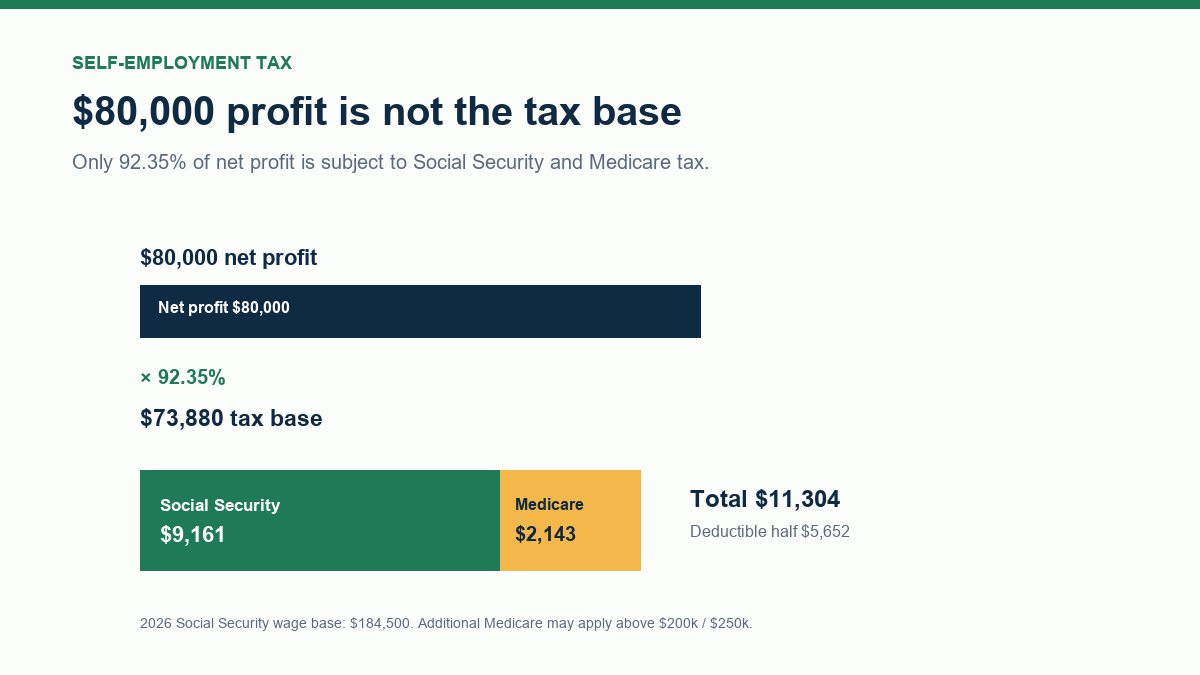
Example: $80,000 of net profit produces a tax base of $73,880. That is not the amount you keep; it is the base used to calculate the two tax components.
The 2027 numbers
The Social Security portion is 12.4% of the tax base, but only up to the annual wage base. For 2027, the Social Security wage base is $184,300. If you also have W-2 wages subject to Social Security, those wages use up part of the base, and the remaining room applies to self-employment income.
The Medicare portion is 2.9% of the tax base with no wage base. The Additional Medicare tax is 0.9% on wages plus self-employment earnings above $200,000 for single filers or $250,000 for married filing jointly. Employers withhold the additional tax on wages above the threshold, but self-employed workers generally account for it on their return.
Worked example
With $80,000 of net profit and no W-2 wages, the tax base is $73,880. Social Security is $9,161 and Medicare is $2,143, for a total of $11,304. The deductible half is $5,652. A flat quarterly set-aside is about $2,826, but that is only a planning number; it does not include income tax.
If you already earned $150,000 in W-2 wages, only $34,300 of the 2027 Social Security wage base remains. The Social Security portion is calculated on the smaller amount, while Medicare still applies to the self-employment tax base. Additional Medicare may also apply if combined earnings exceed the filing-status threshold.
What the calculator does not include
It does not calculate federal income tax, state income tax, local tax, credits, or estimated tax penalties. It does not apply the Qualified Business Income deduction or other deductions. It also does not decide whether a payment is required; that depends on your full tax picture.
Use the result as a set-aside estimate, then build a full tax projection with your income, deductions, credits, and withholding. If you have multiple businesses, rental income, or a spouse with wages, the combined calculation can change.
Quarterly payments and safe-harbor planning
The quarterly set-aside in the calculator is a simple division of the annual self-employment tax. It is not a quarterly tax filing. Estimated tax payments also need to cover federal income tax and may need to cover state tax. Many taxpayers use safe-harbor rules based on last year’s tax or a percentage of current-year tax to avoid an underpayment penalty.
If your income is uneven, a flat quarter may not match the actual liability. Recalculate after each quarter and keep the self-employment tax estimate separate from the income tax estimate. A tax professional can help you choose a payment method that fits your cash flow.
2027 calculator update: what changed
The linked calculator has been upgraded. It now includes a professional worksheet with the inputs used, the method and scope, and a one-variable sensitivity check for finance tools. You can save two input sets as Scenarios A/B and compare the results side by side. The Print / PDF action produces a branded worksheet, and table-producing calculators can export a CSV.
The page also explains why a bank, lender, broker, or provider can quote a different number: rate versus APR, fees, credit pricing, taxes, insurance, and timing. Use the written quote or Loan Estimate as the binding document, not the calculator estimate.
For tax results, treat the output as a component estimate. Withholding, credits, filing status, and state or local rules can change the final liability; a calculator is not a tax return.
2027 calculator upgrade: quarterly set-aside table
The self-employment tax calculator now includes the component table, a quarterly set-aside table, and a tax-component chart. The deductible half is shown separately; it reduces income tax, not the self-employment tax itself. This is still an estimate, not a tax return.
Frequently asked questions
What income is subject to self-employment tax?
Generally, net earnings from self-employment. The calculator applies the 92.35% adjustment to net profit before calculating Social Security and Medicare.
Why is only 92.35% of profit taxed?
The adjustment approximates the employer portion of payroll tax that would be paid on wages. It is part of the Schedule SE calculation.
Does the deductible half reduce self-employment tax?
No. It is an income tax deduction. It reduces taxable income, not the self-employment tax itself.
Does this include federal income tax?
No. It estimates self-employment tax only. Use a full tax projection for income tax, credits, and state tax.
Further reading
Keep exploring
Decision path