What this calculator does
This calculator estimates how many calories an adult body burns at rest and with daily activity. It uses the Mifflin-St Jeor equation, a common formula for resting energy needs, and an activity multiplier for total daily energy expenditure. The result gives you a starting range for weight loss, maintenance, or weight gain. It is built for healthy adults, not for diagnosing a condition or planning medical nutrition therapy.
Is this the right calculator?
Use it when
- You want an estimated daily calorie target for maintenance, loss, or gain.
- You want to compare activity levels at the same body size.
- You want to compare Mifflin-St Jeor and Harris-Benedict, or see a protein/carb/fat split.
Use something else when
- You need a clinical diet plan for a medical condition or eating disorder.
- You need measured resting metabolic rate from a lab test.
What changes the result most
| Body size | A larger body generally needs more daily energy. |
|---|---|
| Activity level | More activity raises the estimated maintenance calories. |
| Age and sex | These affect resting energy use in the formula. |
| BMR formula | Mifflin-St Jeor and Harris-Benedict use different coefficients and can produce different calorie targets. |
| Activity multiplier | A higher activity factor raises maintenance calories without changing BMR. |
How to use it
- Enter age, sex, height, weight, and activity level.
- Choose Mifflin-St Jeor or Harris-Benedict for BMR.
- Open Advanced options to choose a macro split.
- Review maintenance calories, BMR, weight goals, and macro grams.
- Use the formula choice to compare methods; do not treat the result as a prescription.
How it works
Example calculations
Example 1: moderately active woman
A 35-year-old woman at 165 cm and 68 kg has a BMR of about 1,375 calories. At moderate activity, her daily needs are about 2,132 calories, with targets of about 1,632 for loss, 2,132 for maintenance, and 2,632 for gain.
Example 2: lightly active man
A 40-year-old man at 178 cm and 81.6 kg has a BMR of about 1,734 calories. With light activity, his daily needs are about 2,384 calories, so the loss target is about 1,884 and the gain target is about 2,884.
Example 3: sedentary office worker
A 30-year-old woman at 157 cm and 63.5 kg has a BMR of about 1,305 calories. At sedentary activity, her daily needs are about 1,566 calories, and the loss target would be about 1,066, which is low enough that a clinician should be involved.
What the result means
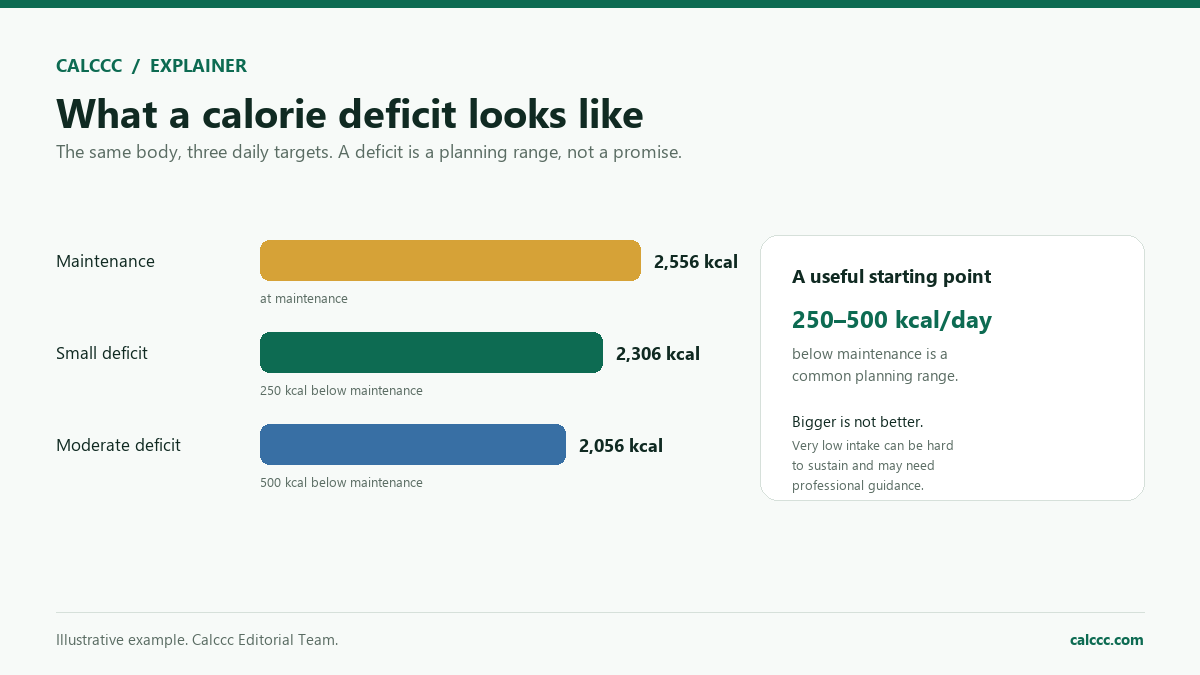
Your BMR is what you would burn at complete rest, and your TDEE adds movement, exercise, and the energy used to digest food. The targets are estimates, not rules. A 500-calorie daily deficit is often described as a gradual pace of about one pound per week, but real change is rarely linear. Very low intakes can make it hard to get enough nutrients, so many guidelines suggest not going below about 1,200 calories for women or 1,500 for men without medical supervision. Track your weight over two to four weeks and adjust by small amounts. This calculator does not account for medical conditions, medications, pregnancy, breastfeeding, or athletic training loads.
Common mistakes
- Choosing an activity level that reflects your best day instead of a typical week.
- Eating back the calories a fitness tracker says you burned, which often overstates the burn.
- Cutting calories very low for fast results instead of making a gradual change.
- Forgetting drinks, oils, sauces, and bites while tracking.
- Expecting steady weekly loss instead of looking at a multi-week trend.
Assumptions and limits
- The person is a healthy adult age 18 or older.
- Mifflin-St Jeor reasonably estimates resting energy needs for most adults.
- The activity factor matches overall weekly activity, including work and exercise.
- No medical condition, medication, pregnancy, or breastfeeding affects calorie needs.
- Food and activity records are reasonably accurate.
Frequently asked questions
Which BMR formula is better?
Mifflin-St Jeor is generally more accurate for most people; Harris-Benedict is an older equation. Individual variation is large.
Does this include exercise calories?
Activity level is a multiplier on BMR. It is an estimate, not a measurement of every workout.
Are the macro targets medical advice?
No. They are a simple percentage split for planning. Medical conditions, pregnancy, and sports nutrition may need individual guidance.
How fast can I lose weight?
A 500-calorie daily deficit is often used for about 1 lb/week, but sustainable loss varies. Very low intake should be discussed with a clinician.
Why do the formulas give different numbers?
They use different coefficients and were derived from different populations. Pick one and track consistently.
Does this replace a food diary?
No. It estimates a starting target; actual intake and weight trends determine whether it is appropriate.
Sources
2026 update
How to use the professional output
This page is not just a formula box. The result is designed to be checked, compared, and taken away.
- Professional worksheet. The result includes the inputs used, the method and scope, and a one-variable sensitivity check for finance calculators.
- A/B scenarios. Save two input sets in the browser and compare the primary, secondary, and breakdown figures side by side.
- Print / PDF and CSV. Print a branded worksheet, or export the year-by-year table when the calculator produces one.
The formulas and assumptions above still govern the number. The worksheet makes the estimate auditable; it does not make it a lender quote, tax return, or personalized advice.
Part of a decision center
Health Decision Center
See the companion tools, decision guides, and patterns that go with this calculator.
Go deeper