What this calculator does
Scientific notation writes a number as a coefficient between 1 and 10 multiplied by a power of ten. It keeps long strings of zeros out of the way, so 0.00042 becomes 4.2 x 10^-4. This converter moves the decimal point, counts the places, and returns the coefficient, exponent, and ordinary decimal form, which makes it easy to check homework or read a calculator display.
How to use it
- Enter a positive or negative number.
- Read the scientific notation with the coefficient and exponent.
- Check the standard decimal form against your input.
- Use the exponent sign to see whether the value is large or small.
How it works
Example calculations
Example 1: 12,345
12,345 becomes 1.2345 x 10^4. The coefficient is 1.2345, the exponent is 4, and the standard decimal form is 12,345.
Example 2: 0.00042
0.00042 becomes 4.2 x 10^-4. The decimal point moves four places right, so the exponent is negative four, and the coefficient is 4.2.
Example 3: -0.00305
-0.00305 becomes -3.05 x 10^-3. The coefficient is -3.05, whose absolute value is between 1 and 10, and the exponent is -3. The sign belongs to the coefficient, not the power of ten.
What the result means
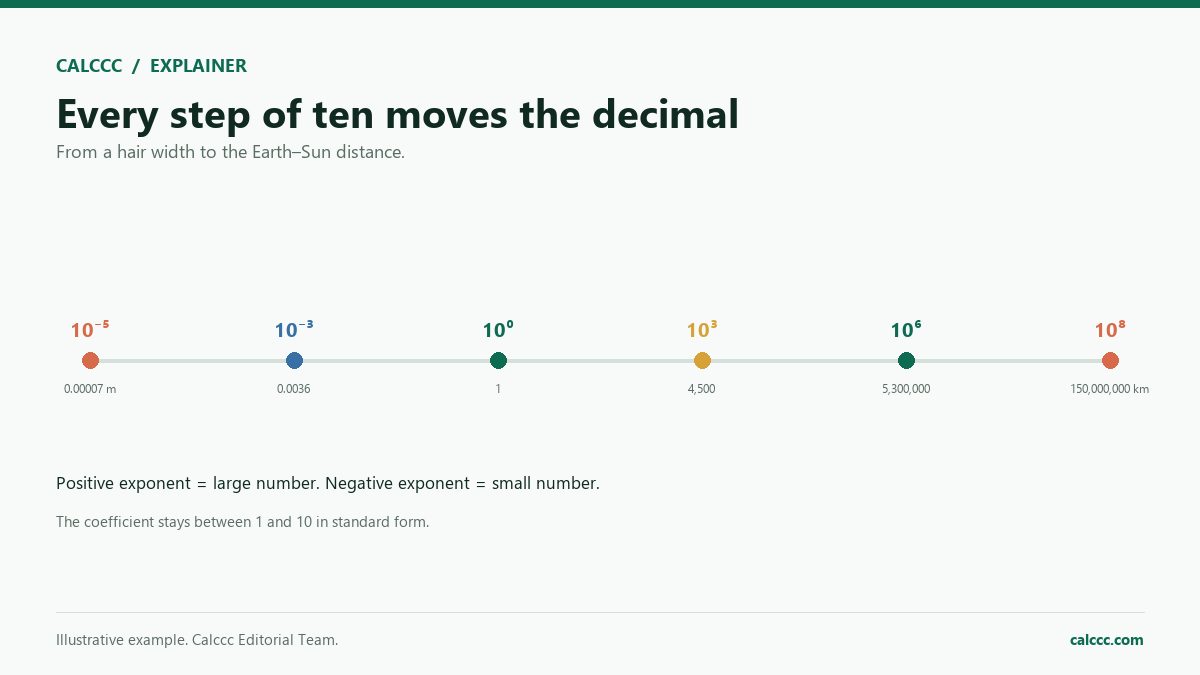
The exponent counts decimal places, not zeros. A positive exponent means the number is 10 or more, and a negative exponent means it is between 0 and 1. Each step of one in the exponent multiplies or divides by 10, which makes magnitudes easy to compare: 10^5 is ten times 10^4. Calculators often show the same value as 1.2345E4, where E stands for exponent. The converter keeps the digits you enter, so trailing zeros that indicate precision may be dropped. Normalizing matters: 12.345 x 10^3 is the same value, but it is not standard scientific notation because the coefficient is above 10.
Common mistakes
- Leaving a coefficient of 12.345 instead of 1.2345.
- Using the wrong sign on the exponent for small numbers.
- Moving the decimal point in the wrong direction.
- Dropping the negative sign on a negative number.
- Counting zeros instead of decimal places.
Assumptions and limits
- The input is a finite decimal number.
- The coefficient has an absolute value from 1 up to but not including 10.
- The exponent is a whole number.
- Displayed digits may be rounded for very long inputs.
- Zero is reported separately because it has no nonzero coefficient.
Frequently asked questions
What is scientific notation?
It is a shorthand that writes a number as a coefficient times a power of ten, such as 3.2 x 10^5. It is common in science and engineering.
Why must the coefficient be between 1 and 10?
That range makes the form standard, so every number has one agreed representation. 0.32 x 10^6 is the same value but not normalized.
How do I read a negative exponent?
It means a value below 1. 10^-3 equals 0.001, so 4.2 x 10^-3 equals 0.0042.
Can the coefficient be negative?
Yes. The sign of the original number goes on the coefficient, so -0.00305 becomes -3.05 x 10^-3.
What happens with zero?
Zero cannot be written with a nonzero coefficient. It is simply 0, and this converter reports it that way.
What does E mean on a calculator?
E is the calculator's shorthand for times ten to a power. 1.2345E4 means 1.2345 x 10^4.
Sources
2026 update
How to use the professional output
This page is not just a formula box. The result is designed to be checked, compared, and taken away.
- Professional worksheet. The result includes the inputs used, the method and scope, and a one-variable sensitivity check for finance calculators.
- A/B scenarios. Save two input sets in the browser and compare the primary, secondary, and breakdown figures side by side.
- Print / PDF and CSV. Print a branded worksheet, or export the year-by-year table when the calculator produces one.
The formulas and assumptions above still govern the number. The worksheet makes the estimate auditable; it does not make it a lender quote, tax return, or personalized advice.
Go deeper