What this calculator does
This calculator estimates body mass index for adults age 20 and older using the standard formula. It is a fast way to compare your weight with a broad range that researchers associate with lower health risk. You can switch between metric and imperial units, and the result includes the healthy weight range for your height. BMI is a starting point for a conversation, not a complete picture of your health.
Is this the right calculator?
Use it when
- You want a quick adult BMI screening from height and weight.
- You want to see which broad BMI range applies to an adult.
Use something else when
- You need an assessment for a child, pregnant person, or high-muscle athlete.
- You need a clinical diagnosis or body-composition measurement.
What changes the result most
| Weight | BMI rises or falls directly with weight at a fixed height. |
|---|---|
| Height | The same weight produces a higher BMI at a shorter height. |
| Body composition | BMI does not distinguish muscle from fat, so athletes can be misclassified. |
How to use it
- Choose metric or imperial units.
- Enter weight and height.
- Open Advanced options to add waist circumference and choose centimeters or inches.
- Review BMI, category, healthy weight range, and waist-to-height ratio.
- Discuss the result with a clinician if you have health concerns.
How it works
Example calculations
Example 1: imperial units
A person who is 5 feet 9 inches tall (69 inches) and weighs 160 pounds has a BMI of about 23.6, which falls in the healthy weight category. The healthy weight range for that height is about 125 to 169 pounds.
Example 2: metric units
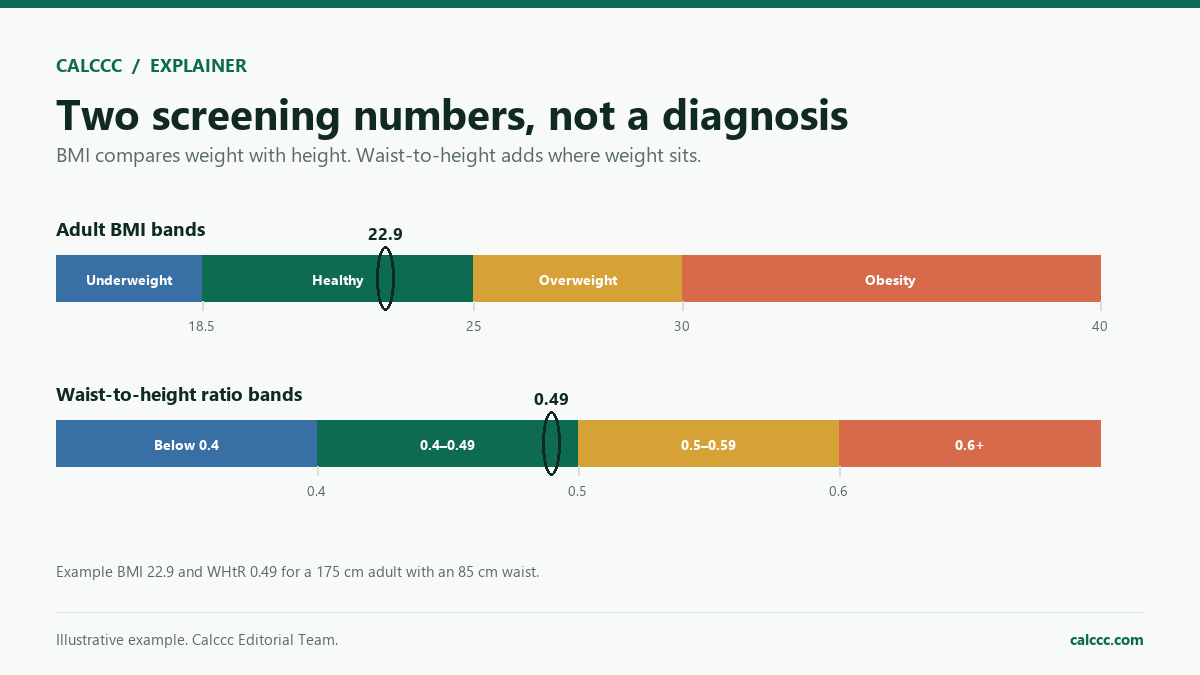
A person who is 1.75 meters tall and weighs 70 kilograms has a BMI of about 22.9, also in the healthy range. For that height, the healthy weight range is about 56.7 to 76.3 kilograms.
Example 3: above the healthy range
A person who is 5 feet 4 inches tall (64 inches) and weighs 180 pounds has a BMI of about 30.9, in the obesity category. The healthy weight range for that height is about 108 to 145 pounds.
What the result means
BMI is a screening measure, not a diagnosis. It compares your weight with your height and flags whether your weight may raise health risks, but it cannot tell how much of your weight is muscle, bone, or fat, or where fat is stored. A muscular athlete can have a high BMI while carrying little body fat, and an older adult can have a healthy BMI with low muscle mass. Waist circumference, blood pressure, blood sugar, and cholesterol add context. If your result is outside the healthy range, the useful next step is to talk with a clinician about the whole picture rather than to focus on the number alone. Do not use this calculator for children, during pregnancy, or as a substitute for medical care.
Common mistakes
- Treating a BMI number as a diagnosis instead of a screening result.
- Measuring height with shoes on or weight on a different scale than usual.
- Mixing metric and imperial units in the same calculation.
- Using adult BMI categories for children or teenagers, who need age-based percentiles.
- Ignoring muscle mass, waist size, and other health measures.
Assumptions and limits
- The person is an adult age 20 or older and not pregnant.
- Height and weight are measured accurately without shoes or heavy clothing.
- Standard adult BMI categories are used.
- BMI is interpreted as a screening tool, not a measure of body fat percentage.
- Health risk can vary by age, ancestry, and other factors that BMI does not capture.
Frequently asked questions
Is BMI accurate for athletes?
No. Muscle is denser than fat, so BMI can classify muscular people as overweight. Waist ratio adds context but is still a screening measure.
What is waist-to-height ratio?
Waist circumference divided by height. It is an additional screening measure for central fat distribution.
Which waist unit should I use?
Choose centimeters or inches; the calculator converts it to match your height unit.
Does this diagnose obesity?
No. BMI and waist ratio are screening tools; a clinician considers other factors.
Should children use this?
No. Children and teens need age- and sex-specific BMI percentiles.
Why is my BMI different from my scale app?
Rounding, height conversion, and measurement differences can change the result slightly.
Sources
2026 update
How to use the professional output
This page is not just a formula box. The result is designed to be checked, compared, and taken away.
- Professional worksheet. The result includes the inputs used, the method and scope, and a one-variable sensitivity check for finance calculators.
- A/B scenarios. Save two input sets in the browser and compare the primary, secondary, and breakdown figures side by side.
- Print / PDF and CSV. Print a branded worksheet, or export the year-by-year table when the calculator produces one.
The formulas and assumptions above still govern the number. The worksheet makes the estimate auditable; it does not make it a lender quote, tax return, or personalized advice.
Part of a decision center
Health Decision Center
See the companion tools, decision guides, and patterns that go with this calculator.
Go deeper