


Key takeaways
- BMR is measured under strict resting conditions; most online numbers are predictions, not measurements.
- TDEE = BMR × an activity multiplier in the common planning model.
- Mifflin-St Jeor is the default in our calculator; Harris-Benedict is available for comparison.
- Activity multipliers are ranges, not precise measurements of today’s movement.
- Use TDEE as a starting point, then track weight and intake for 2–3 weeks before adjusting.
BMR: the resting floor
BMR is the energy required for breathing, circulation, cell turnover, and other basic functions at rest. A true measurement requires controlled conditions (often indirect calorimetry). Most calculators predict BMR from sex, age, height, and weight.
The Mifflin-St Jeor equation is widely used in clinical and consumer settings:
Men: BMR = 10 × kg + 6.25 × cm − 5 × age + 5
Women: BMR = 10 × kg + 6.25 × cm − 5 × age − 161
The Harris-Benedict equation is older; revised versions are still used. Neither equation knows your body composition, thyroid status, medications, or recent weight change.
TDEE: the whole day
TDEE adds activity to BMR. The common planning formula is:
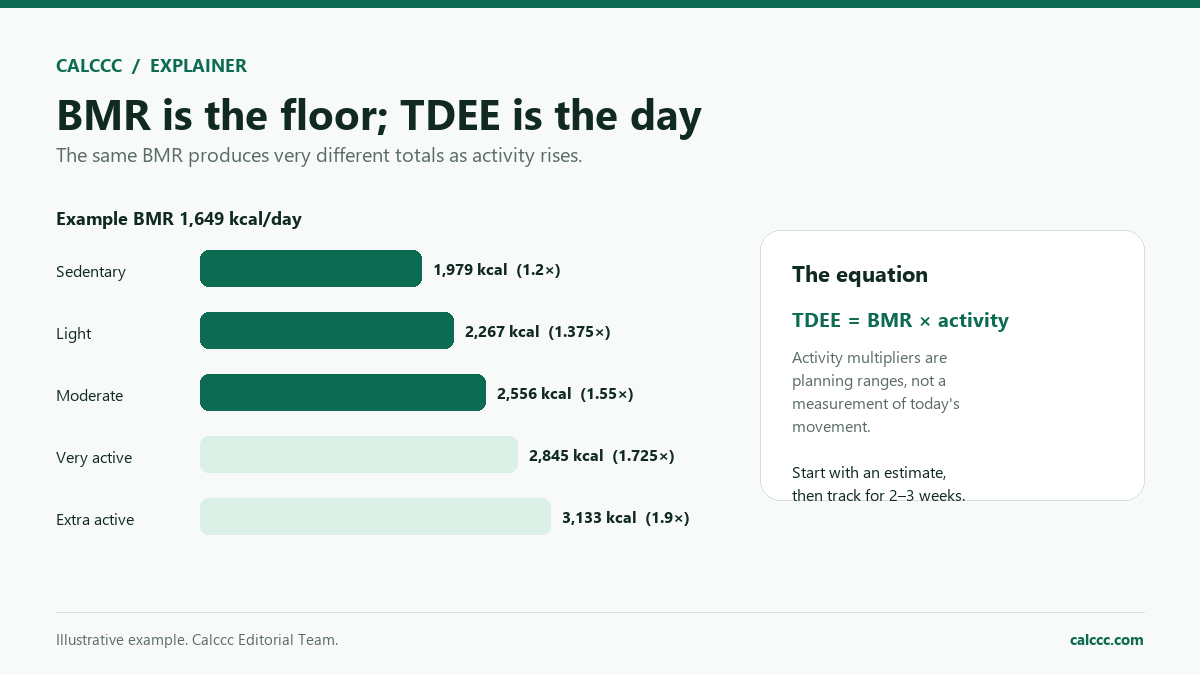
TDEE = BMR × activity multiplier
The multiplier is meant to capture exercise, walking, standing, fidgeting, and the energy cost of digesting food. It is a blunt instrument. Two people with the same job title can have very different daily movement.
| Activity description | Common planning multiplier | Example TDEE at BMR 1,649 |
|---|---|---|
| Sedentary — little or no exercise | 1.2 | 1,979 kcal |
| Light — 1–3 days/week | 1.375 | 2,267 kcal |
| Moderate — 3–5 days/week | 1.55 | 2,556 kcal |
| Very active — 6–7 days/week | 1.725 | 2,845 kcal |
| Extra active — physical job or two-a-days | 1.9 | 3,133 kcal |
These multipliers are common planning conventions, not validated individual measurements. Use the one that matches your typical week, not your best week.
Worked example
A 30-year-old man, 175 cm and 70 kg: BMR = 10(70) + 6.25(175) − 5(30) + 5 = 1,649 kcal/day. At a moderate multiplier of 1.55, TDEE = 2,556 kcal/day. At sedentary 1.2, it is 1,979 kcal. The difference between the two assumptions is 577 kcal — enough to change a weight trend.
BMR, RMR, and the “metabolism” label
RMR (resting metabolic rate) is measured under less strict conditions than BMR and is usually slightly higher. In everyday conversation, BMR and RMR are often used interchangeably; in a clinical setting they are not identical. If you see a device or app report “RMR,” it may be a prediction or a measurement under different conditions.
“Slow metabolism” is often used loosely. A low predicted BMR can reflect a smaller body, older age, or less muscle mass; it is not a moral failing. Thyroid disease and other medical conditions can affect energy use, but they need clinical testing, not a calculator.
Which number should you use?
- For a rough calorie target: use TDEE, then adjust based on the scale trend.
- For comparing formulas: look at BMR. Mifflin-St Jeor is a reasonable default for most adults.
- For exercise planning: do not add workout calories on top of a multiplier that already includes training.
- For clinical nutrition: use a clinician or dietitian; predictive equations can be inaccurate in illness, pregnancy, and extreme body sizes.
Why the scale can disagree with the math
Water, glycogen, sodium, menstrual cycle, travel, and training can move weight by several pounds in a week. A TDEE estimate is not a contract. If weight is stable on your intake and you want to lose, a deficit of roughly 250–500 kcal/day is a common starting point; larger deficits can be harder to sustain and may need professional supervision.
Do not use a very low calorie intake without medical guidance. This article is educational and does not prescribe a diet.
2026 calculator update: what changed
The linked calculator has been upgraded. It now includes a professional worksheet with the inputs used, the method and scope, and a one-variable sensitivity check for finance tools. You can save two input sets as Scenarios A/B and compare the results side by side. The Print / PDF action produces a branded worksheet, and table-producing calculators can export a CSV.
For health tools, the worksheet makes the inputs and assumptions visible, but it does not replace a clinician. Use the print view when you want to discuss the result with a professional.
Frequently asked questions
Which BMR formula is more accurate?
Mifflin-St Jeor is generally preferred for most adults; Harris-Benedict is older but still used. Both are predictions, and individual accuracy varies.
Does TDEE include exercise?
Yes, through the activity multiplier. It is not a workout-by-workout calorie count. Do not double-count by adding exercise calories on top of an “active” multiplier.
Why is my TDEE different from an app’s number?
Different equations, activity assumptions, rounding, and body-composition inputs produce different results. Use one method consistently and track the trend.
Can I use TDEE to gain weight?
Yes, as a starting point. Add a modest surplus and track the rate of gain. A large surplus often adds fat faster than muscle.
How we checked this guide
We used the Mifflin-St Jeor equation as implemented in the calculator and compared it with published descriptions of the equation and the revised Harris-Benedict equation. The activity multipliers are labeled as planning ranges, not measured values. The example is reproducible by hand.
Further reading
Keep exploring
Decision path