What this calculator does
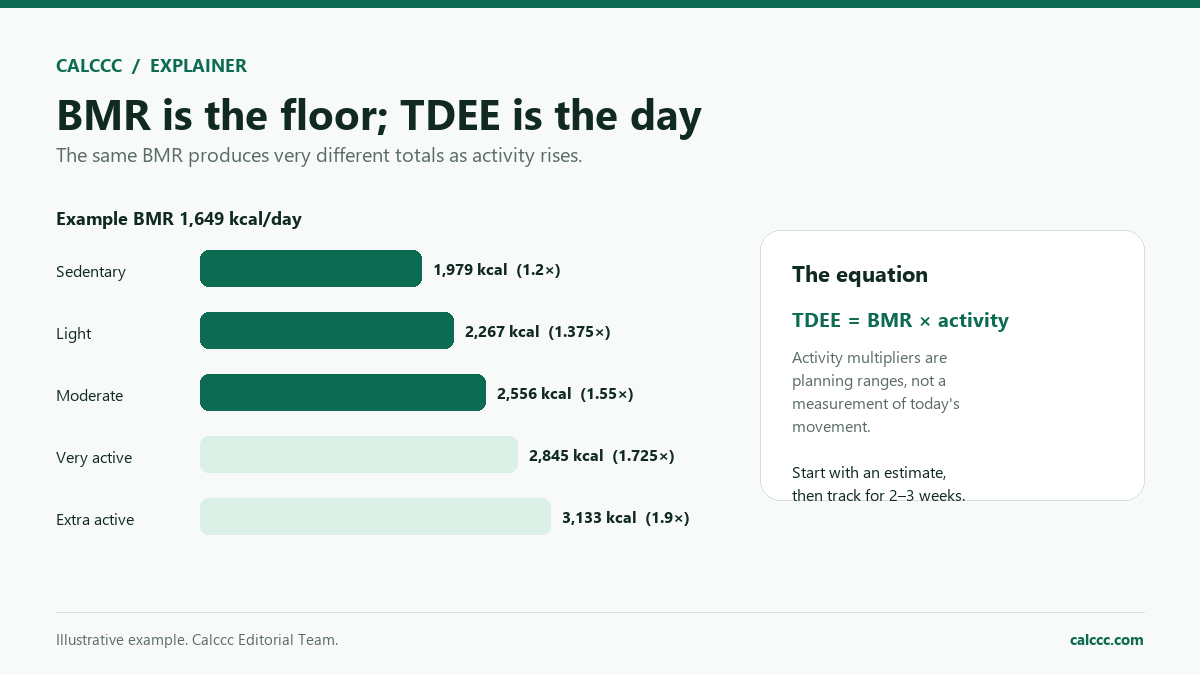
TDEE combines BMR with the energy used by movement, exercise, and digestion. The activity multiplier is a shortcut, not a measurement. Two people with the same inputs can differ by hundreds of calories because of muscle mass, job activity, sleep, and non-exercise movement. Use TDEE as a starting point and adjust from real weight data over two to three weeks.
How to use it
- Choose metric or imperial units.
- Enter sex, age, height, and weight.
- Choose activity level and a BMR formula.
- Review BMR, TDEE, deficit, and surplus calories.
- Track weight over 2–3 weeks and adjust.
How it works
Example calculations
Example 1: 30M, 175 cm, 70 kg, moderate
BMR is about 1,649 kcal/day. TDEE is about 2,556 kcal/day, with a 500 kcal deficit at about 2,056.
Example 2: 30F, 165 cm, 60 kg, light
BMR is about 1,320 kcal/day. TDEE is about 1,815 kcal/day.
Example 3: 45M, 180 cm, 90 kg, very active
BMR is about 1,805 kcal/day. TDEE is about 3,114 kcal/day.
What the result means
A 500 kcal daily deficit is often described as about one pound per week, but real weight change is noisy. Water, glycogen, sodium, and menstrual cycles can mask fat loss for days. Track a weekly average, keep protein adequate, and avoid aggressive deficits that hurt training or sleep. If weight is stable for three weeks, the estimate is close enough to adjust.
Common mistakes
- Choosing a high activity multiplier for a desk job.
- Eating back all exercise calories on top of a high multiplier.
- Expecting linear weekly weight loss.
- Ignoring protein and strength training.
- Using TDEE as a medical prescription.
Assumptions and limits
- The person is a healthy adult.
- The activity multiplier reflects the normal week.
- BMR uses Mifflin-St Jeor.
- No medical condition changes energy needs.
- The estimate is a starting point.
Frequently asked questions
Which BMR formula should I use?
Mifflin-St Jeor is generally preferred for most people; Harris-Benedict is an older alternative. Compare and track consistently.
Does this work in pounds and feet?
Yes. Choose Imperial and enter feet/inches and pounds.
Is TDEE exact?
No. Activity multipliers are rough; actual energy expenditure varies day to day.
How much should I cut?
A 500 kcal/day deficit is a common starting point, but individual needs vary. Do not use very low intake without professional guidance.
Does this include exercise?
Only through the activity multiplier. It is not a workout-by-workout calorie count.
Is this medical advice?
No. It is an educational estimate.
Sources
2026 update
How to use the professional output
This page is not just a formula box. The result is designed to be checked, compared, and taken away.
- Professional worksheet. The result includes the inputs used, the method and scope, and a one-variable sensitivity check for finance calculators.
- A/B scenarios. Save two input sets in the browser and compare the primary, secondary, and breakdown figures side by side.
- Print / PDF and CSV. Print a branded worksheet, or export the year-by-year table when the calculator produces one.
The formulas and assumptions above still govern the number. The worksheet makes the estimate auditable; it does not make it a lender quote, tax return, or personalized advice.
Part of a decision center
Health Decision Center
See the companion tools, decision guides, and patterns that go with this calculator.
Go deeper