


Key takeaways
- Maintenance calories are an estimate, not a fixed number.
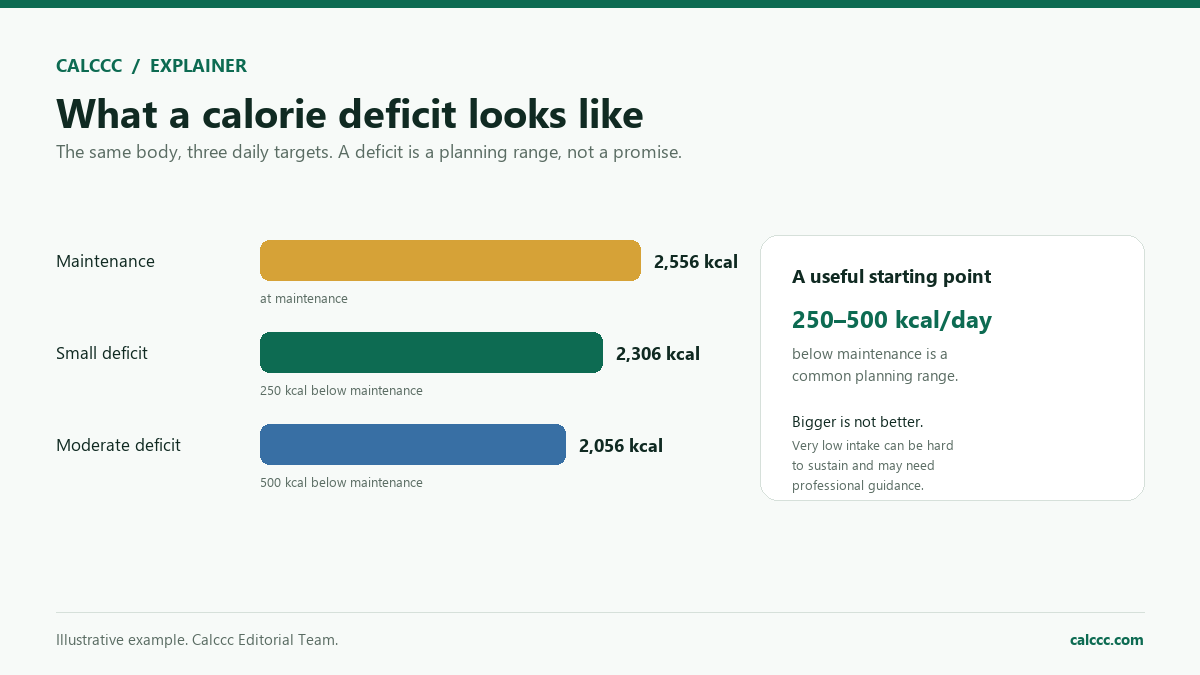
- A 250–500 calorie daily deficit is a common planning range.
- Weight loss is not perfectly linear; water and glycogen can mask fat loss.
- Protein and fiber help with satiety, but calories still matter.
- Very low intake can be unsafe without medical supervision.
What “calorie deficit” actually means
Your body uses energy for breathing, circulation, movement, and digesting food. The total is your total daily energy expenditure, or TDEE. If you eat less than that, you are in a deficit. If you eat more, you are in a surplus.
Think of it like a bank account. Food is a deposit; daily energy use is spending. A deficit is spending more than you deposit. The body fills the gap partly from stored energy, which is why weight can fall over time.
This is a simplification. Hormones, medication, sleep, stress, and medical conditions affect appetite and energy use. A calculator gives you a starting estimate, not a diagnosis.
How to estimate maintenance calories
Use a TDEE calculator or the calorie calculator, then treat the number as a hypothesis. For a 30-year-old man at 175 cm and 70 kg with moderate activity, the estimate is about 2,556 calories a day. A sedentary week might be closer to 1,979. The difference is large, which is why the activity assumption matters.
| Daily intake | Deficit vs 2,556 | What it means in practice |
|---|---|---|
| 2,556 | 0 | Estimated maintenance |
| 2,306 | 250 | Small deficit; often easier to sustain |
| 2,056 | 500 | Moderate deficit; common starting point |
| 1,556 | 1,000 | Aggressive; may be hard to sustain or unsafe without guidance |
Why “500 calories equals one pound” is only a rough guide
You will see the claim that a 3,500-calorie deficit equals one pound of fat. It is a useful teaching approximation, not a precise forecast. Weight loss changes body composition, water, glycogen, and metabolism. As you lose weight, maintenance calories often fall because a smaller body uses less energy.
That does not make the deficit useless. It means the scale will not move in a straight line. A reasonable plan is to set a deficit, track intake and weight for two to three weeks, then adjust based on the trend rather than a single day.
How fast should you lose?
A common planning range is 0.5–1% of body weight per week. For a 70 kg adult, that is about 0.35–0.7 kg (0.8–1.5 lb) per week. Faster loss can happen initially because of water, but a very aggressive deficit may increase hunger, fatigue, muscle loss, and the risk of rebound.
If you have a history of disordered eating, are pregnant, are under 18, or have a medical condition, talk to a clinician before restricting calories.
Why the scale stalls
- Water retention: sodium, hormones, travel, and hard training can add pounds of water.
- Glycogen: lower carbohydrate intake can reduce stored glycogen and water, then refill later.
- Constipation: food volume and fiber changes affect scale weight.
- Tracking drift: portions, oils, drinks, and bites are easy to underestimate.
- Adaptation: a smaller body burns less; the original deficit may no longer be a deficit.
Use a weekly average, not a daily reading. If the average is flat for three weeks and your tracking is consistent, adjust by 100–200 calories or increase activity.
Protein, fiber, and food quality
Calories determine weight change; food quality affects how you feel and how sustainable the plan is. Protein and fiber can increase fullness. Whole foods with water and fiber tend to be more filling per calorie than ultra-processed snacks. That is not a moral judgment; it is a practical way to make the deficit easier.
You do not need to eliminate any food group. A plan that fits your culture, budget, and schedule is more likely to last.
Exercise is helpful, but food is the main lever
Exercise burns calories and improves health, but it is easy to overestimate. A hard workout may burn a few hundred calories; a large restaurant meal can erase that quickly. Use exercise for fitness and mood, and use intake for the deficit. If you add activity, do not automatically “eat back” every calorie on the watch.
2026 calculator update: what changed
The linked calculator has been upgraded. It now includes a professional worksheet with the inputs used, the method and scope, and a one-variable sensitivity check for finance tools. You can save two input sets as Scenarios A/B and compare the results side by side. The Print / PDF action produces a branded worksheet, and table-producing calculators can export a CSV.
For health tools, the worksheet makes the inputs and assumptions visible, but it does not replace a clinician. Use the print view when you want to discuss the result with a professional.
Frequently asked questions
Is a 1,200-calorie diet safe?
For some people under medical supervision, a low intake may be appropriate. For many adults, 1,200 calories is very low and hard to sustain. Do not choose an extreme target from a calculator alone.
Do I need to count calories forever?
No. Counting is a learning tool. Many people transition to portion awareness and consistent meals once they understand their patterns.
Can I lose weight without a deficit?
Not fat mass, in the long run. Some weight can change from water or glycogen, but fat loss requires an energy deficit over time.
Why did I gain weight after a deficit?
Water, glycogen, food volume, and return to maintenance can all raise the scale quickly. A single day or week is not a trend.
How we checked this guide
We used the calorie calculator’s Mifflin-St Jeor and activity assumptions to produce the example, then compared the guidance with CDC and NHLBI weight-management resources. The 3,500-calorie figure is described as an approximation, not a guarantee. The example is illustrative and not a prescription.
Further reading
Keep exploring
Decision path