What this calculator does
Credit utilization is the share of your available revolving credit that you are using. It is usually reported both per card and across all cards. A lower utilization can help your credit profile, but the exact scoring formula is not public and utilization is only one factor.
How to use it
- Use the balances reported on your latest statements for a closer estimate.
- Add the credit limits across the cards you want to include.
- Set a target utilization, such as 30% or 10%.
- Compare current utilization with the target and the paydown amount.
- Recheck after the next statement reports.
How it works
Example calculations
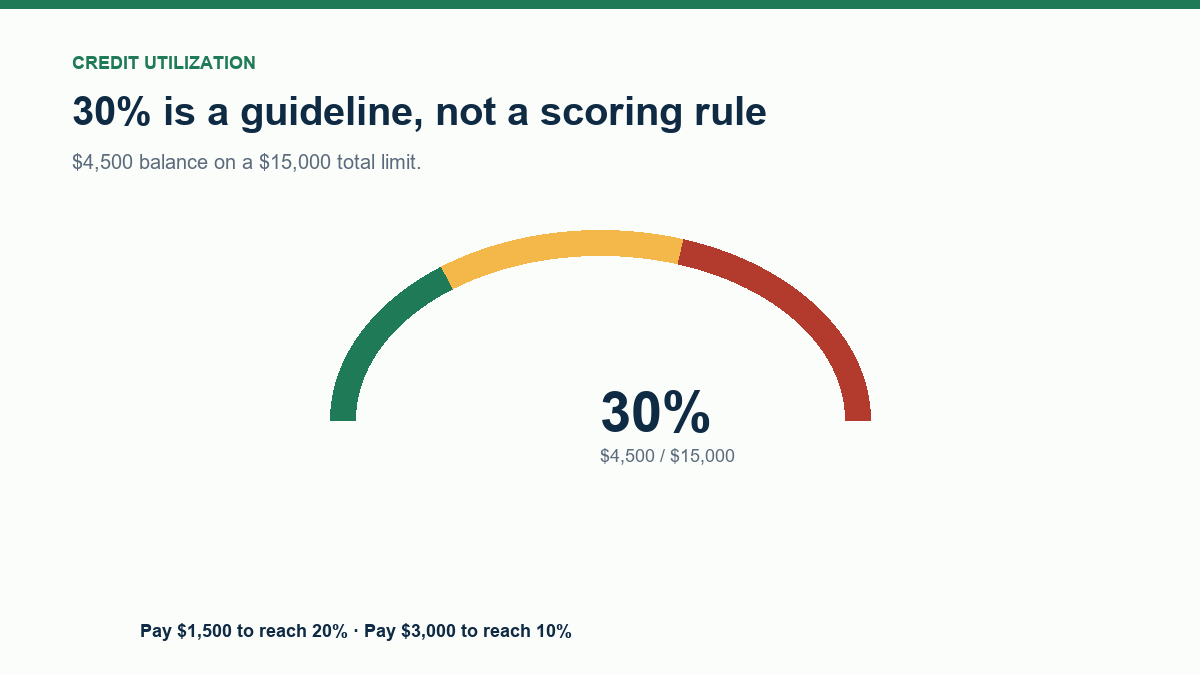
Example: $4,500 balance on a $15,000 limit
Utilization is 30%. Paying $1,500 brings the balance to $3,000, or 20%. Paying $3,000 brings it to $1,500, or 10%.
Per-card utilization
A single maxed-out card can matter even if the overall utilization looks low. This calculator uses totals; review each card separately when possible.
What the result means
A utilization ratio above 30% is often described as high, but 30% is a guideline rather than a scoring rule. Paying before the statement closing date can lower the balance that is reported. Closing a card can lower your total limit and raise utilization, so consider the effect before closing an old account.
Common mistakes
- Using a balance from before the latest statement.
- Ignoring per-card utilization.
- Closing a card to “clean up” credit and increasing the overall ratio.
- Assuming one payment immediately changes every score.
Assumptions and limits
- Balances and limits are reported accurately.
- The target applies to total revolving utilization.
- No new charges or limit changes occur before the next statement.
- The scoring effect is not guaranteed.
Frequently asked questions
What is a good credit utilization ratio?
Many guidelines suggest keeping utilization below 30%, and below 10% may be better for some profiles. The exact scoring formula is not public.
Does paying before the statement date help?
It can lower the balance reported to the credit bureaus, which may lower the utilization that is scored. The statement date is set by the issuer.
Should I close a card with a zero balance?
Closing a card reduces your total available credit and can raise your overall utilization. Consider the tradeoff before closing an old account.
Is utilization the only credit factor?
No. Payment history, account age, credit mix, new credit, and other factors also matter.
Sources
2026 update
How to use the professional output
This page is not just a formula box. The result is designed to be checked, compared, and taken away.
- Professional worksheet. The result includes the inputs used, the method and scope, and a one-variable sensitivity check for finance calculators.
- A/B scenarios. Save two input sets in the browser and compare the primary, secondary, and breakdown figures side by side.
- Print / PDF and CSV. Print a branded worksheet, or export the year-by-year table when the calculator produces one.
- Quote differences. The section below explains why a bank, lender, broker, or provider can quote a different number.
The formulas and assumptions above still govern the number. The worksheet makes the estimate auditable; it does not make it a lender quote, tax return, or personalized advice.
Before you use a quote
Why your bank, lender, or provider’s number may differ
A lender’s quote can differ from this estimate because the advertised rate is not always the APR, and fees and credit pricing are lender-specific.
What changes the quote
- APR versus interest rate. Origination, documentation, and registration fees are part of the APR but not the note rate.
- Credit and term. A longer term lowers the payment but usually raises total interest.
- Taxes and insurance. Sales tax, registration, and required coverage vary by state and lender.
- Promotional pricing. Dealer or issuer incentives may be conditional and can change the effective cost.
How to compare offers
- Compare the APR and total cost, not only the monthly payment.
- Ask for a written quote or Loan Estimate with all fees itemized.
- Use the same loan amount, term, date, and assumptions for every offer.
- Check what is excluded: taxes, insurance, closing costs, maintenance, or provider fees.
- Keep an emergency reserve; the lowest payment is not always the safest choice.
Reference: CFPB Loan Estimate explainer.
Part of a decision center
Debt & Credit Center
See the companion tools, decision guides, and patterns that go with this calculator.
Go deeper