


Key takeaways
- “10 business days” is not the same as 10 calendar days.
- Decide whether day 1 is the start date or the next day; contracts often specify.
- Decide whether the end date is included.
- Holidays are local and vary by country, state, and year.
- Weekends are not always Saturday–Sunday; some regions use Friday–Saturday.
Calendar days vs business days
Calendar days include every date: weekdays, weekends, and holidays. Business days (also called working days) usually exclude weekends and public holidays. A shipping estimate, a loan rescission period, and a court deadline may each use a different definition.
The ambiguity is not academic. A 10-business-day deadline can land two to four days later than a 10-calendar-day deadline, depending on weekends and holidays.
Step 1: decide whether day one counts
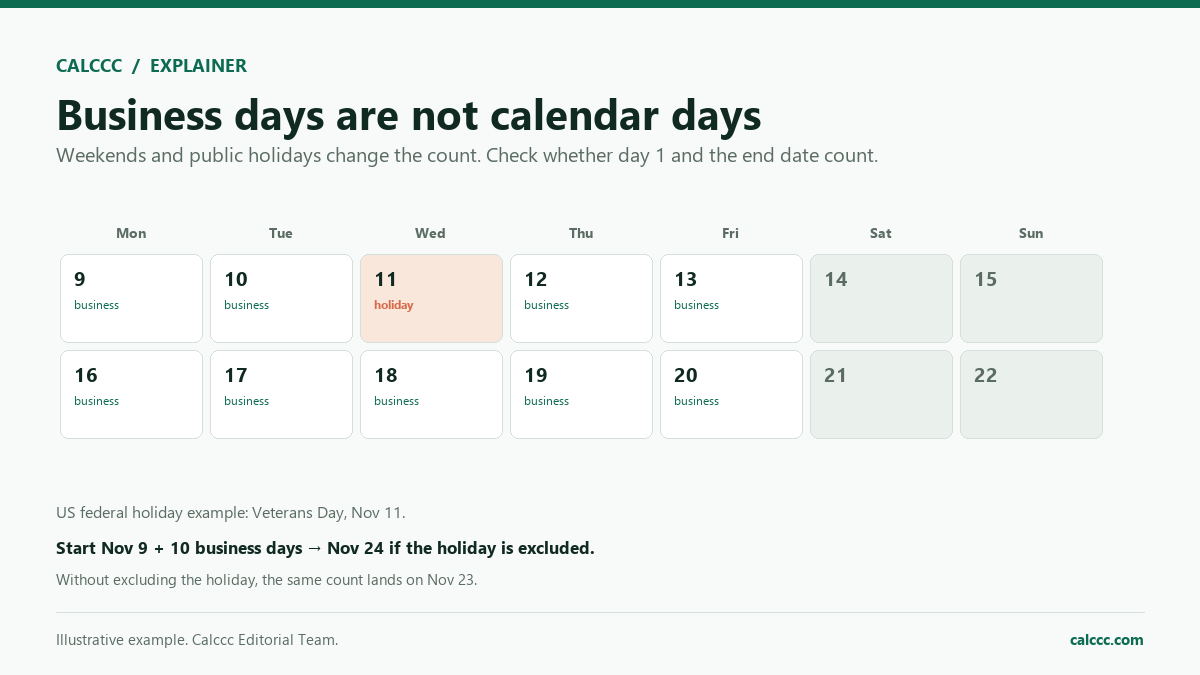
If a notice says “you have 10 business days from November 9,” does November 9 count as day 1? Some legal rules exclude the triggering day and start counting the next business day. Others include it. The difference can move the deadline by one day.
Write the rule down before you count. For contracts, use the definition in the contract; for court deadlines, use the court’s rules; for payroll, use the employer’s policy.
Step 2: exclude non-business days
Mark weekends and public holidays on a calendar, then count only the remaining days. In the US, federal holidays are set by 5 U.S.C. 6103 and observed on a Friday or Monday when they fall on a weekend. In the UK, bank holidays vary by nation (England and Wales, Scotland, Northern Ireland).
2026 US federal holidays
| Date | Holiday |
|---|---|
| January 1 | New Year’s Day |
| January 19 | Martin Luther King Jr. Day |
| February 16 | Washington’s Birthday |
| May 25 | Memorial Day |
| June 19 | Juneteenth |
| July 3 (observed) | Independence Day (July 4 is a Saturday) |
| September 7 | Labor Day |
| October 12 | Columbus Day |
| November 11 | Veterans Day |
| November 26 | Thanksgiving Day |
| December 25 | Christmas Day |
Federal holidays are not automatically state or private-employer holidays. Banks, schools, and companies may follow a different calendar.
2026 UK bank holidays: England and Wales
| Date | Bank holiday |
|---|---|
| January 1 | New Year’s Day |
| April 3 | Good Friday |
| April 6 | Easter Monday |
| May 4 | Early May bank holiday |
| May 25 | Spring bank holiday |
| August 31 | Summer bank holiday |
| December 25 | Christmas Day |
| December 28 | Boxing Day (substitute day) |
Scotland and Northern Ireland have additional or different dates. GOV.UK publishes the official lists and notes that a substitute weekday is normally used when a bank holiday falls on a weekend.
A worked example
Start Tuesday, November 10, 2026, and count 10 business days, excluding weekends and Veterans Day (November 11). If November 10 is day 1: 10, 12, 13, 16, 17, 18, 19, 20, 23, 24 → November 24. If the trigger day is November 9 and day 1 is November 10, the same count also lands on November 24. If you count November 9 as day 1, the tenth business day is November 23.
This is exactly why “10 business days from…” needs a convention. The date-difference calculator lets you toggle include-end-date, weekend pattern, and a holiday count.
2026 calculator update: what changed
The linked calculator has been upgraded. It now includes a professional worksheet with the inputs used, the method and scope, and a one-variable sensitivity check for finance tools. You can save two input sets as Scenarios A/B and compare the results side by side. The Print / PDF action produces a branded worksheet, and table-producing calculators can export a CSV.
Counting business days
Start with the calendar days, remove weekends, then remove holidays that fall on weekdays. If the start or end date is a weekend or holiday, clarify whether it counts. For deadlines, “within 10 business days” usually starts the next business day. A holiday observed on a Monday changes the count.
What to compare
Compare the start date, the holiday list, and the inclusive/exclusive rule. A one-day difference can matter for contracts and shipping.
Frequently asked questions
Are business days always Monday to Friday?
In the US and UK, usually, but not universally. Some countries and industries use different weekends, and “business day” can be defined by contract.
Does the end date count?
Often no for date-difference calculations, but contracts and court rules can say otherwise. Check the definition; if the end date counts, add one day.
Do holidays count as business days?
Usually not if the holiday is observed where the work is performed. A holiday in one state or country may not be a holiday in another.
How are weekend holidays observed?
In the US federal system, a Saturday holiday is usually observed on Friday and a Sunday holiday on Monday. UK bank holidays use substitute weekdays. Local rules can differ.
How we checked this guide
We checked the US list against the Office of Personnel Management’s federal holiday guidance and the UK dates against GOV.UK’s bank holiday page. We then counted the example by hand, excluding weekends and Veterans Day. Holiday observance can change; verify the current official calendar before relying on a legal deadline.
Further reading