


Key takeaways
- Measure the walls, not the floor. Wall area = 2 × (length + width) × wall height.
- Subtract about 20 sq ft per door and 15 sq ft per window.
- Multiply by coats before dividing by coverage.
- Add 10% for touch-ups, texture, and roller loss; round up to whole cans.
- Primer, ceiling paint, trim enamel, and supplies are separate.
Step 1: measure the walls
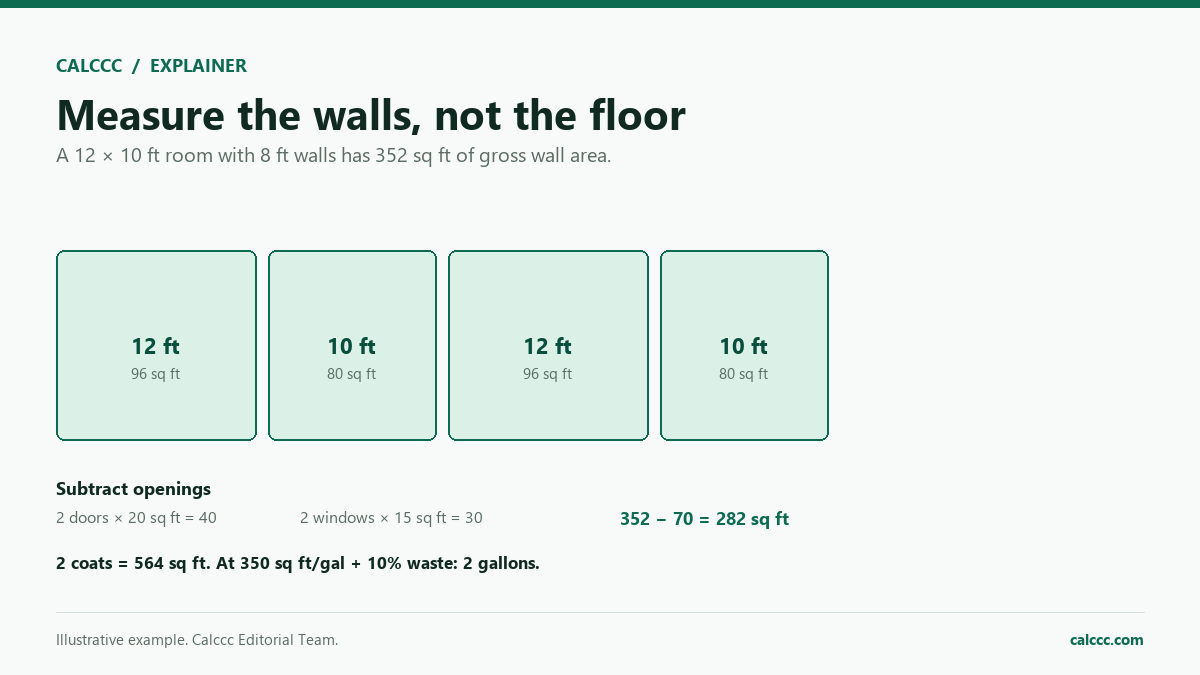
For a rectangular room, the gross wall area is 2 × (length + width) × wall height. A 12 × 10 ft room with 8 ft ceilings has 2 × (12 + 10) × 8 = 352 sq ft of gross wall area.
Do not use floor area as a shortcut. Floor area is length × width; wall area includes the height and all four walls. A 120 sq ft floor can easily have 350 sq ft of wall.
Step 2: subtract openings
A standard interior door is roughly 20 sq ft; a standard window is roughly 15 sq ft. For two doors and two windows: 40 + 30 = 70 sq ft. Paintable area = 352 − 70 = 282 sq ft.
If you are painting the door slabs or window trim, add those areas back or calculate them with a trim calculator. The wall estimate should not include surfaces you are not coating.
Step 3: multiply by coats
Most color changes need two coats. A dramatic color change, a porous surface, or a very light color over a dark wall may need three. Two coats on 282 sq ft = 564 sq ft of coating.
“One coat” paint still usually looks better with two. The label may say one-coat coverage under ideal conditions; your walls may not be ideal.
Step 4: divide by coverage and add waste
Coverage is printed on the can. A common range is 300–400 sq ft per gallon for interior wall paint; for this example, use 350. 564 ÷ 350 = 1.61 gallons. Add 10% for touch-ups and roller loss: 1.61 × 1.10 = 1.77, then round up to 2 gallons.
| Input | Example |
|---|---|
| Room | 12 × 10 ft, 8 ft walls |
| Gross wall area | 352 sq ft |
| Openings | 2 doors (40) + 2 windows (30) = 70 sq ft |
| Painted area | 282 sq ft |
| Coats | 2 → 564 sq ft |
| Coverage | 350 sq ft/gal |
| Waste | 10% → 1.77 gal |
| Buy | 2 gallons |
Primer is not paint
Primer has its own coverage and purpose. Bare drywall, patched walls, stains, and drastic color changes may need a primer coat. Do not assume the paint estimate includes primer. If you are covering a dark color with a light one, a tinted primer can reduce the number of finish coats.
Sheen, product, and surface matter
- Flat/matte: hides imperfections; less washable in high-traffic areas.
- Eggshell/satin: easier to clean; common for walls.
- Semi-gloss/gloss: durable and washable; often used on trim and doors.
- Texture: heavy texture increases surface area and paint use.
- Color change: dark to light or light to dark often needs an extra coat.
Coverage varies by product and surface. Use the number on the label, not a generic number, if you want a tighter estimate.
What the estimate does not include
- Ceilings (calculate separately: length × width).
- Trim, doors, baseboards, and window frames.
- Primer, sanding, caulk, tape, rollers, and trays.
- Multiple rooms with different colors.
- Paint loss from spraying or heavy texture.
2026 calculator update: what changed
The linked calculator has been upgraded. It now includes a professional worksheet with the inputs used, the method and scope, and a one-variable sensitivity check for finance tools. You can save two input sets as Scenarios A/B and compare the results side by side. The Print / PDF action produces a branded worksheet, and table-producing calculators can export a CSV.
Coats and coverage
Wall area = perimeter × height minus doors and windows. Coverage is usually 350–400 sq ft per gallon. Two coats double the paint, but the second coat may use less. Primer may be needed for bare drywall or repairs. Buy a little extra for touch-ups.
What to compare
Compare the wall area, the coverage, and the number of coats. A gallon estimate that ignores the second coat is the most common error.
Frequently asked questions
How much waste should I add?
10% is a common starting point for walls. Diagonal patterns, rough texture, spraying, and multiple colors may need more. The cost of one extra gallon is usually small compared with a second trip.
Does one gallon cover a room?
Usually not a whole room with two coats. A gallon covers roughly 300–400 sq ft; a typical bedroom has more wall area than that after openings and two coats.
Should I subtract windows and doors?
Yes for the wall estimate, unless you are painting them. Subtract the opening area once; do not double-count trim.
Can I use the same calculator for exterior paint?
The arithmetic is similar, but exterior surfaces, siding texture, and coverage differ. Use the exterior product’s coverage and add more waste for rough surfaces.
How we checked this guide
We built the example from the same area-and-coverage method used by the paint calculator and checked the arithmetic by hand. Coverage is presented as a range because manufacturer labels and surface conditions vary. The door and window allowances are planning estimates, not universal standards.
Further reading