


Key takeaways
- Use exact definitions, not rounded rules of thumb.
- Convert to a base unit first to avoid direction errors.
- Multiply or divide by the right factor; check the direction.
- Nautical miles are not statute miles.
- Round only at the end.
The factor method
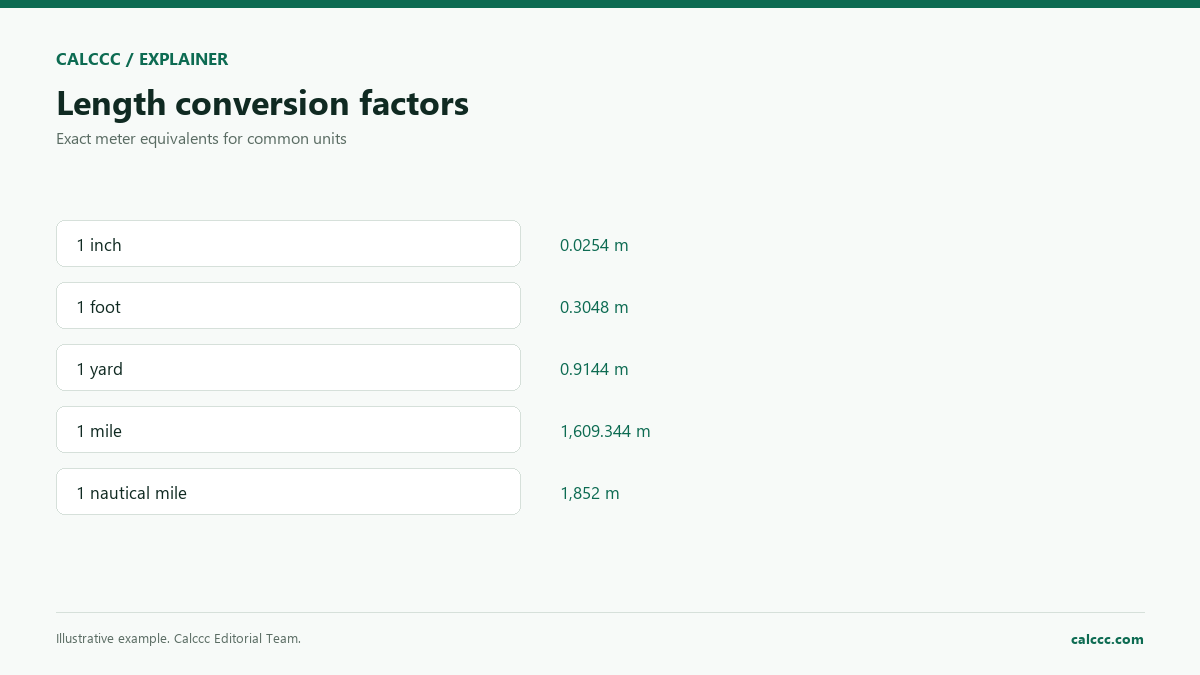
Each unit has a factor in meters: millimeter 0.001, centimeter 0.01, meter 1, kilometer 1,000, inch 0.0254, foot 0.3048, yard 0.9144, mile 1,609.344, and nautical mile 1,852. To convert 5 miles to kilometers, multiply by 1,609.344 to get meters, then divide by 1,000 to get 8.04672 km. The calculator does both steps and shows the factor.
Why direction errors happen
Multiplying when you should divide is the most common conversion mistake. A meter is longer than a foot, so a value in meters becomes a larger number in feet. A value in feet becomes a smaller number in meters. Sanity-check whether the number should grow or shrink.
Metric prefixes
The metric system uses powers of ten. A kilometer is 1,000 meters; a centimeter is 0.01 meters; a millimeter is 0.001 meters. Moving between metric units is a decimal shift, not a new conversion factor. The difficult part is usually the imperial units.
Nautical miles
A nautical mile is 1,852 meters, or about 1.15078 statute miles. It is used in aviation and marine navigation because it relates to latitude. Do not substitute it for a statute mile in road-distance calculations.
Rounding
Keep full precision through intermediate steps and round at the end. If the input has two significant figures, the output should not pretend to have six. The calculator displays more digits for convenience; the measurement’s precision still limits what is meaningful.
Feet, inches, and mixed units
Height is often written as 5 ft 9 in, not as a decimal. To convert to inches, multiply feet by 12 and add the remaining inches. To convert to centimeters, multiply the total inches by 2.54. The calculator accepts a single unit, so convert a mixed measurement to one unit first.
A decimal foot is not the same as feet and inches. 5.9 ft is about 5 ft 10.8 in, not 5 ft 9 in. Mixing the two formats is a common source of error.
Miles, yards, and sports distances
A marathon is 26.2 miles, but race signs may use kilometers. A 5K is 5,000 meters, or 3.10686 miles. A swimming mile is not a statute mile. When a distance matters for training, travel, or a contract, use the definition that applies to the context.
Precision in engineering
In engineering and manufacturing, conversions should be carried out with enough precision to avoid tolerance errors. Use exact factors and keep track of significant figures. A small rounding difference can matter when a part must fit within a thousandth of an inch.
A quick mental model
A meter is a little longer than a yard. A kilometer is a little more than half a mile. A centimeter is about 0.4 inch. These approximations are useful for a sanity check, but they are not exact. Use the exact factor for anything that matters.
For a rough conversion, remember that 1 mile is about 1.6 km and 1 kg is about 2.2 lb. Then check the exact calculator result. The approximation tells you whether the answer is in the right neighborhood; the exact factor tells you the answer.
Label every number
Write the unit next to every value in a calculation. A number without a unit is easy to misapply. When a result looks surprising, check the unit before checking the arithmetic; the direction of the conversion is often the real mistake.
Common exact values
One foot is 0.3048 meters, one yard is 0.9144 meters, and one inch is exactly 2.54 centimeters. These exact relationships let you derive the other imperial conversions without a lookup table. Keep them in mind for quick checks.
Frequently Asked Questions
How many feet are in a meter?
1 meter = 3.280839895 feet.
How many kilometers are in a mile?
1 mile = 1.609344 kilometers.
Is a nautical mile the same as a mile?
No. A nautical mile is 1,852 meters; a statute mile is 1,609.344 meters.
Why do my conversions disagree slightly?
Different rounding at intermediate steps can cause small differences. Use exact factors and round once at the end.
How we checked this guide
We checked the factors against NIST SI guidance and BIPM definitions and verified the examples by hand. The converter uses exact international definitions.
Common conversions
1 inch = 2.54 cm; 1 foot = 30.48 cm; 1 mile = 1.609 km; 1 meter = 3.281 ft. Convert in one step to avoid compounding rounding errors. For a room, convert the measurement before multiplying, not after.
What to compare
Compare the unit, the factor, and the precision. A conversion with too many decimals can imply false accuracy.
Now check the unit, the factor, and the precision.
Compare the unit, the conversion factor, and the precision before using the result.
2026 calculator update: what changed
The linked calculator has been upgraded. It now includes a professional worksheet with the inputs used, the method and scope, and a one-variable sensitivity check for finance tools. You can save two input sets as Scenarios A/B and compare the results side by side. The Print / PDF action produces a branded worksheet, and table-producing calculators can export a CSV.
Further reading
Keep exploring
Decision path