


Key takeaways
- Use gross income for the 30% rule. Then check the result against take-home pay and real expenses.
- DTI can bind before the 30% rule. Monthly debts reduce how much housing the budget can carry.
- Utilities are part of housing cost. A low rent with high utilities may cost more than it looks.
- Move-in cash matters. Deposit, first month, fees, and furniture can strain the first month.
- The maximum is a ceiling, not a target. Leaving room for savings and emergencies is part of affordability.
What “affordable” means
Housing affordability is usually described as a share of income. The 30% guideline says a household should spend no more than about 30% of gross income on housing. It is widely used in housing policy and rental planning, but it is not a universal rule for every person or every city.
A renter with no debt, a stable emergency fund, and a short commute may be comfortable above 30%. A renter with student loans, a car payment, and irregular income may be stretched below 30%. The percentage is a starting point for a conversation, not an answer.
The two limits
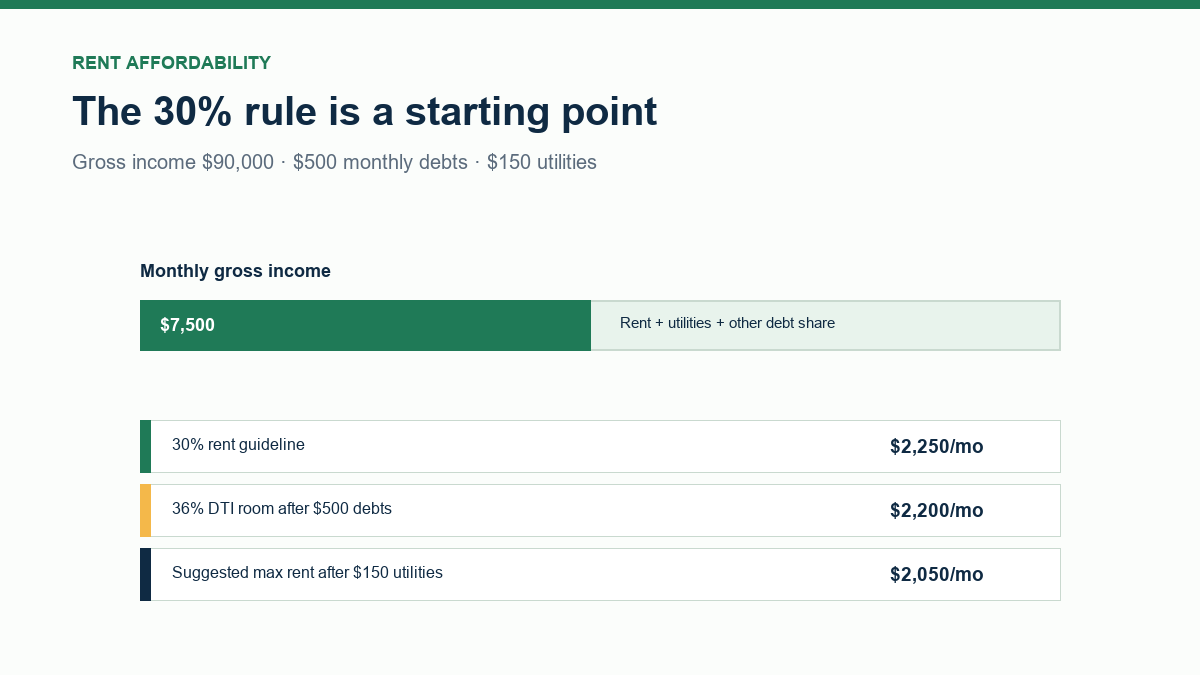
The first limit is rent-to-income: monthly gross income times the target percentage. On $90,000 per year, gross monthly income is $7,500. At 30%, the rent limit is $2,250.
The second limit is debt-to-income. Lenders and some landlords look at total monthly debt payments divided by gross monthly income. If the maximum DTI is 36%, the housing budget is 36% of $7,500, or $2,700, minus $500 of other debt, leaving $2,200 for housing.
The lower number wins. In this example, the DTI limit is $2,200, so the renter should plan around $2,200 of housing, not $2,250. After a $150 utilities budget, the rent-only figure is $2,050.
Gross income versus take-home pay
The 30% guideline uses gross income, before taxes and deductions. That makes it easy to compare across households, but it can overstate what is available for rent. A useful second check is to build a monthly budget from take-home pay and subtract rent, utilities, food, transportation, insurance, debt, and savings.
If the rent works on gross income but leaves no room for an emergency fund, the budget is too tight. A renter should also consider irregular costs such as car repairs, medical bills, and a security deposit.
Costs the rent number misses
Rent is not the only housing cost. Utilities, renters insurance, parking, pet fees, laundry, internet, and move-in fees can add hundreds of dollars per month. A “no utilities included” unit can be more expensive than a higher-rent unit with utilities included.
Move-in costs are a cash-flow issue, not a monthly ratio. First month, last month, security deposit, broker fee, and furniture can require thousands of dollars before the first night. Keep that cash separate from the emergency fund.
When the market is tight
In a competitive rental market, landlords may require income of 40 times the monthly rent, a minimum credit score, or a guarantor. The 30% rule may not match the landlord’s screening formula. Do not stretch the budget to win a unit; a rejected application costs time, and an approved but unaffordable lease costs more.
If rent is above the comfortable range, consider a roommate, a longer commute, a smaller unit, or a lease with a clear renewal plan. A short-term stretch can work if the rest of the budget is stable; a permanent stretch is a housing-cost problem.
A practical move-in budget
Before signing a lease, add up the cash needed before move-in: security deposit, first month’s rent, last month’s rent if required, application fees, parking, pet deposit, and furniture. A unit that fits the monthly ratio can still be unaffordable if the move-in cash drains the emergency fund. Keep at least one month of expenses after moving, not just enough to pay the lease.
Also check the lease terms: rent increases, utilities, maintenance responsibilities, early termination, and renewal fees. A lower rent with a large annual increase can cost more over two years than a slightly higher rent with a stable renewal clause.
2026 calculator update: what changed
The linked calculator has been upgraded. It now includes a professional worksheet with the inputs used, the method and scope, and a one-variable sensitivity check for finance tools. You can save two input sets as Scenarios A/B and compare the results side by side. The Print / PDF action produces a branded worksheet, and table-producing calculators can export a CSV.
The page also explains why a bank, lender, broker, or provider can quote a different number: rate versus APR, fees, credit pricing, taxes, insurance, and timing. Use the written quote or Loan Estimate as the binding document, not the calculator estimate.
The 30% guideline
A common guideline is rent at or below 30% of gross monthly income. In expensive cities, 30% may be unrealistic; in cheaper areas, it may be conservative. Include utilities, parking, renter’s insurance, and commute costs, not only rent.
What to compare
Compare rent, total housing cost, and take-home pay. A rent that fits the 30% rule can still strain a tight budget.
Frequently asked questions
Is 30% of income the right rent budget?
It is a common guideline, not a rule. The right number depends on debts, savings, market, and other goals.
Should I use gross or net income?
The 30% guideline usually uses gross income. A real budget should also check take-home pay and other expenses.
What is DTI?
Debt-to-income ratio is total monthly debt payments divided by gross monthly income, including housing and other debts.
Does this calculator include utilities?
Yes. Utilities are subtracted from the housing budget so the suggested rent is rent-only.
Related guides
- Weighted Grades: Where Your Course Grade Really Comes From
- Home Affordability in 2026: PITI, DTI, and the Price You Can Actually Carry
- Square Footage: Rectangles, Irregular Rooms, and Waste
Further reading