What this calculator does
Rent affordability is not one number. A common guideline is to keep rent near 30% of gross income, but lenders and landlords may look at total debt-to-income instead. This calculator shows both limits and subtracts utilities from the housing budget so the rent figure is not overstated.
How to use it
- Enter gross annual income before taxes.
- Add minimum monthly payments on cards, auto loans, student loans, and other debts.
- Add a realistic monthly utilities budget.
- Set a target rent-to-income ratio and a maximum DTI.
- Use the lower of the two limits as a starting range.
How it works
Example calculations
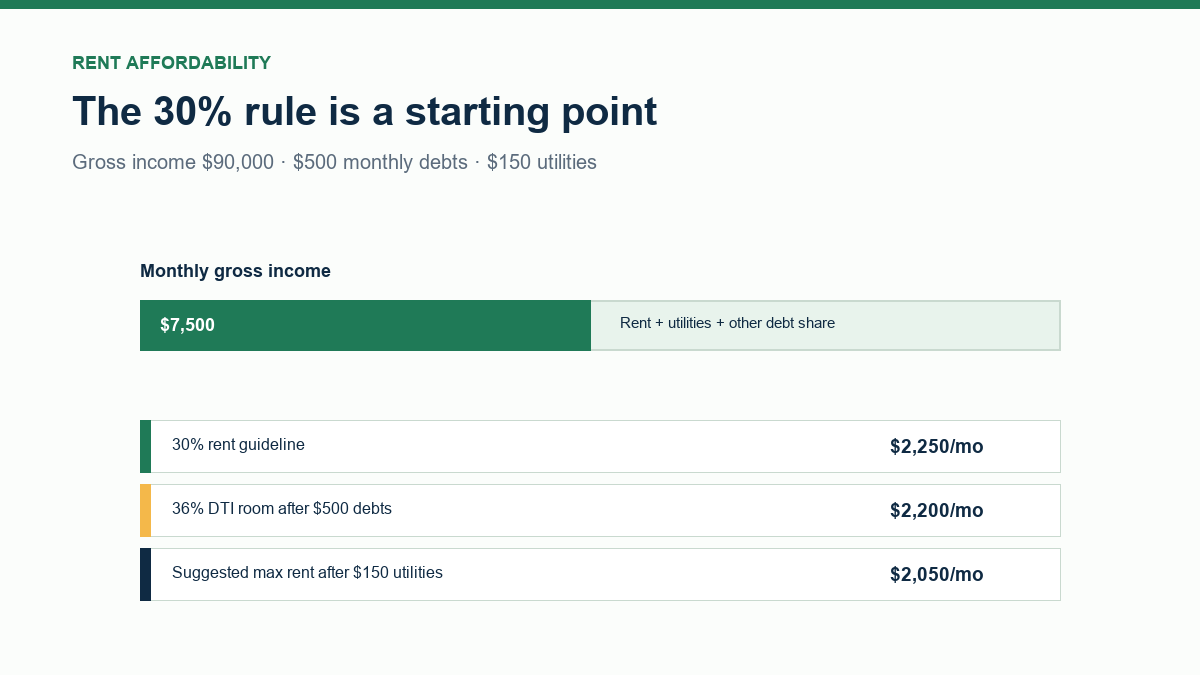
Example: $90,000 income, $500 debts, $150 utilities
Monthly income is $7,500. The 30% guideline allows $2,250 for rent. The 36% DTI cap allows $2,200 of housing after debts. After $150 of utilities, the suggested rent is $2,050.
Why utilities matter
If utilities are excluded, the rent number looks larger than the total housing cost. A $2,050 rent plus $150 utilities is $2,200 of housing, which is the DTI limit in the example.
What the result means
The 30% rule is a planning guideline, not a law. In high-cost markets, renters may spend more; in lower-cost markets, they may choose less. A landlord may require income of 40 times the monthly rent or a minimum credit score. Lenders use their own DTI limits.
Common mistakes
- Using take-home pay instead of gross income for the 30% rule.
- Forgetting minimum debt payments.
- Ignoring utilities, renters insurance, parking, and fees.
- Treating the maximum as a target rather than a ceiling.
Assumptions and limits
- Income and debts are monthly and stable.
- Utilities are not included in rent.
- The rent-to-income and DTI limits are planning assumptions.
- No move-in costs, deposits, or renters insurance are included.
Frequently asked questions
Is 30% of income the right rent budget?
It is a common guideline, not a rule. The right number depends on your debts, savings, market, and other goals.
Should I use gross or net income?
The 30% guideline usually uses gross income. A budget should also check take-home pay and other expenses.
What is DTI?
Debt-to-income ratio is total monthly debt payments divided by gross monthly income. It includes housing and other debts.
Does this calculator include utilities?
Yes. Utilities are subtracted from the housing budget so the suggested rent is rent-only.
Sources
2026 update
How to use the professional output
This page is not just a formula box. The result is designed to be checked, compared, and taken away.
- Professional worksheet. The result includes the inputs used, the method and scope, and a one-variable sensitivity check for finance calculators.
- A/B scenarios. Save two input sets in the browser and compare the primary, secondary, and breakdown figures side by side.
- Print / PDF and CSV. Print a branded worksheet, or export the year-by-year table when the calculator produces one.
- Quote differences. The section below explains why a bank, lender, broker, or provider can quote a different number.
The formulas and assumptions above still govern the number. The worksheet makes the estimate auditable; it does not make it a lender quote, tax return, or personalized advice.
Before you use a quote
Why your bank, lender, or provider’s number may differ
A mortgage quote can differ from this estimate even when the loan amount and rate look the same. The lender’s Loan Estimate is the document that controls the actual offer.
What changes the quote
- Rate versus APR. Points, lender credits, and closing costs can make the APR different from the note rate.
- Escrow and insurance. Property tax, homeowners insurance, PMI, and HOA are local and lender-specific.
- Loan-level pricing. Credit score, down payment, occupancy, property type, and loan size can change the rate.
- Timing. Rates can change daily; a quote is not a lock until it is locked in writing.
How to compare offers
- Compare the APR and total cost, not only the monthly payment.
- Ask for a written quote or Loan Estimate with all fees itemized.
- Use the same loan amount, term, date, and assumptions for every offer.
- Check what is excluded: taxes, insurance, closing costs, maintenance, or provider fees.
- Keep an emergency reserve; the lowest payment is not always the safest choice.
Reference: CFPB Loan Estimate explainer.
Go deeper